







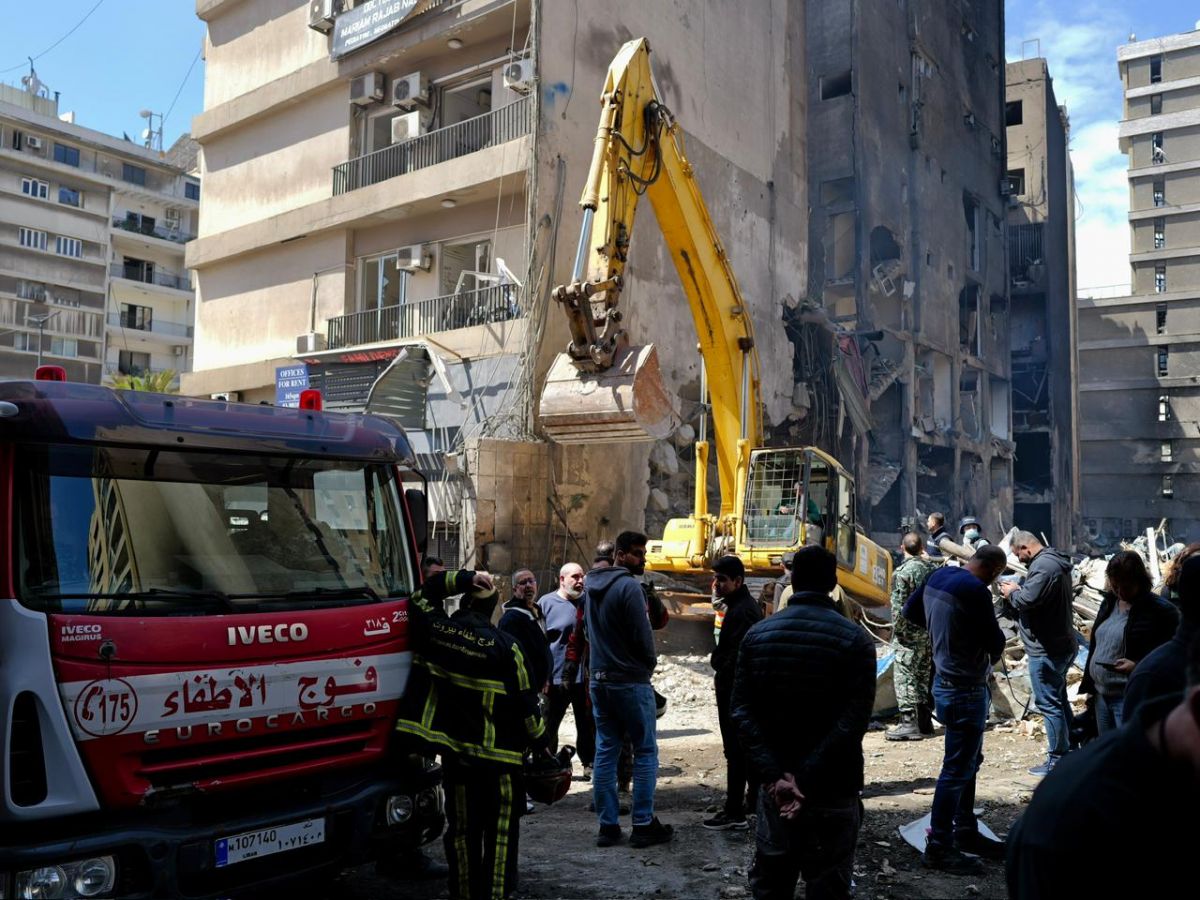
Rescue teams busy at the site of the Israeli strike that destroyed a building on Wednesday in the residential Mazraa neighborhood in Beirut on April 9, 2026. (Credit: Matthieu Karam/L'Orient-Le Jour)






As Israel continues its indiscriminate bombing of Lebanese territory as part of its war against Hezbollah, and despite the truce reached on April 8 between Tehran and Washington, several Western chanceries have condemned Israeli attacks on civilians and called for Lebanon’s inclusion in the agreement.
It should be noted that Pakistan — which has taken on the role of mediator — and Iran have maintained that the truce agreement includes Lebanon, while Israel and the United States say it does not.
Iranian Foreign Minister Abbas Araghchi reiterated Wednesday on X that ending Israeli attacks on Lebanon is among Tehran’s conditions for implementing the cease-fire, echoing a stance already expressed by President Massoud Pezeshkian.
In a surge of violence that has not targeted only Hezbollah, as it claims, the Israeli army launched a hundred strikes in a matter of minutes across several regions of the country, including residential areas for which no warnings had been issued. The death toll, still not final at this stage, numbers in the hundreds, most of them in Beirut, while entire buildings have been razed.
‘Intolerable’ strikes
“Hezbollah has dragged Lebanon into war, but Israel’s right to defend itself does not justify inflicting such massive destruction,” wrote European Union Foreign Affairs Chief Kaja Kallas on X, adding that “Israel’s actions put the cease-fire between the United States and Iran under heavy pressure” and that “the truce with Iran should extend to Lebanon.”
“Israeli strikes killed hundreds of people last night, making it hard to argue that such forceful actions qualify as self-defense,” she also denounced, before calling on Hezbollah to disarm “as it committed to do.” “The European Union supports Lebanon’s efforts to disarm Hezbollah,” she concluded.
Speaking on France Inter, French Foreign Minister Jean-Noël Barrot considered that the Israeli strikes — which continued Thursday — are “intolerable,” and assured that France was “fully” joining the national day of mourning declared the previous day by the Lebanese government.
“We firmly condemn these massive strikes which, in ten minutes, killed more than 250 people, adding to the 1,500 victims of this conflict initiated by Hezbollah against Israel on March 2,” he said. “And these attacks are all the more intolerable as they weaken the temporary cease-fire reached yesterday between the United States and Iran,” he added.
While Hezbollah indeed triggered the resumption of war with Israel, Israel was itself bombing Lebanese territory almost daily before March 2, in violation of the truce agreement reached at the end of November 2024 to end the previous war between the two sides.
“Yes, Iran must stop terrorizing Israel through Hezbollah, which must absolutely be disarmed and hand over its weapons to the Lebanese state. But no, Lebanon should not be the scapegoat for a government frustrated that a cease-fire has been found between the United States and Iran,” he also said. “Today is a national day of mourning in Lebanon and we fully share in it,” the minister added, considering that “it is not in Israel’s interest to pound Lebanon.” The day before, French President Emmanuel Macron had expressed this same position.
In addition to France, the United Kingdom also indicated its strong desire for the cease-fire between Washington and Tehran to be “extended” to Lebanon, according to British Foreign Secretary Yvette Cooper, who said in an interview with Sky News that she was “deeply concerned” by the deadly Israeli attacks in the country on Wednesday.
Also on Thursday, the Emir of Qatar, Tamim bin Hamad al-Thani, expressed his solidarity with Lebanon during a meeting with President Joseph Aoun, in which he expressed “his willingness to offer his help for anything that could contribute to ending the military escalation, particularly regarding the inclusion of Lebanon in the cease-fire agreement between the United States of America and Iran,” according to a statement from the Lebanese presidency.
The Russian Foreign Ministry, for its part, firmly condemned the Israeli strikes on Thursday and called for an immediate cease-fire, according to Reuters. It added its concern that these aggressive actions could derail the ongoing negotiating process and lead to a further escalation in the region.
At a press conference, the Turkish foreign minister said Turkey “wants the cease-fire” between the United States and Iran “to be durable on the ground and to also include Lebanon.” He was speaking at a joint press conference with his Syrian counterpart, Foreign Minister Assad al-Sheibani, broadcast by Turkish media. The Syrian minister, for his part, condemned the Israeli bombings of Lebanon and called for Lebanese authorities to handle Hezbollah’s disarmament “without any external interference.”
Cypriot President Nikos Christodoulides also contacted Aoun to “condemn” the relentless Israeli attacks against Lebanon, express his “solidarity,” and his desire to help end the escalation and ease the suffering of the friendly Lebanese people by providing medical, humanitarian and emergency aid.
In the evening, the German chancellor said Thursday that the American-Iranian “peace process” aimed at ending tensions in the Middle East could fail due to the Israeli offensive in Lebanon, in an intervention made before Benjamin Netanyahu’s announcement on negotiations between Israel and Lebanon. Friedrich Merz also said he had asked the “Israeli government to end the escalation of its attacks,” as other leaders had, on Wednesday.
Irish Foreign Minister Helen McEntee assured her Lebanese counterpart, Joe Rajji, that her country would “bring its full weight within the European Union to end the ongoing Israeli escalation on Lebanese territory.” She also expressed strong outrage at the innocent civilian victims caused by Wednesday’s Israeli bombings, according to a statement relayed by the state-run National News Agency.
‘This must stop’: Prévot
On Wednesday night, Belgian Foreign Minister Maxime Prévot had already denounced the shelling of Beirut by the Israeli army, which he witnessed Wednesday, during a visit to support the most senior Lebanese political leaders.
“We were at the embassy with my delegation, only a few hundred meters from where the missiles struck. This must stop. The cease-fire between the United States, Israel and Iran must include Lebanon!” Prévot wrote on X. He accused Israel of launching on Lebanon “not a single prior warning, one of the most massive strikes since the start of hostilities” on Feb. 28. “Beirut cannot become a new Gaza,” he said earlier, adding that “the Israeli ground advance – coupled with the systematic destruction of villages, bridges and infrastructure – is in effect creating a buffer zone that threatens Lebanon’s sovereignty.”
Also Wednesday, Spanish Foreign Minister José Manuel Albares said it was “unacceptable” for Israel to continue fighting in Lebanon. “It is unacceptable that Israel’s war, Israel’s invasion of a sovereign country like Lebanon, continues,” Albares told RNE radio, while Spanish Prime Minister Pedro Sánchez called the Iran truce “good news” on X. “Cease-fires are always good news,” but “the Spanish government is not going to applaud those who set the world on fire because they show up with a bucket,” the socialist leader added.
Italian Foreign Minister Antonio Tajani had directly contacted Aoun to condemn the attacks. Less categorically, Germany called on Israel to limit its offensive in Lebanon to “legitimate self-defense,” according to a spokesperson for the German Foreign Ministry.