
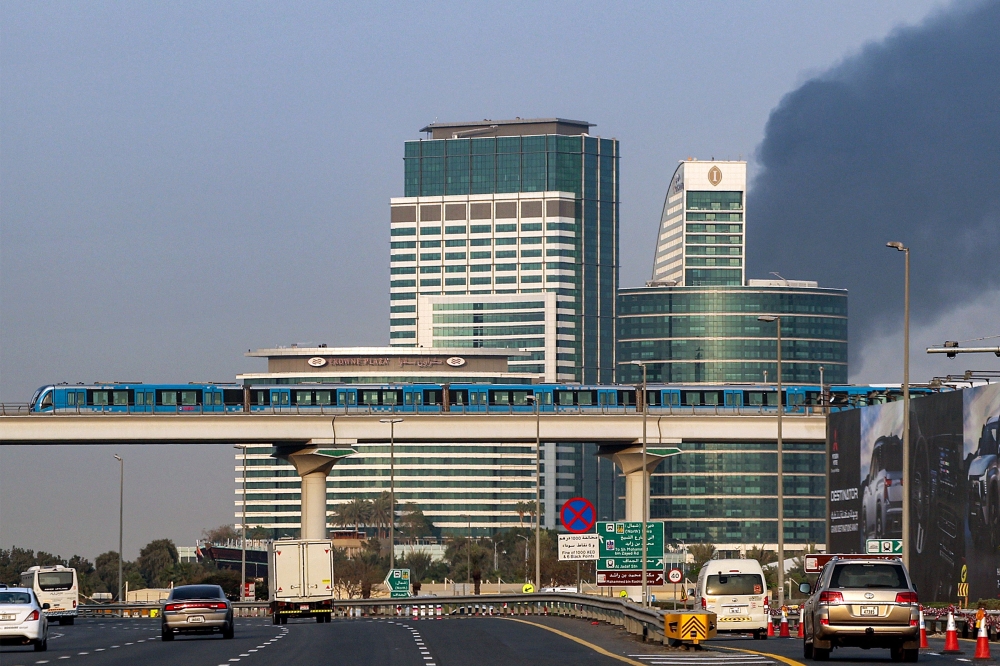
Smoke rises from a fire near Dubai International Airport on March 16, 2026. (Credit: AFP)






In this third week of the war sparked by Israel and the United States in Iran, the aviation sector is facing growing uncertainty and restrictions, the long-term effects of which are starting to become clear.
Symbolizing this anxiety, the organizers of the Arabian Travel Market announced Wednesday that the major tourism event for the Middle East and the Gulf would be postponed from May to August.
According to data from Cirium, a company specializing in aviation data and analysis, more than 52,000 out of 98,000 flights to or from the region have been canceled.
"The situation is extremely precarious. Flights can be canceled at the last minute, even if tickets have been issued. Demand is stifled and some airlines are struggling to fill their planes, as few travelers want to take the risk of traveling," said Jean Abboud, president of the Association of Travel and Tourism Agencies.
"Agencies are overwhelmed with calls from clients, but there are few stable parameters," he added, describing the situation as "catastrophic" as the summer season approaches.

Status quo for airspace
Raymond Wehbe, CEO of the agency We Reach the World, said flight conditions remain unpredictable. "Monitoring departures and arrivals in Beirut is disrupted and managed on a day-to-day basis. Only Middle East Airlines is operating daily flights," he said.
"Even open airspace, such as in Saudi Arabia or Jordan, may be temporarily closed in the event of an attack and reopened afterward. Nothing is guaranteed," he added.
Airlines’ decisions reflect the same uncertainty. Royal Jordanian changed the resumption date of its flights between Amman and Beirut twice within 24 hours, while Lufthansa, Pegasus and Aegean Airlines have announced medium-term suspensions.
Some carriers, including Air France and Turkish Airlines, review the situation weekly. Middle East Airlines also regularly adjusts its schedule to adapt to airspace closures.
Major Gulf carriers, including Emirates, Qatar Airways and Etihad, are gradually resuming commercial flights, but at a slow pace, with detours significantly lengthening journeys and sometimes interrupted by missile alerts along their routes.
Several countries are keeping their airspace completely closed, including Iraq, Kuwait, Iran with some exceptions, and Israel, where prior authorization is still required for takeoff and landing. Bahrain and Qatar also keep their airports closed except with prior approval, though with slightly less strict rules.
In Qatar, where traffic is gradually resuming, the military grants permission for aircraft to use a corridor that bypasses the United Arab Emirates and avoids Iran.
Syria limits access to its airspace to a few corridors, notably toward Aleppo. Saudi Arabia has closed only certain areas near Iraq and the Gulf. The United Arab Emirates remains generally open but with restrictions in security-controlled air traffic zones. Jordan, Lebanon and Oman have kept their airspace open.
Yemen is still considered an active conflict zone, and airports in neighboring countries have restricted flights to the area.

Ticket prices
Raymond Wehbe also said ticket prices are rising, mainly due to higher fuel costs linked to hydrocarbon prices. Tehran’s near-complete disruption of the Strait of Hormuz, through which about one-fifth of the world’s oil and a large share of its liquefied natural gas typically pass, has sent oil and gas prices rising, as have U.S. and Israeli strikes on energy facilities in Iran and Iranian strikes on those in the Gulf.
Higher insurance costs for war risk policies are also contributing to the increase. This assessment was echoed by Royal Jordanian vice president and managing director Samir Majali, who said in a statement Thursday that the airline is facing rising operating costs due to detours to avoid closed airspace, declining demand and a surge in refund and ticket change requests.
In response, airlines are adapting in different ways. Scandinavian Airlines and Air New Zealand, for example, have canceled large numbers of flights, about 1,000 in April for the former and more than 1,100 through the end of May for the latter.
Romanian carrier Dan Air has postponed the launch of several new routes to Europe that were initially planned for April 1, 2026. Other airlines have raised fares, including Air France-KLM, which increased prices on long-haul flights for tickets issued starting March 11. Some Asian carriers, such as Singapore Airlines and Cathay Pacific, have temporarily raised ticket prices sharply, taking advantage of strong demand following Gulf carriers’ flight suspensions.
Some markets remain relatively insulated due to their distance from the conflict zone. Executives from the three largest U.S. carriers, United Airlines, Delta Air Lines and American Airlines, said in comments reported by AFP this week that demand remained strong through mid-March, but warned that rising energy prices could weigh on profits.