








A building located in the Nabaa-Burj Hammoud neighborhood, in the north of Beirut, targeted by an Israeli strike, on March 13, 2026. (Credit: L'Orient-Le Jour)






BEIRUT — The military escalation in Lebanon reached a new level Friday, as Israeli aircraft bombed a bridge over the Litani River in Tayr Filsey (Sour) — the first strike on state infrastructure since the war began.
A few hours earlier, an unprecedented strike hit the eastern suburb of Beirut, which had largely been spared by Israeli bombings, including during the 2024 war.
Around 5 a.m., a drone strike hit an apartment in the Nabaa neighborhood of Burj Hammoud. At the same time, the Israeli army said it had killed “a Hezbollah member” in Beirut. Earlier, another drone strike destroyed a car in Jnah, south of Beirut, killing one person, according to local media.
These attacks followed overnight raids on Beirut’s southern suburbs.
Later in the day, three Israeli strikes hit the bridge over the Litani River at Tayr Filsey, which links the districts of Sour, Nabatieh, Bint Jbeil and Zahrani.
An ambulance from the Islamic Health Committee, affiliated with Hezbollah, was damaged at the scene, but no injuries were reported.

The Israeli army said, in a message from its Arabic-language spokesperson Avichay Adraee, that the targeting and destruction of the bridge was “a message to the Lebanese state.” “We will strike any infrastructure used by Hezbollah inside Lebanon to target Israel,” he warned.
After the strike on the bridge — located near positions of the Lebanese army and UNIFIL — Israel accused Hezbollah of using it to move between the north and south of the Litani River and to “prepare for combat” against Israel. Earlier on Thursday at dawn, the Kantara bridge in the strategic Wadi Houjeir valley had also been destroyed by Israeli forces.
‘Significant’ reinforcement of Israeli forces at the border
The strikes on bridges came after Israel warned it could target civilian infrastructure as part of a gradual plan that could precede a larger ground operation. The first stage reportedly involves bombing roads in southern Lebanon and between the South and the Bekaa Valley to isolate the region, before potentially expanding to other infrastructure.
In this context, Israeli Prime Minister Benjamin Netanyahu on Friday asked the military to provide a list of “civilian targets” in Lebanon to pressure the government to accelerate Hezbollah’s disarmament, according to Kan 11. At the same time, Israeli Chief of Staff Eyal Zamir ordered a “significant reinforcement of forces in the Northern Command” in preparation for various offensive and defensive scenarios.
Meanwhile, the Israeli army’s 146th Division said it had already struck around 400 Hezbollah targets in the western sector.
Overnight, southern Lebanon again came under Israeli fire, leaving at least two people dead and several wounded, with the Nabatieh district particularly targeted.
Israeli aircraft bombed Aabba twice, as well as Arabsalim in Iqlim al-Touffah, the road linking Shoukin and Mayfdoun, the area around Rammal High School in Doueir, and a house in the same village that killed a woman in her sixties, Attaf Sabra. Strikes also hit a house in Ansar, Sir al-Gharbieh, and Kfar Sir. Another strike targeted an area between Kfour and Toul, though the missile failed to explode.
Residential building hit in Saida: at least 8 killed
In the Sour district, a drone strike on a vehicle in Shaitieh killed one person. The villages of Qleileh and Srifa were also bombed. In the Saida area, raids struck Kaakayet al-Snoubar and Kharayeb. In the Bint Jbeil district, Israeli artillery fire hit Kouzah, while in Jezzine, airstrikes targeted the heights of Rihan.
An Israeli drone strike also targeted a motorcycle in Aitit (Sour district), leaving one person in critical condition. Another drone strike hit a motorcycle on the road between Tebnine and Safad al-Batikh (Bint Jbeil district), seriously injuring two people.
An Israeli strike on a residential building in Fawar, in the Saida area, killed eight people and wounded nine. A man also died of his injuries after being critically wounded in a strike on his home in Nabatieh al-Fawqa.
In Ghazieh (Saida), a drone strike near the Shahouri mosque hit an empty apartment, but two boys were killed by falling debris as they stood below the building. Five people were wounded in an Israeli airstrike that hit an Islamic Health Committee civil defense post — Hezbollah-affiliated paramedics — in Sawaneh (Marjayoun), according to our correspondent.
A motorcyclist was also killed in Kfar Tebnit (Nabatieh) in a drone strike on his vehicle. Another strike targeted an Islamic Health Committee center in Aitit (Sour district), wounding one person.
A soldier killed in Sawaneh
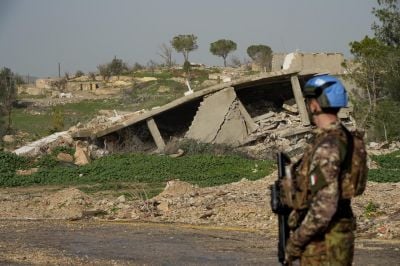
A second drone strike on Sawaneh destroyed a motorcycle, killing a Lebanese Army soldier. Another Israeli drone struck Abbassieh (Sour district), near the Elite School, after an evacuation warning issued by the Israeli army, but caused no injuries. A separate strike also targeted a motorcycle in the Shaqra water tank area (Bint Jbeil district).
In the Bekaa, an Israeli strike hit an apartment in Bar Elias belonging to Youssef al-Daouk, a Jamaa Islamiya official. His two sons, Abdelrahmane and Moussab, were killed, while several others were wounded. Elsewhere, a nighttime drone strike hit the outskirts of Hermel.
For its part, Hezbollah claimed several rocket attacks on northern Israel, targeting the Giv’a drone control base, the settlements of Kabri and Metula (on Israel’s northern edge, facing Khiam), as well as gatherings of Israeli soldiers in Metula.
Israeli aircraft also dropped thousands of leaflets over Beirut, including the Hamra neighborhood, calling for Hezbollah’s disarmament. While such leaflets have often been dropped over southern Lebanon, this is the first time in two years that pamphlets have been scattered over the Lebanese capital.
According to the Health Ministry, Israeli strikes have killed 773 people, including 103 children, and injured 1,933 others since the start of the war between Israel and Hezbollah on March 2.