







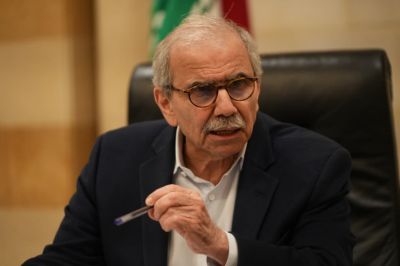
The Lebanese Prime Minister, Nawaf Salam, during an interview given on March 8 to L'Orient-Le Jour. (Credit: Mohammad Yassine/L’Orient-Le Jour)






Prime Minister Nawaf Salam, surrounded by some of his advisers and ministers at the Grand Serail, granted L’Orient-Le Jour an exclusive interview nearly a week after the start of the Israeli war triggered by Hezbollah.
The prime minister set out his positions on negotiations with Israel, the disarmament of the party and the humanitarian catastrophe unfolding.
L'Orient-Le Jour: What can the government do, and what is it doing in concrete terms, to stop the Israeli aggression?
Nawaf Salam: First, we did everything to prevent this war by repeatedly calling for restraint. We emphasized that Lebanon had no direct or indirect interest in being drawn into this conflict. We had received commitments from Hezbollah that it would not intervene and also assurances from Israel, through intermediaries, that if Hezbollah did not intervene, it would not launch an operation against Lebanon. None of this lasted 48 hours.
L'OLJ: And now?
N.S.: Not a day goes by without us trying to mobilize Arab countries, Europeans and Americans in an effort to stop this war. But it has not ended for several reasons. On the one hand, it is organically linked to the Israeli and American conflict against the Iranian regime and on the other, some of our partners – particularly Arab countries – are themselves driven by their own interests and concerns in this conflict.
I would nonetheless like to thank the Kingdom of Saudi Arabia, which was the first to offer its help, and also salute the unwavering support of France, reaffirmed by [France’s] President Emmanuel Macron at the political and humanitarian levels. We will do everything we can to stop this war, but we are particularly expecting our European friends to be more active in providing diplomatic support and in their military assistance.
L'OLJ: Is a serious initiative underway?
N.S.: At this stage, we cannot speak of an initiative. But there are ideas on the table, particularly from the French side.
L'OLJ: If Hezbollah committed to handing over its weapons, have you received guarantees that the war would stop?
N.S.: We have not received any messages to that effect. In any case, the handover of Hezbollah’s weapons is a process, whereas the cessation of the fighting must be immediate.

L'OLJ: Are you ready to hold direct negotiations with Israel with the aim of ending this war?
N.S.: During last Monday’s Cabinet meeting, we stated that we were ready to resume negotiations that would include a civilian component under international sponsorship. The question of direct negotiations was not discussed and the Israelis have not responded to our proposal. But we are open to discussing any agenda, any format and any venue.
L'OLJ: Since the start of the war, the government has declared Hezbollah’s military activities illegal and has asked Iran’s Revolutionary Guards Corps (IRGC) to leave the country. Why not go further by dissolving the party and deploying the army in the areas it controls?
N.S.: Hezbollah is a party that has MPs in Parliament, a large popular base and controls dozens of municipalities. If Hezbollah fully transforms itself into a political party, if it ends its military and security activities that we can no longer tolerate, we have no problem with it.
As for the deployment of the army, we were in phase two of the plan adopted by the government in early September. This phase can no longer take place as planned but we will not change course. In any case, we will move toward a total monopoly of arms in the hands of the state across the entire country.
L'OLJ: The army’s chief commander, Rodolph Haykal, said that "the implementation of the plan is being hindered by the war." Do you agree with him?
N.S.: Our position is clear and we will not change course. The Cabinet, in the presence of the president and with the backing of a large majority of the ministers present, decided that Hezbollah’s military activities are now illegal. That is the government’s position and it must be implemented.
L'OLJ: How will this decision be implemented?
N.S.: I have always been clear. We do not seek a confrontation with Hezbollah, but we will not allow ourselves to be intimidated by it.
L'OLJ: Hezbollah’s entry into the war, and the fact that part of its operations are being carried out from south of the Litani, which was supposed to have been completely disarmed, does that not undermine the government’s credibility?
N.S.: We have not lost our credibility at all. On the contrary, we are firm in the decisions we took and we began to implement them. People cannot come and tell us that we have not done enough in six months when Hezbollah has been supplied with weapons and massively financed by Iran for 44 years. It is an illusion to believe that we could have put an end to it in five or six months. We are moving forward, although perhaps not at the speed everyone would like.
L'OLJ: Will we have any choice at the end of this war but to make peace on Israel’s terms?
N.S.: No one in Lebanon will accept making peace on Israel’s terms. But that does not mean we do not want peace. We have in fact been seeking peace for 25 years with the Arab peace initiative that was adopted in Beirut.
L'OLJ: But is linking peace to this initiative still realistic in the current context, especially if Israel once again occupies the south of the country?
N.S.: A solid, lasting and effective peace cannot be separated from the regional context, which is why I remain committed to this initiative. The Israelis have destroyed Gaza, they continue to colonize the West Bank and they have annexed East Jerusalem but we have no alternative other than this initiative based on a very simple formula: “land for peace.” There can be no lasting “pax israelica.”
L'OLJ: The war has already caused a real humanitarian catastrophe with several hundred thousand displaced people. What are you doing to respond?
N.S.: Our duty was to prepare for all options, and we did. However, it took us several days to adjust our preparations to the realities of the war. But we are now in a better position to ensure a dignified place of refuge for every person. These displaced people are victims of those who dragged Lebanon into this war. I call for national solidarity because our humanity is at stake.
L'OLJ: Finally, have you obtained guarantees that certain areas will be spared by Israeli strikes?
N.S.: Until further notice, the only guarantees we were able to obtain were that the airport and the airport road would be spared.
This article was originally published in French in L'Orient-Le Jour and was translated by Sahar Ghoussoub.

 8 p.m. recap: Israel again threatens Beirut’s south suburbs; 2 ships hit near Hormuz; Riyadh football matches canceled