







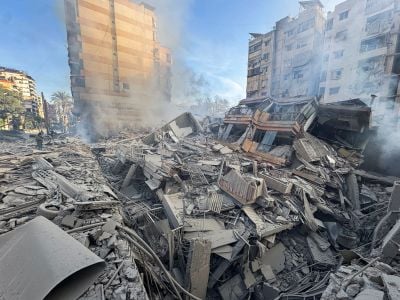
Smoke rises after Israeli strikes in Lebanon, following an escalation between Hezbollah and Israel amid the U.S.-Israeli conflict with Iran, as seen from Marjayoun, Lebanon, March 8, 2026. (Credit: Karamallah Daher/ Reuters)






BEIRUT — Human Rights Watch (HRW) on Monday accused Israel of "unlawfully" using white phosphorus over densely populated residential parts of a southern Lebanese town on Tuesday, just after the conflict between Israel and Hezbollah resumed.
"The Israeli military unlawfully used artillery-fired white phosphorus munitions over homes on March 3, 2026, in the southern Lebanese town of Yohmor," the NGO said in a statement.
HRW added that it "verified and geolocated seven images showing airburst white phosphorus munitions being deployed over a residential part of the town and civil defense workers responding to fires in at least two homes and one car in that area."
Since the beginning of the escalation, L’Orient-Le Jour’s sources told our correspondent in the south, that several white phosphorus attacks occurred, mainly in the area closest to the border, notably in Khiam (Marjayoun district).
White phosphorus, a substance that ignites on contact with oxygen, can be used to create smokescreens and to illuminate battlefields. But the munition can also be used as an incendiary weapon and can cause fires, horrific burns, respiratory damage, organ failure and death.
"The Israeli military's unlawful use of white phosphorus over residential areas is extremely alarming and will have dire consequences for civilians," Ramzi Kaiss, Lebanon researcher at HRW, was quoted saying in the report.
"Israel should immediately halt this practice and states providing Israel with weapons, including white phosphorus munitions, should immediately suspend military assistance and arms sales and push Israel to stop firing such munitions in residential areas," he added.

Lebanese authorities and HRW have over the past years accused Israel of using controversial white phosphorus rounds, in attacks authorities say have harmed civilians and the environment. These previous incidents – in 2023 and 2024 in border areas of the country’s south – "put civilians at serious risk and contributed to the displacement of civilians," according to HRW.
On Monday, Hezbollah's attack on Israel drew Lebanon into the war, prompting massive Israeli retaliation.
Since then, the Israeli army has repeatedly called on residents to immediately evacuate large parts of southern Lebanon, where hundreds of thousands of civilians live.
In February, Beirut also accused Israel of spraying glyphosate, a controversial herbicide, on the Lebanese side of the border, raising concerns about long-term damage to farmland and the population.

 7 p.m. recap: Saudi Arabia warns Houthis as Israeli strikes hit south Lebanon