






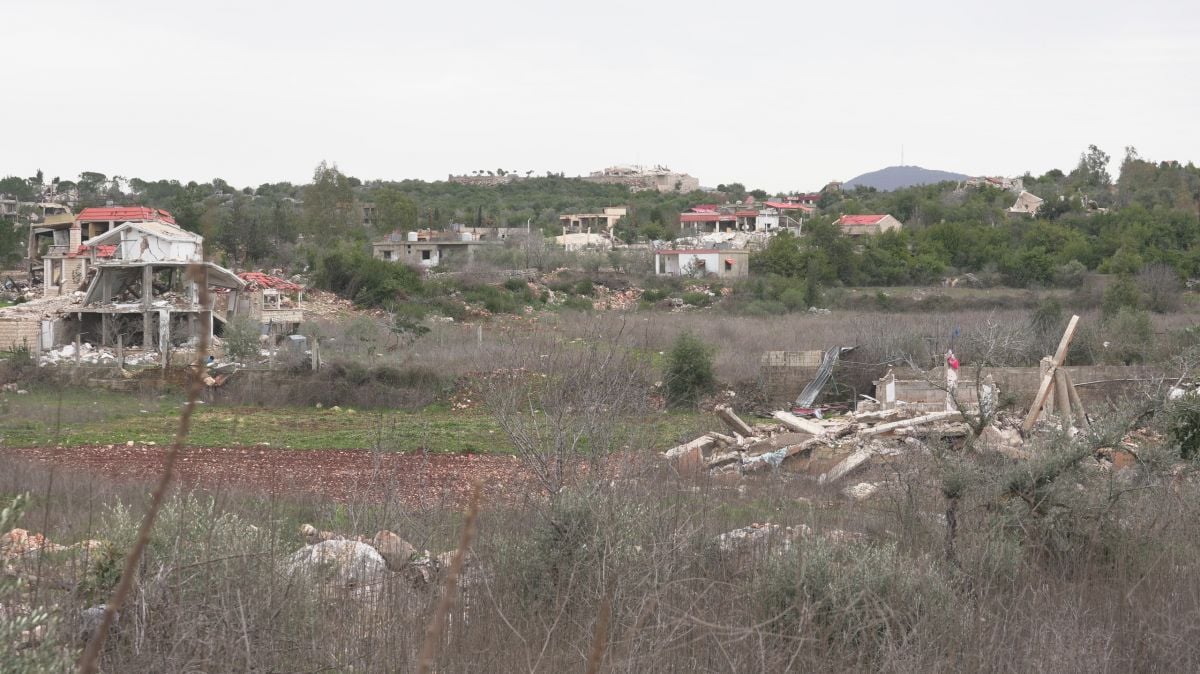
An agricultural field in Aita al-Shaab, Feb. 6, 2026. (Credit: L’Orient-Le Jour / Téa Ziadé)






BEIRUT — Agriculture Minister Nizar Hani said in an interview with the Russian news agency Sputnik published on Tuesday that during his visit to southern border villages, he noticed that the effects of Israel's spraying of glyphosate began to appear very clearly on trees and forests.
In recent weeks, Israeli planes sprayed this substance on several villages in the region, including Aita al-Shaab, Ramieh and Marwanieh (Bint Jbeil).
The incident was documented by residents, who then alerted local authorities.
It also sparked concerns about long-term impacts on farmland and the population. After analysis of collected samples, the agriculture and environment ministries detected glyphosate concentrations “20 to 30 times higher than average” in the region, citing “damage to agricultural production” and “soil fertility.”
"Last week, I visited Ramieh, Beit Lif and Aita al-Shaab, and the effects of this spraying had begun to appear very clearly on trees and forests. This is not the only activity being carried out. The Israeli army has announced that it seeks to establish a buffer zone between Lebanon and occupied Palestine, and has therefore carried out bulldozing operations, caused damage and cut down trees," Hani told Sputnik.
Regarding the size of the targeted area, the minister said: "Initial estimates indicate that we are talking about around 400 to 500 hectares, which is a very large area. We also know that aerial spraying cannot be precisely controlled, meaning these substances may spread to both sides of the border, into Lebanese territory as well as to the opposite side."
As for the measures taken by the Ministry, Hani said: "Today, in cooperation with the Environment Ministry, the Cabinet has tasked the National Council for Scientific Research with conducting a comprehensive study of the entire area. Work has already begun this week in cooperation with the Lebanese Army and UNIFIL, with samples being collected to prepare a more detailed study that will allow better guidance for farmers and municipalities in the region."
He added that President Joseph Aoun has also instructed the Foreign Ministry to gather all necessary information to submit a complaint to the United Nations, including impact assessment reports and documentation of damage to the agricultural sector and vegetation cover, to take appropriate action.
Regarding the total damage since the beginning of the conflict between Hezbollah and Israel in October 2023, Hani said: "The damage is very extensive. We have prepared a detailed report in cooperation with the Food and Agriculture Organization and the National Council for Scientific Research, and its findings show that we are talking about thousands of hectares, hundreds of thousands of olive trees, and vast areas subjected to direct attacks, whether through white phosphorus shelling or bulldozing."
"More than 70,000 ancient olive trees have been uprooted. Some were stolen and transferred into occupied territory, while others were buried," he added.
Hani finally pointed out to "a three-year plan to rebuild the agricultural sector better than before, despite the high cost, estimated at around $800 million, covering both direct damage and losses."
Despite a cease-fire agreement reached in November 2024 following more than 13 months of war, Israel continues to occupy several areas in southern Lebanon and carry out near-daily airstrikes.

 7 p.m. recap: Saudi Arabia warns Houthis as Israeli strikes hit south Lebanon