



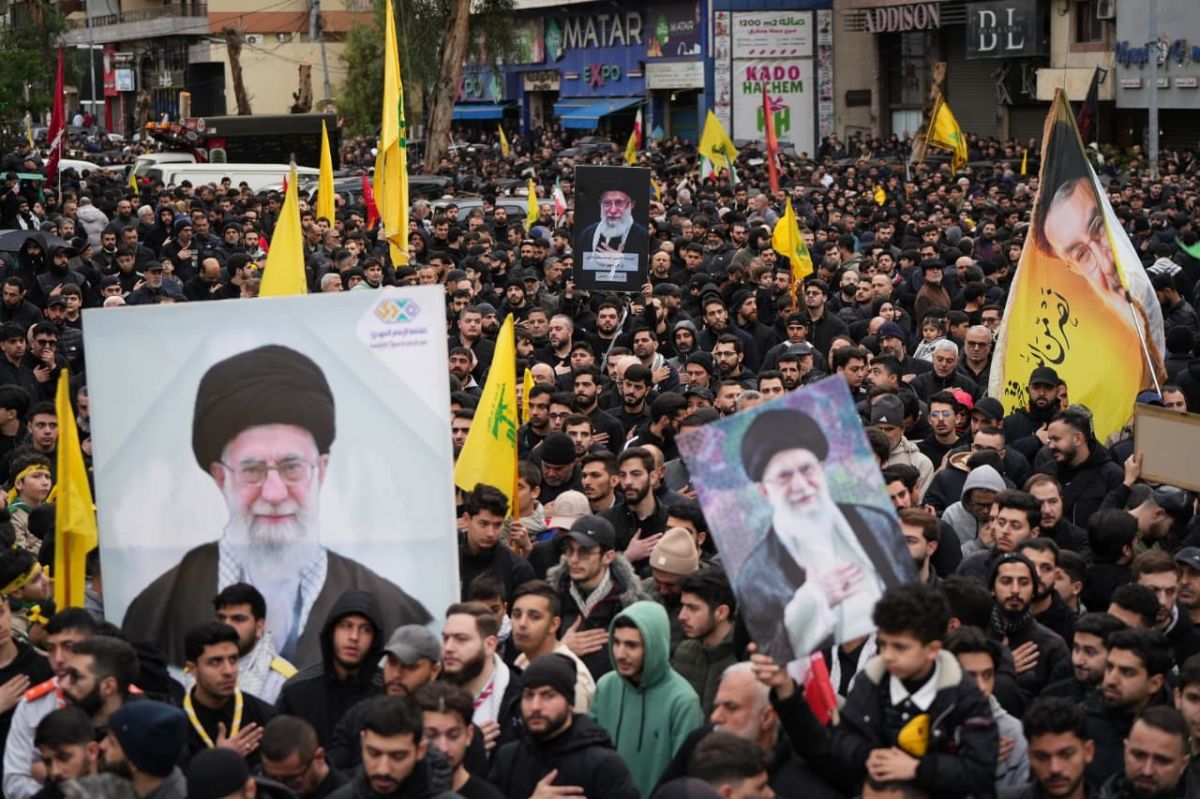
People gather on Sunday, March 1, 2026, in Beirut's southern suburbs to mourn former Iranian Supreme Leader Ali Khamenei, who was assassinated by the U.S. on Feb. 28, 2026. (Credit: Mohammad Yassin/L'Orient-Le Jour)






Anthony Elghossain is a lawyer and writer. He advises organizations on geopolitics, U.S. foreign policy and the rule of law.
Having long styled itself as a national resistance, Hezbollah — now, as ever, the Islamic Revolution in Lebanon — has again launched a war of servility disguised as solidarity.
This week, it fired rockets into Israel and again plunged headfirst into a regional war. By doing so, and rather than pocketing the symbolic defeat and availing itself of the Lebanese government’s diplomatic efforts, Hezbollah has dragged Lebanon toward disaster and already doubled down on its latest and greatest folly.
Why? And for what? Hezbollah has followed the dead-hand orders of their erstwhile supreme leader, the jurisprudential guardian Ali Khamenei, to whom they’ve long pledged allegiance — as they’ve demonstrated in deed and explained in word from the beginning.
Not only has Hezbollah triggered all of the post-occupation Israel-Lebanon wars without informing Lebanese leaders, but it has launched this one despite a Lebanese president and premier who have repeatedly, clearly and publicly declared that Lebanese policy was against such a war.
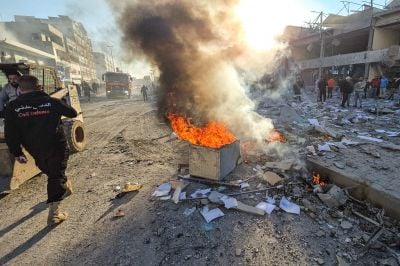
Hezbollah has already secured another pyrrhic defeat. Israeli reprisals have already killed scores of people in Lebanon, while tens of thousands have fled their homes — again.
Hundreds of thousands must delay returning to their communities, rebuilding their homes and resuming their already-threatened ways of life. Their boom seasons preempted and their support mechanisms paused, citizens must now fret over food, fuel and other resources.
Issuing evacuation orders for southern Lebanon, the Israelis have recaptured territory for the third time since ending their original occupation of Lebanon in 2000 — all as a consequence of a so-called liberator’s folly.
Make no mistake: Hezbollah went to war with Tel Aviv in defense of Tehran — not Beirut, not Baalbeck, and not Sour. Its action today speaks as loudly as its inaction yesterday. Before attacking Iran, Israel had already serially violated the Lebanese cease-fire: occupying five points in southern Lebanon, assassinating alleged Hezbollah personnel while killing and injuring hundreds of civilians in the process, trampling Lebanese sovereignty by land, sea, air and cyber, and devastating the craggy hills of the south with lasting environmental damage.
In response, Hezbollah’s becloaked leaders did little but lick their wounds, attack U.N. personnel, organize obstructionist protests, chirp at the Lebanese government and — well, of course — threaten civil strife should anyone so much as glance at their arsenal north of the Litani.
Against that backdrop, Lebanese leaders have declared Hezbollah’s military and security operations illegal. While parchment declarations are not solutions, they’re necessary, important and — here, in a land where Hezbollah has long waged lawfare within and outside of the state — long overdue. Far from perfect, it marks progress toward freedom, sovereignty and independence.
They must do more. And so must their partners in the world. Together, they must address all aspects of the Hezbollah problem, not fixate on either its regional or local dimensions. Hezbollah is, after all, a transnational organization.
Since the beginning, Hezbollah has intimately fused Iranian and Lebanese ideology, (pseudo)historical narratives, sociocultural programs, political objectives and more. It has also integrated Iranian, Lebanese and political aims, while integrating personnel, funding, training, education, indoctrination, decisionmaking and warfighting into a single operational structure. Hezbollah presents hybrid challenges that require hybrid solutions.
Lebanese leaders, as well as others, must abandon old delusions: that Syria might solve Lebanese problems with no political price; that Israeli force can substitute for others’ influence cultivated over decades; that Lebanon can conjure local solutions by, say, pushing cookies at Geneva conferences they’re happy to attend; or that Hezbollah will simply transmogrify into a political party if Tehran changes course.
All nonsense. The Lebanese must not take the future for granted. So long as Hezbollah exists as an armed organization, with intelligence and other operatives, it will find — or conjure — purpose, even if only survival. As long as they endure, elements of the Iranian regime and Hezbollah itself will retain the same impulses.
So, too, will the scores of thousands of people that they’ve indoctrinated — not just civilians, but also men long on grievances and weapons and short on basics and opportunities. Leaders cannot again sit on their hands, as they have in the past — and as Israeli cycles of destruction have perversely encouraged them to do.
If the Iranian regime collapses and Hezbollah survives as a militia, the self-styled Party of God will seek to preserve and leverage its weapons — the crux of the problem locally, just as they have been regionally. Hezbollah could also conceivably use parts of Lebanon as refuges for rejectionists: remnants of the Iranian and Syrian regimes, Hamas and others, many of which are already in Lebanon.
Regardless, an armed Hezbollah would inherently undermine sovereignty, threaten stability and obstruct progress in Lebanon. And what a strange, sordid end that would be for the Lebanese: a Hezbollah too weak to project power in the region yet strong enough to impose its retrograde vision at home — too marginal for world powers to confront, yet potent enough to exploit a republic too small to rescue.
To set the stage for the future, Lebanese leaders must now secure their borderlands and points of exchange — airports, seaports and overland crossings — while international partners bolster support for border security specifically.
Working with Lebanese security forces, they can create multi-year programs with incentives and international guidance to plan, reorganize and execute. In doing so, the Lebanese and others may truly grapple with what is a dynamic problem — and not just seize weapons, as if Hezbollah’s organization, cadres or weapons are static.
Only then can Hezbollah be prevented from reconstituting as a militia. Only policies crafted for Lebanon, not merely against the group, stand a chance of addressing the ills that the country has long struggled to contain.
Now, Lebanese leaders must grapple with the consequences of yet another conflict triggered by Hezbollah. And, yet, they must also move — not just on paper, but in practice — to prevent the self-styled Party of God from surviving as the Last Militia and dragging the republic toward future disaster.