






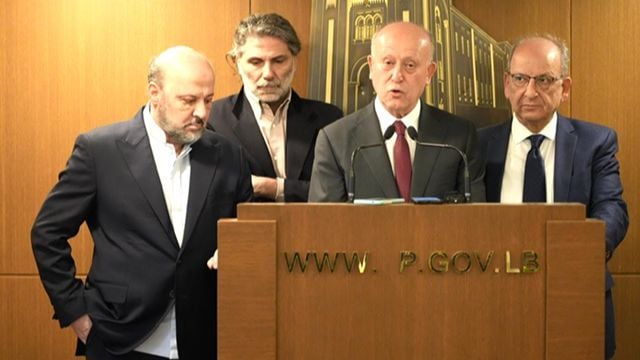
MPs Ashraf Rifi, Melhem Riashy, Elias Khoury, and Nazih Matta submitting a draft law to the Parliament aimed at banning the Arab Socialist Ba'ath Party (Syria) in Lebanon on Feb. 4, 2026. (Credit: National News Agency)






BEIRUT — MPs Ashraf Rifi, Melhem Riashy, Elias Khoury, and Nazih Matta submitted a draft law to the Lebanese Parliament aimed at banning the Arab Socialist Ba'ath Party (Syria) and its linked associations in Lebanon, the state-run National News Agency reported Wednesday.
Rifi stated at a press conference held at Parliament that, “Under this law, all associations directly or indirectly linked to the Syrian Ba'ath Party will be dissolved, and all their movable and immovable assets will be confiscated in favor of the Lebanese state.”
He further explained that the draft law also stipulates “changing all street and place names that bear the names of any figures of the Syrian regime or the Ba'ath Party,” considering that “this Syrian regime, which is dead, must be buried in our society.”
This proposal was submitted more than a year after the end of the Assad regime, on Dec. 8, 2024, and a 13-year civil war that killed around 250,000 people.
It states three articles. The first is that "the use of names, terms, attributes, slogans, symbols, images, flags, advertisements, or any other means, whether written, audio, visual, or otherwise, that relate to or indicate, directly or indirectly, the Arab Socialist Ba'ath Party [Syria], its leaders, its activities, or anything connected to its regime, is prohibited in both public and private places throughout all Lebanese territory.
"This prohibition applies when such use aims at endorsement, promotion, marketing, publicity, advertising, solidarity with, or defense of the party for any reason whatsoever."
Excluded from this ban are cultural, journalistic, artistic, or literary works that address the subject from a historical, analytical, or critical perspective, provided that such works do not include any of the prohibitions mentioned in this law, and on the condition that prior authorization is obtained from the relevant administrative and judicial authorities.
Article two states that by "decree of the Parliament, all associations, parties, or entities — under any name, structure, or forum whatsoever — that are directly or indirectly linked or affiliated with the Arab Socialist Ba'ath Party [Syria], its leaders, its regime, or its symbols, shall be dissolved. All their movable and immovable assets, of any kind, shall be confiscated in favor of the Lebanese state."
Article three states that "all names given to public or private roads, neighborhoods, boulevards, squares, roundabouts, public or private places, monuments, or landmarks that include prohibitions stipulated in Article One of this law shall be abolished and replaced exclusively with Lebanese names, by decisions issued by the competent central or decentralized administrative authorities."
Speaking to L’Orient Today, Riachy explained that “the state will be responsible for checking who this proposed law will apply to and will be in charge of checking if this applies to the party."
Hijazi, who announced that his party would change its name to the 'National Emblem Party' in December, told L'Orient Today that "proposing this law is a populist move that will not pass in parliament, besides this bill does not mean anything to us, nor concern us since now we are the National Emblem Party."
Syria had historically used the Lebanese Ba'ath Party to project power and maintain influence in Lebanese politics, particularly during its military presence from 1976 to 2005.
The Ba'ath party had served as the ideological foundation for a regime that tolerated minimal dissent, imprisoning and killing hundreds of thousands of opponents.
In the early hours of Dec. 8, after Bashar al-Assad fled, Syrians stormed Ba'ath offices and destroyed party flags. The party was officially banned in Syria in late January 2025 by interim president Ahmad al-Sharaa.

 8 p.m. recap: Israel again threatens Beirut’s south suburbs; 2 ships hit near Hormuz; Riyadh football matches canceled