






The real identity of "Abu Omar" remains unclear. Illustrative photo






Since December, a financial con involving a fake Saudi prince and an influential Lebanese sheikh has shaken Lebanon, exposing how easily some political leaders are tempted by the lure of exclusive access to the “royal court in Riyadh.”
The story took another turn on Monday as the case landed on the public prosecutor office at the Court of Appeal of Beirut, following initial investigations by the Lebanese Army Intelligence, which led to the two accused being arrested.
The fallout now appears to have reached Dar al-Fatwa, the highest Sunni religious authority in Lebanon, as one of the two accused is said to have played a major role in extending the Grand Mufti’s term in office.
What’s the deal with this fake Saudi prince and how did this fraud scandal get out of control?
Let’s break it down.
1. Who is ‘Abu Omar,’ and what did he actually do?
“Abu Omar” is a pseudonym for a man whose real identity remains unclear. According to several reports, the so-called “Prince Abu Omar” could be a man named Mustafa al-Hessian, a Lebanese mechanic from Akkar, one of the country’s most disadvantaged areas. Other reports suggest that Hessian was acting as an intermediary notifying “victims” of imminent calls for the “real Saudi prince”
More details here
Prosecution initiates proceedings in the ‘Abu Omar’ case
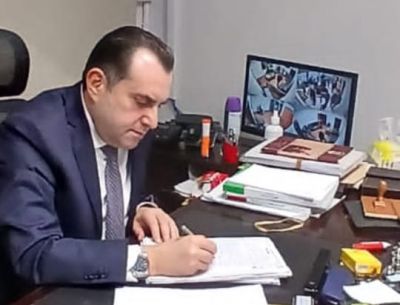
Hessian has been arrested for several weeks now. He is said to have worked closely with Sheikh Khaldoun Oraymet, a figure described as well-connected within Sunni political circles, and a prominent cleric within Dar al-Fatwa, Lebanon’s highest religious authority
The playbook was simple, and effective.
“Abu Omar” allegedly posed as a Saudi prince, adopting a flawless Saudi accent, and claiming direct ties to the royal court in Riyadh, along with access to financial and political backing from Saudi Arabia.
Oraymet, leveraging his network, reportedly introduced him to several politicians, mainly from the Sunni community.
The alleged scheme: Large sums of money were solicited in exchange for promised Saudi political support and influence, — support that, according to investigators, never existed.
How did ‘Abu Omar’ pull it off? This is where the story turns almost absurd.
None of the supposed “victims” ever met the “fake prince” in person. Abu Omar is said to have operated entirely over the phone, speaking with what was described as a flawless Saudi accent and presenting himself as a direct conduit to the Kingdom’s leadership. Calls were frequent and carefully staged, reinforcing the illusion of authority and access.
Face-to-face interactions were allegedly handled by Oraymet, who reportedly met with the “victims” in person to collect the money — always in cash. According to information leaked from the investigation, more than $1 million was transferred through this setup.
Fouad Makhzoumi, a Sunni MP for Beirut, is alleged to have paid the largest amount — around $500,000. Makhzoumi has categorically denied the allegations.
Our last edition
Hacking Lebanese Politics #27: How does Lebanon’s judiciary work?
But the scheme does not appear to be something new. According to L’Orient-Le Jour’s information, Saudi authorities had flagged the “fake prince’s” activities a couple of years ago. The Saudi embassy in Beirut reportedly warned Lebanese officials to be cautious of individuals claiming to speak on Riyadh’s behalf.
So why did the story come to light now? The answer appears to lie with Oraymet’s son, Mohammad Oraymet, who is also targeted by the public prosecutor’s legal action for his alleged involvement in the fraud. Mohammad Oraymet is suspected of having extorted a large sum of money and an expensive car from an Akkar businessman, Ahmad Haddara, as part of his claimed “connection” to the supposed Saudi prince.
According to judicial information, Haddara filed a complaint before the Court of Cassation in December, a move that appears to have triggered the broader investigation and brought the Abu Omar affair into the open.
Context matters. In Lebanon’s sectarian system, Sunni leaders are historically and “spiritually” linked to Saudi Arabia. But since the 2019 financial collapse, Riyadh has largely pulled back from Lebanese politics, creating a vacuum that figures like “Abu Omar” allegedly exploited.
Both Hessian and Oraymet were arrested earlier this month. A week before his arrest, Oraymet held a press conference in which he denied all accusations and denounced what he described as a smear campaign against him.
2. Does the Abu Omar case expose the fragility of the Sunni political landscape?
Context matters again. For decades, the Hariri family served as the main pillar holding Lebanon’s Sunni community together politically and symbolically.
That balance was disrupted in 2022, when former Prime Minister Saad Hariri withdrew from political life — a decision widely seen as a major shock to the Sunni landscape, leaving behind a leadership vacuum.
In the aftermath, Sunni MPs (who were previously affiliated with Hariri) attempted to regroup through the National Moderation bloc in Parliament, which became the community’s main structured vehicle for representation. The bloc also sought to preserve channels of dialogue with Riyadh, the Sunnis’ historic regional patron, occasionally influencing key political moments.
That fragile arrangement has since unraveled. MP Walid Baarini’s recent withdrawal from the bloc — publicly linked to the Abu Omar affair, with the names of some members being implicated in the scandal that shook the Sunni landscape — but widely viewed as driven by electoral calculations in Akkar. His withdrawal effectively sealed the bloc’s collapse as legislative elections, set for May 2026, are drawing closer.
With Baarini preparing to run independently and his former allies forming rival lists, the episode highlights how the post-Hariri vacuum has fragmented Sunni political representation — and how that fragility created openings for figures like Abu Omar to exploit lingering assumptions about Saudi influence.
Incase you were wondering
Hacking Lebanese Politics #26: What’s going on with the reconstruction of south Lebanon?
3. How does the Abu Omar story reach Dar al-Fatwa, and who gets caught in the fallout?
Dar al-Fatwa, Lebanon’s highest Sunni religious authority, sits at the intersection of religion and politics. Headed by Grand Mufti Abdel-Latif Derian, it is meant to provide spiritual leadership. But in practice, it also functions as a key node in the Sunni political system.
According to information circulating in political and media circles, Sheikh Khaldoun Oraymet, who is a senior cleric at Dar al-Fatwa, played a central role in extending the Grand Mufti’s mandate.
Oraymet is said to have leveraged his influence within the Islamic Sharia Council, Dar al-Fatwa’s legislative body, to raise the mandatory retirement age for the mufti from 72 to 76, effectively prolonging Derian’s term. Derian, born in 1953, benefited directly from the change.
The Abu Omar affair dragged in senior Sunni political figures, including former prime ministers Fouad Siniora and Najib Mikati — an important detail in a system where the premiership is traditionally reserved for Sunnis.
Members of the now-defunct National Moderation bloc were also named, including northern MPs Mohammad Sleiman, Sajih Attieh, and Ahmad Kheir, as well as Beirut MP Fouad Makhzoumi and former minister Mohammad Choucair.
All figures implicated in this process have categorically denied any wrongdoing.
 3 p.m. recap: Washington to evacuate 'non-essential' staff from Riyadh embassy; Iran threatens to hit US bases in response to Hormuz escorts