






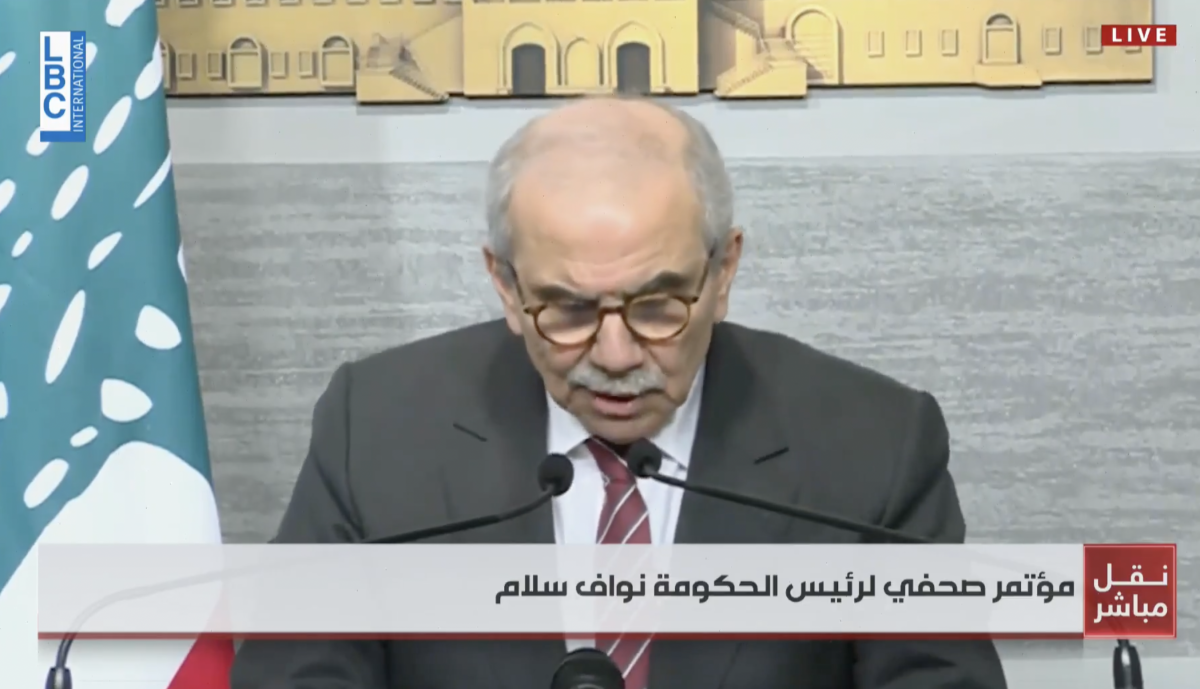
Prime Minister Nawaf Salam during a press conference at the Grand Serail on Dec. 29, 2025. (Screenshot of his address broadcast by LBCI)






Prime Minister Nawaf Salam announced Monday at the Grand Serail the transfer to Parliament of the long-awaited bill on the "restoration of financial order and the return of deposits."
He emphasized that the bill is publicly available "so that citizens can review it." In accordance with procedure, President Joseph Aoun forwarded the text, signed by Salam and Finance Minister Yassine Jaber, to the Chamber of Deputies.
“We have published on our website the bill on the 'financial gap' to allow citizens to review it, which will help dispel ambiguities,” Salam announced. “Anyone who examines the bill will find that it returns depositors’ rights and penalizes those who transferred their funds abroad.”
In response to the many criticisms of the text — which was approved in Cabinet last week by 13 votes to 9 — the prime minister said his government is “open to any proposal that can improve this bill,” while stressing he “cannot accept criticism that does not offer alternatives, as this contributes to the squandering of depositors’ funds, the paralysis of the banking sector and the weakening of the economy.”
The Association of Banks in Lebanon has, for its part, decided “to invite banks operating in Lebanon to a meeting on Monday, Jan. 5, 2026 at noon to discuss the bill and take appropriate decisions in this regard,” according to a statement from the Association.
Directly affected by the provisions of the law, the group had firmly opposed it last week, denouncing it as an “unjustified and unacceptable attack on the rights of banks and depositors.”
Even before its approval, the bill had also been criticized by the parliamentary Economy Committee, parts of the private sector, and some depositors’ associations, which protested last week outside the Grand Serail and the Baabda Palace during Cabinet meetings.
Other associations, such as the Depositors Union, however, considered the passage of the text — even if imperfect — a positive step.

The prime minister stressed that the Cabinet had made fairness toward depositors “a priority,” while also taking into account the need for the Lebanese economy to “regain financial discipline.”
He insisted that the “gradual repayment of deposits is preferable to the indefinite postponement of decisions, which leads to a decline in their value and deprives Lebanon of a chance for recovery.”
He concluded: “We do not sell illusions to the Lebanese, nor do we hide the truth. As a government [formed in early February 2025, editor’s note], we named ourselves the government of reform and salvation: that is our goal, and we will not compromise on it.”

The law on the financial gap is one of the most important reforms required by the International Monetary Fund (IMF) before Lebanon can sign up for a financial assistance program.
This is contingent on the implementation of further transformations in the management of the country and its financial system, which has been bankrupt since 2019.
While the prime minister succeeded in passing this key reform before year’s end — where his predecessors Hassan Diab and Nagib Mikati had failed under political pressure — the adopted text does not meet a number of criteria deemed essential by the IMF.
There is also the risk that the bill could be significantly altered by parliamentary committees.

 8 p.m. recap: Israel again threatens Beirut’s south suburbs; 2 ships hit near Hormuz; Riyadh football matches canceled