






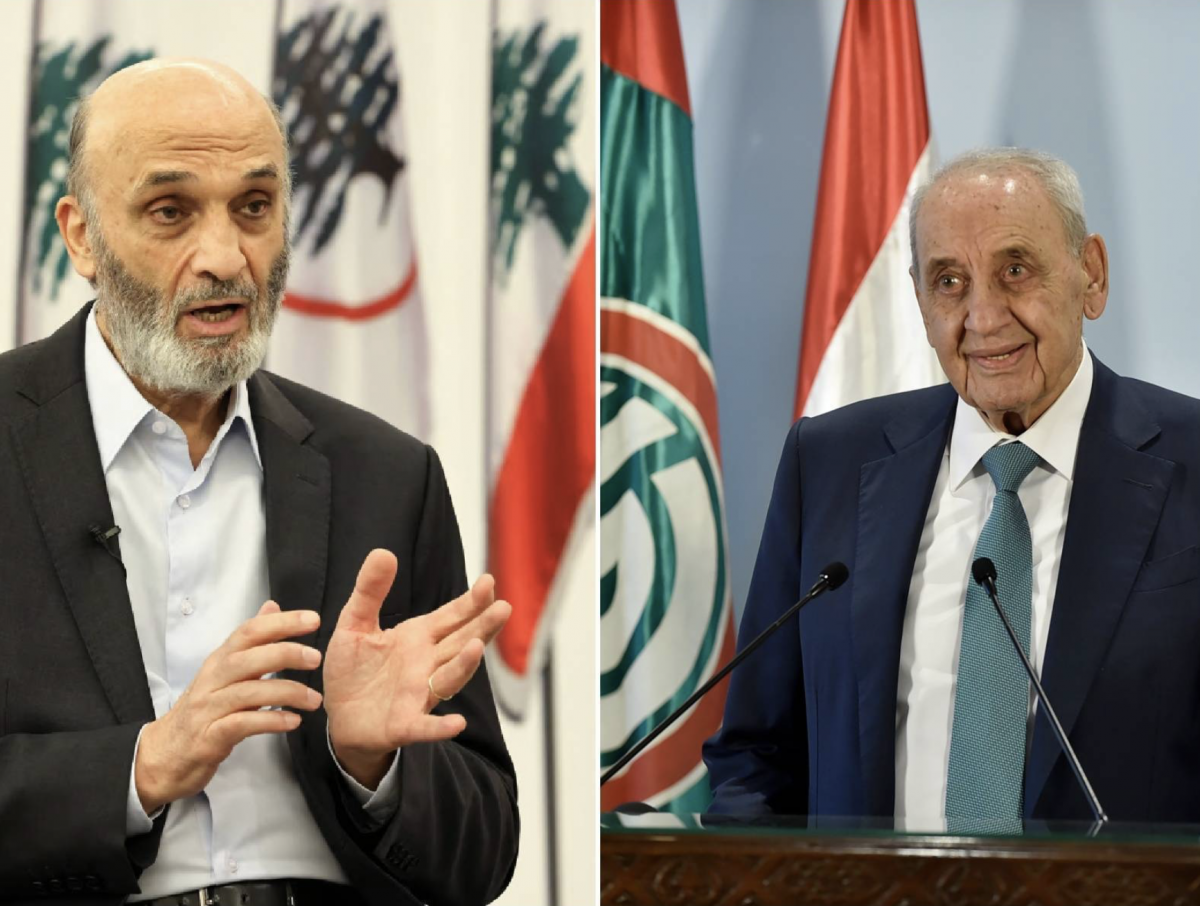
The leader of the Lebanese Forces, Samir Geagea (left), and the Speaker of Parliament, Nabih Berri. (Montage of photos by AFP and the Lebanese Parliament)






Lebanese Forces leader Samir Geagea warned that Parliament Speaker Nabih Berri will “turn a deaf ear” to President Joseph Aoun’s call for amendments to the electoral law, the state-run National News Agency reported Saturday.
Geagea’s remarks were delivered during a Friday evening dinner for the Aley district, held at the Lebanese Forces headquarters in Maarab.
Geagea praised the positions expressed by Aoun during his visit to Bkirki Thursday, saying the president’s insistence on holding elections on time was “very good” and a stance he consistently reiterates.
Aoun had said from Bkirki Thursday that "Parliament has a role to play,” in the debate on the electoral law and that “MPs should go to the Chamber and debate the law they want.”
Aoun and Prime Minister Nawaf Salam also signed a decree convening Parliament for an extraordinary session running from Jan. 2 to March 1, 2026, although discussions about the electoral law has not been included in the texts to be discussed.
Geagea said that, regarding the electoral law, Aoun had “rightly” placed responsibility on Parliament to introduce the necessary amendments to make elections possible.
Addressing Aoun directly, Geagea said that “Berri is not opening parliamentary sessions and is preventing discussion of the proposed amendments to the electoral law.” He described the president’s remarks in Bkerke as a first step, but warned that if Berri “turns a deaf ear,” then the president has a constitutional duty to send a written message, one that would be binding.
If the head of state addresses such a message to Parliament, its speaker has three days to convene a session on the issue raised.
Geagea stressed that “only such a written message can now save the constitutional electoral deadline,” amid growing fears that the May 2026 elections could be postponed.
Tensions are rising over the electoral law. The Amal Movement and Hezbollah support maintaining the law as it stands, which allocates all diaspora votes to six specially designated MPs, while opposing parties want expatriates to vote in their ancestral constituencies regardless of their place of residence. Berri continues to refuse to place any amendment to the electoral law on the agenda of plenary sessions, leading to several meetings being blocked due to walkouts and loss of quorum.
Proposed financial law ‘fails to restore deposits’
On financial reform, Geagea argued that the “proposed law fails to restore deposits, assign responsibility, or provide clear figures. Even repaying deposits under $100,000 would not revive the economy, as larger deposits drive investment and growth.”
On Friday, the Lebanese government approved the draft “financial gap” law, addressing the return of deposits, after reviewing pending provisions. The bill, now set to be sent to Parliament, was adopted by majority vote. No changes were made to key measures, including the classification of deposits into four categories, starting with deposits under $100,000, or the four-year repayment period for these deposits.
Geagea blamed successive governments, particularly those in office between 2011 and 2019, for “misusing central bank funds,” while noting that “some banks and shareholders also bear partial responsibility.”
Lebanon’s 2019 banking collapse stemmed from a severe, long-brewing economic and financial crisis driven by decades of corruption, financial mismanagement, and unsustainable policies. Ranked by the World Bank as one of the worst crises globally since the mid-19th century, it led to widespread banking insolvency, the collapse of the currency, and the freezing of most depositors’ savings.

 8 p.m. recap: Israel again threatens Beirut’s south suburbs; 2 ships hit near Hormuz; Riyadh football matches canceled