


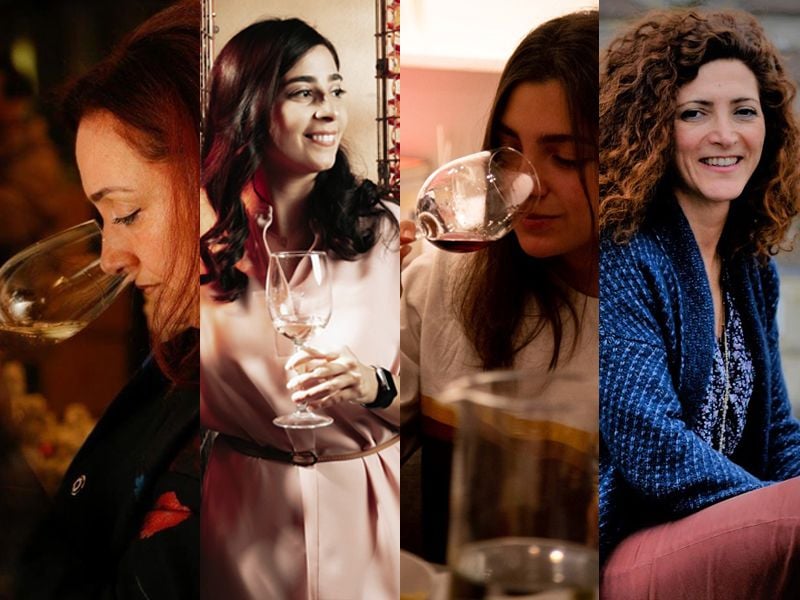
From left to right: Diana Salameh, Tamara Gebara Khater, Karen Rahal, and Diala Younes Lavenu. (Collage: OT)






Winemaking is often seen as a male-dominated profession, yet women have been active on the scene for some time now. In Lebanon, a society often described as patriarchal, do they face an uphill battle?
We spoke with four of them.
All had to prove themselves, some more than others, but working mostly within family businesses helped smooth the way.
Diana Salameh, from Zahle in the Bekaa, says both her grandparents owned vineyards that always fascinated her. After completing her studies in Lebanon, she discovered a bachelor’s program in “Vine and Wine Sciences” in Dijon and enrolled.
She then earned a degree in oenology to enter the field. She spent about 10 years in France studying and working before returning to Lebanon, just as the country began offering new opportunities in the sector. She started out at a major winery, then noticed the growing number of small producers who could not afford full-time staff. She decided to work independently as a consultant.
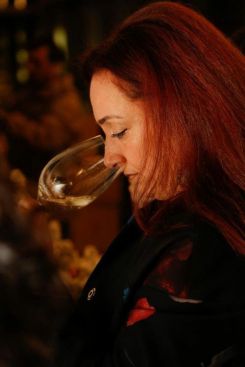
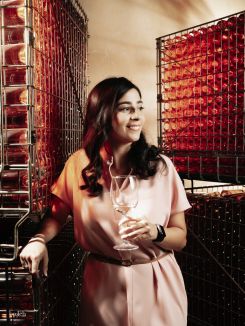
She says she faced no difficulty asserting herself as a woman in Lebanon, unlike in France, where the sector is more traditional and generational. “In Lebanon, I had no issue on that front, especially since the sector is fairly new and people do not yet know how to work vineyards as they do table grapes. The role of cellar master is also new, and those involved listen to people with diplomas, which commands respect, especially when the degree was earned in France.”
She adds that in Lebanon, expertise is respected and gender does not matter, except in wine tasting, where women often have an edge thanks to a more refined sense of smell. “I was among the first to hold this degree in Lebanon. It was the golden age, in the mid-2000s, when demand was very high. I was lucky. Today, I consider myself senior, but I am not sure the same opportunities exist for young people now.”
Tamara Gebara Khater also earned a degree in oenology in Dijon after studying agro-food engineering at USJ. She says she has loved wine from a young age, a passion shared by her family.
She grew up tasting wines and cooking to pair food and wine. She began working in France, in Chablis and then Bordeaux, before returning to Lebanon to work at a major winery. She later went back to France, ending up in Sancerre at Pascal Jolivet. Upon returning to Lebanon, she joined her husband’s winery, where together they produce a wine born of both love and expertise.
Tamara says she works in a male-dominated environment that is often not very educated, where a woman’s presence is still met with a degree of condescension, especially when she runs the business. But she notes that the growing number of women winemakers is changing attitudes, along with time and familiarity.
“Women pay more attention to detail and are more meticulous, which is an advantage in winemaking, a delicate craft. My husband and I see this clearly in the cellar,” she says.
As more women enter the field, male winemakers are starting to appreciate working with them, she adds.
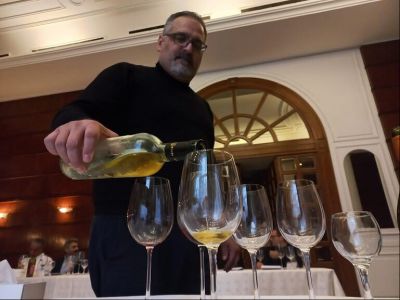
Karen Rahhal was born in 1999, almost at the same time as her family’s vineyards, which were planted in 1998. Alongside her twin brother, she grew up immersed in this culture from an early age. It seemed obvious that her brother would work the vines and she would handle the business side. That assumption proved wrong.
Early on, she developed an interest in science and a passion for vineyard work. She studied agriculture in Italy, then pursued oenology studies between France and Portugal, turning that interest into a passion.
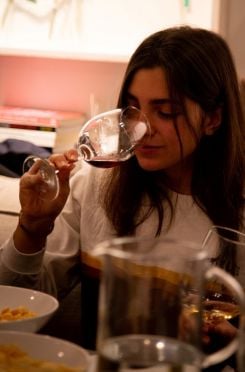
“I tasted wine at a very young age, in moderation, and I loved it. By tasting more and more wines around the world, I realized the extent of Lebanon’s potential.” That was enough for Karen to return home and become the family’s winemaker.
That is when resistance emerged to having a woman rather than a man at the head of such a business. “I had to prove myself, especially since I am the younger sister and the twin of a boy. I had to be firm without setting myself up in competition, but rather in a team spirit,” she says.
Diala Younes Lavenu began with a degree in agronomy engineering at USJ. An internship at a major Bekaa winery made her “fall into the pot,” or rather into the vat. She quickly realized this was the career she wanted.
She completed her engineering studies in Lille, working on beer, before returning to Lebanon to work in the laboratory and then the cellar alongside the technical director at the same winery that had hosted her internships.
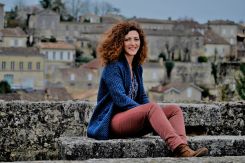
She was soon given responsibility for the laboratory while pursuing a postgraduate degree in quality assurance. She was promoted to assistant technical director, then replaced the technical director himself. At 24, she became the youngest winemaker and one of the few Lebanese women to hold such a senior position in the field.
Three years later, she went to Bordeaux to study oenology at the university. She fell in love with the city and never left. She has worked across all aspects of wine: production, technical management, development and markets. Roles followed one another, her network expanded, and today she travels across France.
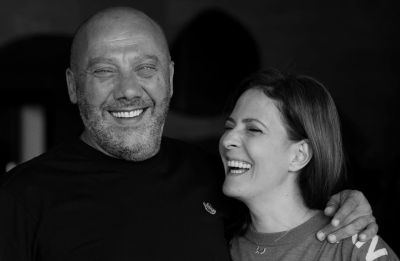
Diala Younes Lavenu agrees with Salameh that the obstacles are greater in France, where the sector is more misogynistic, and women are rare, especially in technical roles.
Still, she says she had no trouble pushing through sound projects she defended fiercely. “I had everything I needed to argue my case and succeed,” she says.
In Lebanon, her engineering credentials commanded respect. In France, some male colleagues challenged her to carry out certain tasks herself, such as pumping oil in the cellar. “I did it once or twice. After that, things fell into place. When your ideas are clear and firmly held, obstacles fall one by one,” she concludes.