


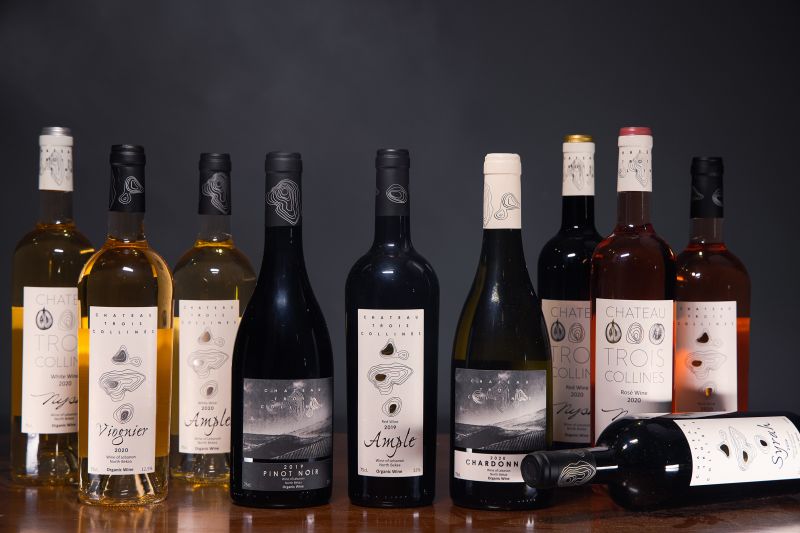
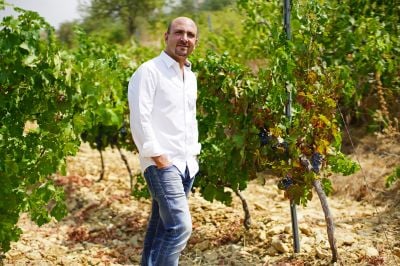
Photo provided by Chateau Trois Collines.
When you arrive at the heights of Ain Bourday (Bekaa), the first impression is of a landscape seemingly abandoned by time. A dry, mineral plateau swept by winds, it offers no obvious promise. Yet it is here, at an altitude of 1,550 meters (about 5,085 feet), that a singular story began. It is the story of a former stone quarry long thought barren, which one man decided to turn into a vineyard.
In 2011, driven by a vision deeply rooted in his land, Ziad Ammar set out to give new life to this forgotten site. Where others saw only arid ground, he recognized the potential of a great terroir. The Romans, after all, had not been mistaken. Less than five kilometers away stand the columns of the Temple of Bacchus, a millennia-old testament to a territory chosen for wine.
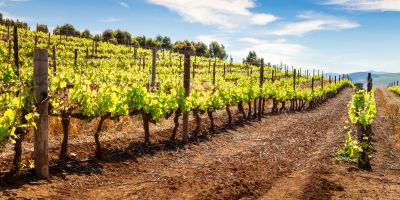
What began as a gamble, almost an act of faith, quickly became an ambitious agricultural project built on the belief that nature rewards those who listen to it. By 2013, the first vines had taken root. Planted on slopes and carefully trellised, they now grow at a density of 5,000 vines per hectare.
They draw from clay-limestone soils resting on a limestone bedrock that already defines their character. Yields are deliberately kept low, barely 1.5 kilograms (about 3.3 pounds) per vine, to allow what matters most to emerge: purity of fruit, depth of terroir and the promise of a high-altitude wine shaped by a harsh yet healthy climate.
Environmental commitment lies at the heart of the estate. The vines are certified organic and ecological, and all the electricity used in the vineyard comes from 100 percent renewable sources. Solar panels provide exemplary energy autonomy. Respect for nature here is not a slogan but the cornerstone of the project and its mission: “Giving back to Lebanon, giving back to nature.”
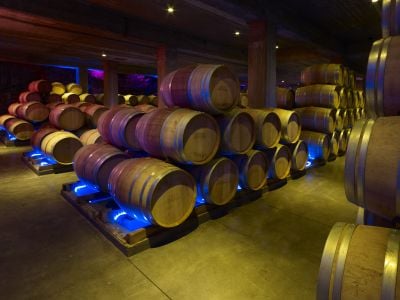
Several dozen kilometers away, yet still at around 1,500 meters (4,920 feet) above sea level, stands the other pillar of Château Trois Collines. The winery in Dahr al-Baidar-Ain Dara was built in 2017. Modern and streamlined, and equipped with temperature-controlled stainless-steel tanks, it was designed to support a move upmarket. Production aims to reach 500,000 bottles a year. It is here that the first red, white and rosé cuvées were born, all organically certified and the result of a rigorous approach and informed craftsmanship.
Innovation continues with the creation of a distillery dedicated to premium arak. Two indigenous grape varieties, Obeideh and Merwah, grown on the estate adjoining the winery, are distilled using brand-new stills and columns. They are then aged for several years in terracotta amphorae imported from Italy. It is a return to tradition, executed with precision and discipline that firmly anchor it in the modern era.
Starting in 2026, Château Trois Collines will unveil a new dimension. Plans include a restaurant with a large summer terrace, a lounge, a tasting room, a boutique, spaces for private events and a guided-tour program. The ambition is clear: to make the estate a living, open place where visitors discover not only wine, but also a culture, a vision and a deep attachment to Lebanese terroir.
Château Trois Collines is not merely a vineyard born on a rocky hill. It is the story of a rehabilitated landscape, a revived heritage and an unwavering determination to remind the world of what Lebanon has always known how to do: turn land into memory and wine into language.