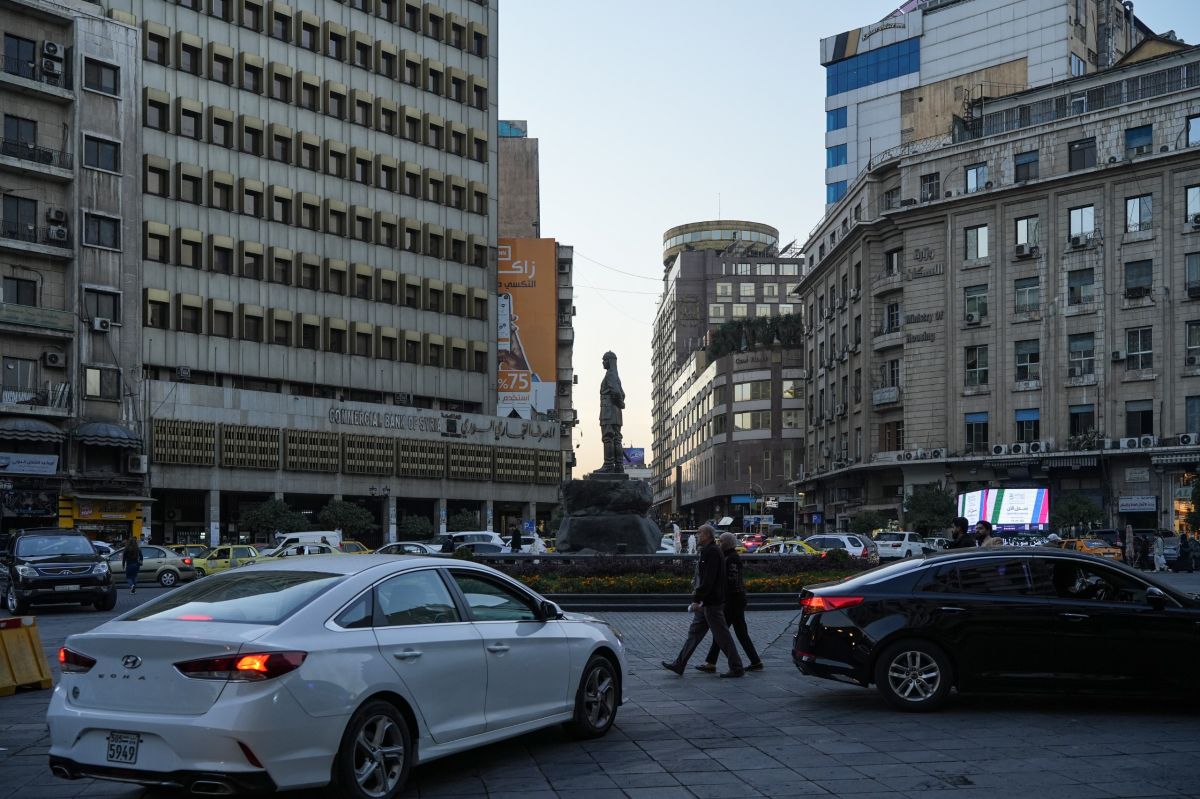
A square in Damascus in November 2025. (Credit: Mohammad Yassin/L'Orient-Le Jour)






It was my first evening in Damascus. The Assad regime had fallen a few weeks earlier, and the new government was still in its early stages. There was a feeling of euphoria, hope regained, and of celebrating the end of one of the worst dictatorships of the last 50 years.
Every gesture and word from Ahmad al-Sharaa, the interim president, was scrutinized, as the mystery about his plans for the new Syria remained. Fifty-four years of terror and 14 years of war had left deep scars.
Fear was already evident in some, a desire for revenge in others, along with the fragility of a destroyed and divided country, the changing lines of geopolitical rivalry and the ambivalence of a new government that, like the rest of the country, had been deeply shaped by the Assad era and could not completely break away so quickly.
It was my first evening in Damascus, and I was on the verge of witnessing a scene almost too perfect to be real.
Around the table, Syrians from various regions and communities gather, embodying, for one evening, the main characters — except for the Kurds and Alawites — of the post-Assad era.
There was an early revolutionary, a Sunni from Aleppo, who saw the Islamists take control of the opposition and now fears they will steal the greatest moment of his life.
There was a student, a Christian from Damascus, who never left the capital during the war, who hated the old regime but was afraid of "those who launched rockets at his school," and is even more afraid today of those who have taken power.
There was an activist living abroad, a Druze from Sweida, who feels that his region is drifting gradually further from Damascus — this was before the July massacres — but who wants to believe in the new regime.
There was an experienced journalist, a Sunni from Hama, very close to the new authorities, who described in detail how Aleppo, and then the rest of Syria, was recaptured. He has personally endured all the atrocities committed by the Assad regime and passionately defends the new government, which — by his account — is the only one capable of representing the hopes of the majority of the people.
There was an artist, a Palestinian born and raised in Syria, who fears more than anything that Damascus will normalize relations with Tel Aviv, who believes the new regime is worse than the old one, and who cannot find words harsh enough to describe her feelings about the man she still calls Abu Mohammad al-Jolani.
These were some of the people around the table, all laughing and arguing, reminiscing about the war years, each naming their own worst enemy in turn, and reflecting on what Syria will become.
And there I was, watching and listening, struggling to believe that this conversation was happening on a rooftop in the heart of Damascus and that they were speaking so openly in what, just weeks before, had been a place of fear and silence.
How do you tell the story of the new Syria? It's a question that often sparks heated debate in the newsroom.
How do you explain that most Syrians support the new government, that millions have been able to return home, that it's unfair to think everything can be resolved in just a few months, and that, compared to what could have been feared after Assad, we are still far from the worst-case scenario?
How can we also reveal the massacres of the Alawites and Druze, the tensions with the Kurds, and the darker aspects of the new regime? What should be preserved? The hope of the majority or the fear of minorities?
How can we forget that everything needs to be rebuilt, that 90 percent of the population lives below the poverty line, that sectarianism has been manipulated for decades, and that the government must manage both internal aspirations and the interests of foreign powers? That it's already a miracle it's still standing, and that the country is experiencing relative stability under these circumstances?
How can we not see, at the same time, that Sharaa represents a vengeful, authoritarian and conservative Sunni power, more Islamist than jihadist, deepening the country's polarization and pushing democratic promises further away?
What should be said after a year? That the former jihadist, a powerful political figure, has reconnected Syria with the world, or that he has failed to heal the wounds of a traumatized society?
The massacres that have shaken the coast and the south are a dark stain on the new Syria. All the more so as we still do not know to what extent the government bears responsibility or whether it was overtaken by some of its own supporters and factions within its army.
Even if they occurred amid widespread violence across the entire region, and partly in response to the suffering that most Syrians endured for many years, we would be wrong to dismiss them. However, it would also be incorrect to judge the new government solely based on that perspective.
In one year, Sharaa has moved mountains, especially on the international stage. But none of the core issues have been resolved yet. The deal with the Kurds is at a standstill, as they refuse to disarm without significant guarantees in return.
The security agreement with Israel is unlikely to succeed due to Tel Aviv's insatiable demands. The separation from Sweida is final. Hostility toward the Alawites remains as intense as ever. Tens of billions have been promised to Damascus, but only a few million have actually been invested so far, and the Caesar Act has not yet been fully repealed.
Syria is no longer the land of promise it was a year ago, but not all of its promises have disappeared. Time must be allowed to pass. We need to view these changes critically yet fairly. We must remember where the country originates from, the overall state of the region and even the direction the world is heading.
We must also remember that our ability to write about and report on this country in depth today is because Syria is freer than it has ever been and than most other states in the region.
Things are moving so fast, and memories are so fractured and incomplete, that it's easy to forget: It was only year one.
P.S. It was crucial for us to publish this special section not only because the future of Sharaa-ism and Syria will impact the entire region but also because we remain convinced that the fates of Lebanon and its neighbor are and will continue to be closely connected.
This article was translated from L'Orient-Le Jour.