












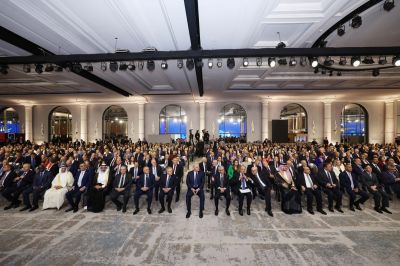
Six years into Lebanon’s financial crisis, the country stands at a crossroads. In the wake of the Beirut One investor conference, the prospect of rekindling investor confidence may still seem ambitious or premature.
Yet capital does not flee risk; it flees uncertainty and dysfunction. Lebanon’s new reformist government, by gradually implementing credible reforms, has begun to chip away at both.
If sustained, these reforms could restore the clarity and confidence that investors need to start seeing opportunity in Lebanon, even today.
As an activist investor, I judge opportunities through three lenses: margin of safety, upside potential and ability to influence outcomes.
Margin of safety is not just about buying undervalued assets; it’s also about quality, both intrinsic and systemic. Lebanon’s assets have undeniable inherent worth, yet macroeconomic and political dysfunction introduce systemic unhedgeable risks.
Upside potential emerges when these systemic risks are reduced, and in Lebanon’s case, the upside is immense.

However, unlocking it requires the ability to influence and drive change through five levers: governance, incentives, capital allocation, strategy and operational excellence. Historically, Lebanon has struggled to engage on these fronts, but this time could, and must, be different.
Intrinsic asset quality
If one digs deep, it becomes clear that Lebanon is endowed with substantial latent comparative advantages.
Take the Economic Complexity Index (ECI), which measures a country's productive capabilities. Lebanon ranked 21st globally between 2009 and 2011, ahead of regional peers. By 2023, it had fallen to 88th due to systemic neglect, but the building blocks of these comparative advantages still exist because they are all rooted in Lebanese culture.
Lebanese culture emphasizes education: Lebanon's universities have trained generations of highly employable engineers and scientists, thereby fostering rich intellectual capital and excellence in the creative industries.
Lebanon’s diversity, geographical position, and history of migration have led to global and regional linkages, which, combined with an entrepreneurial drive, formed a worldwide network of capital, knowledge, commerce and distribution.
If we use remittances as a proxy for diaspora strength, in 2023, Lebanon ranked third globally, accounting for 30.7 percent of its GDP.
The obsession with vanquishing an age-old, unstable macro environment instilled a culture of resilience in its positive sense of creative adaptability. Despite recurring crises, Lebanon maintained a complex export capacity of $5.6 billion in 2011 – the year when early signs of economic strain became visible, with about $1 billion in technology exports.
All this has created a unique "Lebanon Brand," which is another fundamental comparative advantage. But comparative advantage is like a muscle – it must be continuously maintained and used, and a brand, once damaged, is hard to salvage.
It follows that institutional decay, macro dysfunction, and brain drain threaten this very foundation of comparative advantage, and these intrinsic strengths cannot be sustained without addressing Lebanon’s broken macro environment. The cost of capital remains prohibitive, access to credit dismal, monetary policy inadequate and capital markets underdeveloped.
Infrastructure, both hard and soft, has decayed, while legal enforcement is unpredictable. Bureaucracy and weak regulation have driven Lebanon’s decline in the World Bank’s Ease of Doing Business rankings from 80th in 2010 to 145th in 2020. Corporate governance and minority shareholder protections are minimal, with boards often lacking independence and oversight.
This contrast between intrinsic quality and systemic dysfunction frames the real challenge: how to transform Lebanon’s latent strengths into tangible investment opportunities.
A realistic investment thesis
Making Lebanon investable requires using each of the levers of activist investing.
In matters of governance, there is a dire need to strengthen public institutions and judicial independence.
To align incentives, the country needs a modern competition law and adequate tax incentives, such as for remote work and the enactment of double taxation treaties.
Judicious capital allocation should prioritize spending on infrastructure and enabling systems that support production and export capacity.
When it comes to strategy, Lebanon must focus on three essential prongs.
First, Lebanon must focus on what is proven. Rebuilding Lebanon’s investment ecosystem doesn’t mean chasing unicorns. It means de-risking the transition and sequencing reforms around what works today, without giving up on the long-term transformation of the economic model into a more productive one.
Policymakers should actually encourage capital inflows into transitional sectors like real estate, which can bring in $1 to $2 billion per year in foreign exchange, even if not immediately productive.
Second, Lebanon must focus on resilient, scalable sectors that require less complex infrastructure and more brainpower – Lebanon’s true comparative advantage.
From a marketing theory perspective, Lebanon is "stuck in the middle," as it's neither a low-cost nor a high-tech country, so it must focus on knowledge-based export industries, where creativity can compensate for its lack of high-tech. Examples include agri-food, pharma and boutique manufacturing, which can help satisfy domestic demand and improve the balance of payments. Also, creative and cultural industries, including design, media, and music production, have global appeal and leverage Lebanon’s artistic legacy. In addition, health services and medical tourism can be scaled with minimal infrastructure and attract regional demand.
Education services and ed-tech can export Lebanese academic talent and institutions through digital platforms. Specialty tourism – eco and cultural – can support rural economies. While Lebanon should not try to be an AI innovator, it must leverage AI in its strategic verticals to increase their effectiveness.
Finally, Lebanon must leverage its diaspora by institutionalizing engagement through formal policies, developing investment platforms and diaspora-friendly instruments (such as diaspora bonds) and fostering co-production (where diaspora firms anchor operations in Lebanon) and using diaspora networks in order to enable export distribution and help Lebanese firms scale internationally.
Conclusion
From an institutional investor’s perspective, the fundamentals are sound, the levers to drive value creation are clear, and the investment opportunity is within reach.
What Lebanon lacks is not potential but stability. If policymakers can accelerate credible reforms that restore transparency, accountability and confidence, capital – both domestic and foreign – will return. But it would be out of conviction and merit then, not charity.
Firas Abi Nassif is the co-founder and chairman of the supervisory board of Teleios Capital Partners, a leading activist hedge fund based in Switzerland. He is currently a member of the Board of Trustees of the Lebanese American University (LAU), where he chairs the Strategy Committee.
