








Not a day goes by without me asking myself this question. Not a day goes by without me wondering if this country — our country — is still worth the headaches of trying to understand it, dissect it and, for the boldest among us, save it.
Not a day passes without me asking what justifies this visceral, somewhat irrational attachment to a tiny patch of land no bigger than a French department.
You might say there is nothing original about that: All Lebanese ask themselves the same question, and that attachment to one’s homeland is a universal phenomenon found among the wealthy and the destitute alike.
I still want to believe that what binds us so strongly to Lebanon goes beyond the cedars, the family, the mountains, the sea, the food, the friends, the humor, the music, the language — all those things we love and cannot live without.
I want to believe that Lebanon is more than just that, that it is an idea before it is a country, that it is so elastic it can contain the world within its 10,452 square kilometers, that it is one of those places from which the world can be best understood and that it still has something valuable to offer to it.
I know how hackneyed these words have become. I know how they help sustain a national narrative that feeds our narcissism while casting a veil over our wounds.
I know how we take pleasure in reiterating the words of John Paul II — “Lebanon-message” — or those of Emmanuel Macron — “a country greater than itself” — all the while fully aware of how far they are from our reality.
Lebanon, where Pope Leo XIV landed this Sunday — offering a brief moment of serenity — is a tired, battered land, anxiously and with a sense of fatalism, waiting for the next war that would consume it. It is hardly a country, and even less a message.
You might say that it never really was, that this idealized image died with the horrors of the Lebanese Civil War; that our inability to forge a nation tells far more about ourselves than our capacity to “live together.”
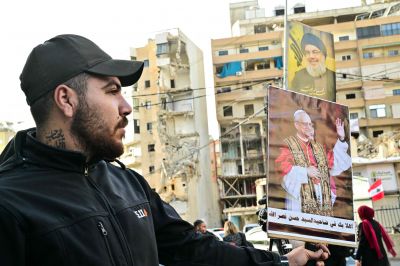
You might also say that we see each other as cautious rivals, mainly focused on protecting our own community. Our pride in embracing diversity, often showcased to the world with Christian and Muslim representatives standing before the pope, becomes much more limited when it involves skin color or sexuality.
You might say that we have been promoters, and perhaps even exporters, of the frenzied and outrageous identitarianism that now spreads like a virus across the globe, judging people not for what they think but solely for who they are.
Lebanon is not only that. But it is not entirely something else either. With all due respect to Khalil Gibran, there aren’t two Lebanons, his and theirs. There is only one, and there has always been only one.
It is this same Lebanon that is sometimes great and sometimes small, sometimes mediocre and sometimes brilliant, sometimes endearing and sometimes repugnant.
It is as if the country were carried by something beyond itself. It is as if someone who can barely stand upright had been asked to carry the weight of the world on their shoulders. Lebanon is obviously too fragile to bear the weight of the world.
The worst part is not that we have failed to turn this Lebanese utopia into something tangible. The only utopia comparable to it, Europe, has also failed, and we still have plenty of time to reverse the trend. This is not a matter of a few years, or even a few decades, but of several centuries.
The worst part is that we are in the process of giving up. We can no longer grasp that our so-natural hybridity — even if it can, in a split second and far more violently than elsewhere, turn into a visceral hatred of the other — is what we have to offer the world. And the world truly needs it.
Managing diversity is one of the greatest challenges of the 21st century. Yet no one has found the key; on the contrary, the current trend is toward isolationism and into primary, often deadly identities — fueled yesterday by social media and tomorrow even more by artificial intelligence.
Lebanon does not have all the answers, but it could have offered some. It could have been living proof that identities can coexist without constantly clashing. It could have embodied the hope for another world.
Instead, it has become a magnifying mirror of its own decay and fragmentation. And on this point, as on so many others, despite Pope Leo XIV’s good intentions, a miracle should not be expected.
This article was translated from L'Orient-Le Jour by Joelle El Khoury.
 Iran has 'lost complete control' of Hormuz Strait, Rubio says