











What will happen after the pope’s visit?
The question now hangs over every debate in Lebanon. People cling to this symbolic event, hoping that the pontiff’s blessing might ward off danger. They want to believe his prayers can solve the country’s dilemma.
But Lebanon’s fate is decided elsewhere, shaped by powers whose calculations have no regard for its longing for peace. For even if it currently enjoys some sort of “papal truce”, what comes next will depend entirely on the dynamics that pit Iran and Israel against each other or bring them into alignment, at times.
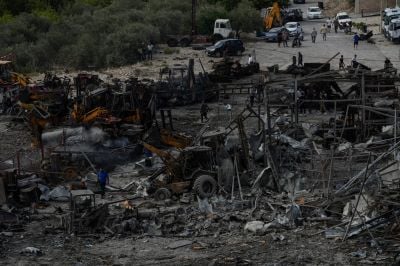
Since Sunday’s assassination of Hezbollah’s military chief, Abou Ali Tabatab’ai, in an Israeli strike on Beirut’s southern suburbs, Lebanon has been holding its breath. Will this latest blow be the last straw for a party caught in a trap of its own making? For when it comes to retaliation, Hezbollah has never been in control of its own choices.

The real question is not whether the party wants to respond or not, but when Tehran will decide the moment is right.
As things stand today, Hezbollah’s greatest challenge lies in containing the moral collapse of its own popular base as the enemy continues to strike at the heart of its leadership structure, and in the fact that its ally is ordering it to keep silent.
Had Hezbollah retaliated to the assassination of its leader Fouad Shukur, or the pager attack, would its leader Hassan Nasrallah be alive today? Had it reacted to the first violations of the cease-fire, would this have spared the hundreds of its fighters and supporters who have been killed since the agreement was reached a year ago?
And if its “full capacity,” [as it continues to boast] had truly been restored, would Tabataba’i have been eliminated? If it is really “recovered,” why is it hiding behind a state it deems “nonexistent,” letting that state shoulder the burden of its suicidal ideology. And if the party hasn’t recovered and is not in full capacity, why proclaim the opposite so loudly, at the risk of feeding Israel’s narrative and exposing the entire country this time to its war machine.
In the end, the matter boils down to this:
Hezbollah does not speak for Lebanon. It carries out Tehran’s strategy. And removing from its recent death notices, [for both combatants and civilian loyalists], the phrase: “a martyr on the path to Jerusalem,” does little to change this reality. Speaking about an Iranian strategy in Lebanon also means bargaining with the Americans by playing the Hezbollah card down to the last Shiite.
How else to interpret the remarks by Ali Akbar Velayati, adviser to Iran’s supreme leader, who sounded even more inspired by the pope’s visit than the Christians themselves. He said that “Hezbollah’s presence has become for Lebanon more essential than daily bread,” reaffirming Tehran’s commitment to supporting it and arguing that the Israeli attacks prove the “disaster” that any attempt to disarm the group would bring.
The height of irony is that this latest insult to Lebanon’s sovereignty serves the strategic interests of both Tehran and Tel Aviv. As if between these two officially hostile powers a grim consensus took hold: To keep Lebanon drained, paralyzed and unable to rise again.
“I do not believe Hezbollah will disarm voluntarily,” Israeli Defense Minister Israel Katz said shortly before Velayati spoke. “The Americans have forced them to dissolve by the end of the year, and I do not see that happening. If it does not happen, there will be no choice but to intervene again with force in Lebanon.” Intervening “with force” in Lebanon is hardly something Israel would object to. Nor would nipping in the bud any agreement between the Americans and the Iranians.
Israeli officials know that what they are demanding — Hezbollah’s disarmament south and north of the Litani by the end of the year — is impossible. And they believe that after having their arm twisted by Washington on Gaza, they will have a freer hand in Lebanon. In this geopolitical vise, no statement, however responsible, can be turned into action.
On Lebanon’s Independence Day, President Joseph Aoun did not stop at the traditional words. He chose southern Lebanon as his platform to assert the state and its sovereignty over all Lebanese territory — a speech that sounded like a revised and more realistic version of his inaugural address after a year in office.
But whatever criticisms can be leveled against him, the president’s hands are tied. If he plays along with Hezbollah, he delivers the country to the Israeli monster; if he alienates the party, he exposes the country to the game the Iranians know best: internal discord.
Everything therefore suggests that once the pontiff’s plane takes off, Lebanon will find itself again on the front lines of a regional conflict it cannot escape and cannot bear. How, then, can anyone expect a miracle when those who hold the country’s fate in their hands have no interest in seeing it regain… peace.

 7 p.m. recap: Iran warns Egypt, Israeli soldiers vote in south Lebanon, Haret Hreik responds to Kataeb