





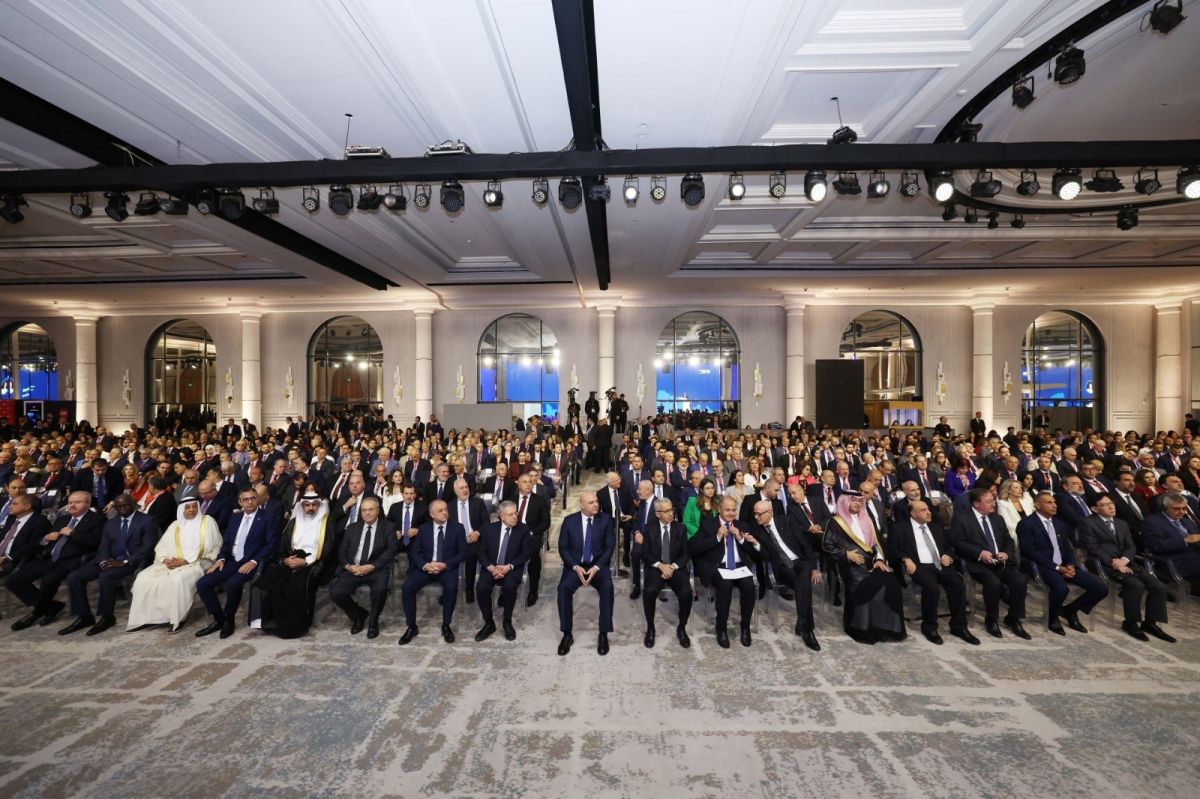
President Joseph Aoun, surrounded by several Lebanese and foreign officials, on Nov. 18, 2025, at the Beirut Seaside Arena. Photo provided by the conference’s press team.






BEIRUT — Business leaders from around the world, government officials, economic institutions and delegations from across the Gulf filled the Beirut Seaside Arena on Tuesday as the Beirut One Conference — organized by the Finance Ministry and the Economic, Social and Environmental Council — opened its first of the two-day event.
The conference is the first of its kind since the outbreak of the economic crisis in 2019. A number of panel discussions took place throughout the day, with hundreds in attendance, bringing Lebanese government officials together with their international counterparts, global financial professionals and representatives from multilateral institutions.
Lebanese ministers used the platform to present several of the projects they have been developing and their required funding.

“Some may ask: why now? How can you hold an investment conference in the middle of a security, economic and political crisis?” President Joseph Aoun said during his opening speech.
“It’s a legitimate question. But the answer is clear: we don’t build the future after the storms pass; we create the calm through action,” he added, stressing that “actions are what change the course of events.”
“Lebanon is not asking for compassion, but for confidence,” Aoun added, urging foreign investors attending the conference to “seize the opportunity,” while emphasizing that their very presence amounts to “an investment in the country’s stability and future.”
Security, stability and confidence
Among the participants were delegations from Egypt, the United Arab Emirates and, most notably, Saudi Arabia, whose group included representatives from the Saudi Ministry of Investment, the Federation of Saudi Chambers, and others.
Their presence coincided with the Saudi envoy Yazid bin Farhan's visit to Beirut on Tuesday. The delegation’s participation comes just days after Riyadh announced plans to revive its commercial relations with Lebanon, following years of diplomatic strain due to Hezbollah’s involvement in the wars in Syria and Yemen and to tensions linked to drug trafficking in the Gulf.

“There is a clear will among Arab countries to support Lebanon in the period ahead,” said Fawzi Al-Hunaif, director general and chairman of the Board of the Arab Fund for Economic and Social Development.
“The strong turnout confirms that there is a real appetite for [investing in] Lebanon,” Egypt’s Minister of Supply and Internal Trade, Sharif Farouk, told L’Orient Today.
But the tone throughout the conference was mostly unified: this kind of event is only a first step, and investment in Lebanon hinges above all on geopolitical security and stability — as well as on long-stalled reforms.
“The steps we’re seeing today are good. Lebanon has exceptional talent, and it has a diaspora with millions that could invest back home. We are ready to start investing in Lebanon again,” said Nasser Alnuwais, Emirati chairman and co-founder of Rotana Hotel Management Corporation.
“But everything comes down to security, stability and confidence,” he added, regarding a return to the country more than twenty years after his first investment.
In his speech, Aoun said the authorities were working to “reinforce internal securities” in order to reassure investors.
“This conference is meant to send a message: Lebanon is beginning to regain its place as a productive and appealing country,” said Charles Arbid, co-organizer of Beirut One and president of the Economic, Social and Environmental Council to L’Orient Today.
“It is a country that has faced many difficulties, but we are at the start of a path that could slowly restore confidence.”
“I think there will be an appetite for investment once people listen to the speakers over these two days and understand the possibilities, and that would be a start,” Arbid noted.
For Economy and Trade Minister Amer Bsat, the purpose of the conference was to create a platform for investors to explore opportunities in Lebanon and to initiate discussions. “The process of due diligence is what we hope to launch during this conference,” he had told L’Orient Today.
And while no memorandums of understanding (MOUs) are expected at this stage, the minister told L’Orient Today that “once we have a clearer sense of investor interest, we plan to hold follow-up side meetings in the coming months to build on these ideas.”
The conference will continue on Wednesday with a second round of panels, concluding with a discussion featuring Prime Minister Nawaf Salam.

 Evening recap: Netanyahu announces West Bank offensive; 7 killed in Jordan church shooting; tents burned in south Lebanon
 US strike on Iran this weekend? ‘Absolutely,’ says Barrack; ‘I have no idea,’ says Trump