


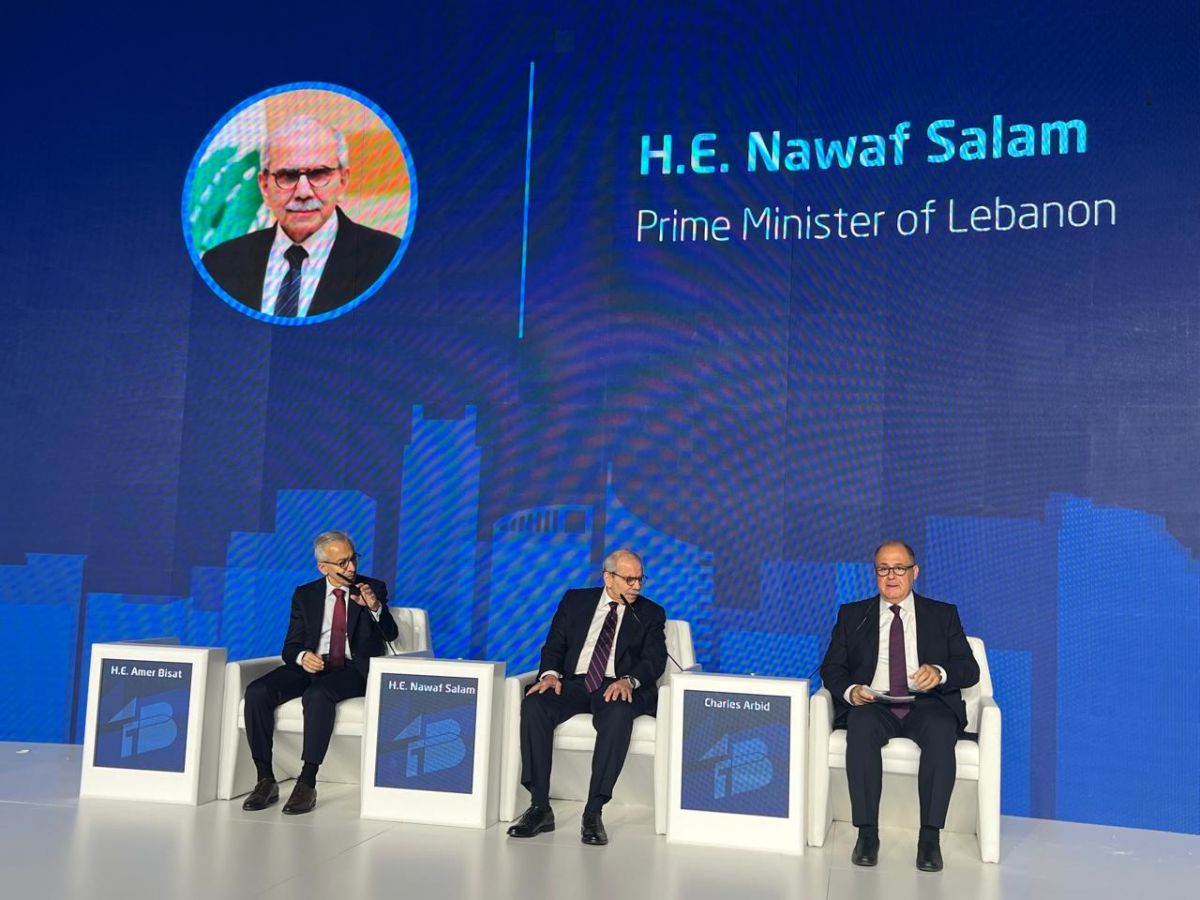
Economy Minister Amer Bisat (left), Prime Minister Nawaf Salam (center), and Economic, Social and Environmental Council President Charles Arbid (right), during the closing address of the Beirut One conference at the Beirut Seaside Arena, on Nov. 20, 2025. Photo provided by Beirut One.






BEIRUT — “Lebanon had long been cut off from its natural Arab environment,” Prime Minister Nawaf Salam said in his closing remarks, adding that the presence of Arab delegations at Beirut One marks “the beginning of a shift” and paves the way for the country’s return to its regional sphere.
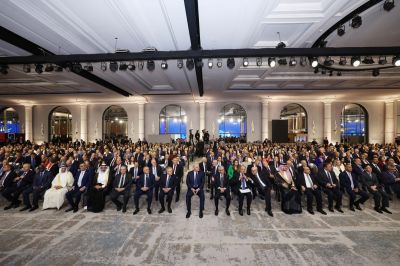
It was in this spirit of enthusiasm that the Beirut One conference — organized by the Economy and Trade Ministry in partnership with the Economic, Social and Environmental Council — wrapped up on Wednesday after bringing together, over two days, a large audience of officials, investors and economic stakeholders.
Panel discussions continued throughout the day, spanning themes from infrastructure and major public works to capital investment in telecommunications, tourism, tech startups and industry.
But the day’s standout moment came during the closing session, when Economy Minister Amer Bisat and Economic and Social Council president Charles Arbid sat alongside Salam for an open dialogue with the audience.
Investor interest peaked?
During the closing discussion, Bisat noted that the government had showcased $7.5 billion worth of projects across sectors throughout the conference sessions.
He also cited an anonymous survey conducted by the Lebanese Private Sector Network — a group of business leaders participating in the event — indicating that 160 companies expressed interest in potential investments totaling $2.5 billion in Lebanon without providing a sector-by-sector breakdown.
“This showed that there is investor interest, and that the progress underway is beginning to translate into a measure of hope,” he noted.
“Participants in the survey, and particularly 30 companies, indicated that they see potential to invest up to $1 billion in digital technology, though they did not specify the projects,” Minister of State for Technology and Artificial Intelligence Kamal Shehadeh told L’Orient-Le Jour.
But financial analyst Mike Azar emphasized that surveys of this kind are “not indicative of actual investor interest, because they do not represent any form of commitment. Respondents are free to say ‘yes’ without any obligation to follow through. They have no reason to say ‘no.’ MOUs [memorandums of understanding] or public commitments to make specific investments are typically how investors indicate interest.”
Bisat had initially said on Oct. 21 that the conference would feature MOU signings, but later walked that back in the days leading up to the gathering, saying no MOUs were expected at this stage.
Reforms still in the making
Participants almost unanimously agreed that security, stability and reforms are the three essential conditions for bringing investment back to Lebanon.
And the message was received: “Lebanon needs more reforms. We’ve begun the process, but we still have a long road ahead to complete the required measures,” acknowledged Salam.
“Ultimately, everything comes down to security,” he reiterated before pointing to the presence of armed groups and non-state weapons as one of the main challenges that still need to be overcome.
He added that the broader reform package spans electricity, telecommunications, civil aviation and a range of public institutions, which remain inseparable from negotiations with the International Monetary Fund (IMF).
“An agreement with the IMF is essential not only for credibility, but above all for restoring confidence,” stressed Salam, as the Fund has continued to express several reservations about texts that have been adopted or are still under discussion.
This is particularly true for the gap resolution law, a text that has been under negotiation for months, hindered in part by persistent disagreements. Salam noted that “tangible progress” could emerge “in the coming weeks.”
He also announced that the government is in the process of forming a new board for Lebanon’s Investment Development Authority (IDAL). The goal, he said, is to reactivate the institution “in the coming weeks.”
 2 Israeli soldiers injured in 'operational accident,' as army continues attacks in the South