






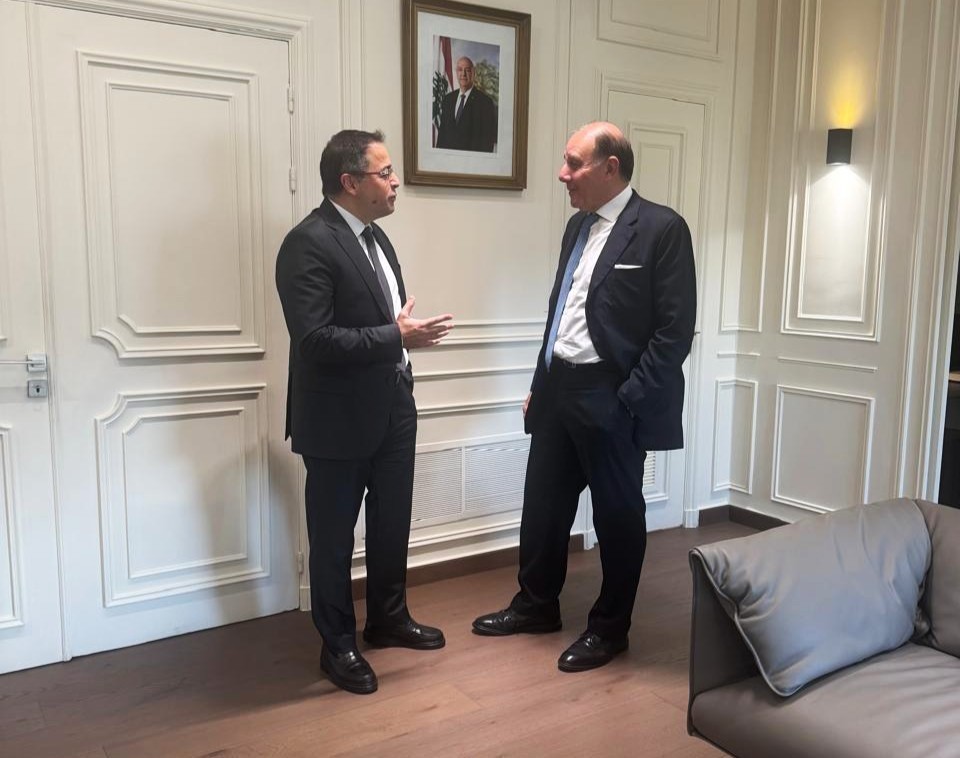
The governor of the BDL, Karim Souhaid, and his first vice-governor, Wassim Manssouri, talking at the institution's headquarters in Hamra, in November. (Credit: Photo released by BDL)






BEIRUT — The Banque du Liban (BDL) on Wednesday denied any frictions between its governor, Karim Souhaid, and First Vice Governor Karim Manssouri, in a statement issued by its press office, illustrated with a photo of the two men talking in one of the institution's hallways in Beirut.
According to the press office, which we contacted, the photo was taken that very day, on the sidelines of a regular meeting of the BDL Central Council, in an unusual move.
"The BDL governor works and collaborates with all the deputy governors as members of a single team, as colleagues and peers. Within the Central Council, where policies and sensitive issues are discussed, each member, including the governor, has a single vote, and no member holds a veto, which reflects the spirit of collective institutional work within the Bank," the statement said.
The central bank's response came after reports published the same day by two local media outlets, Polygraph News and Lebanon Debate, reported increasing tension between the two men amid U.S. pressure on Lebanese authorities to cut off funding to Hezbollah, which is heavily sanctioned by Washington.

Polygraph News claimed, citing its sources, that Manssouri, who has held the post of first vice governor — reserved for the Shiite community — at the head of the Central Council since 2020, had boycotted several meetings in protest of policies adopted by Souhaid, who was appointed in March as BDL governor, a post reserved for Maronites.
Closely linked to Nabih Berri, parliament speaker and head of the Amal movement, an ally of Hezbollah, Manssouri served as acting governor for nearly two years after the end of the highly controversial Riad Salameh's term.
‘Solid friendship’
Lebanon Debate went further, mentioning "buried differences that have resurfaced" since Souhaid came to the BDL. These tensions were said to be linked both to the governor's "direct character"—supported by the U.S. administration and adopting a cautious stance toward banks over the division of the country's financial losses — and the increased pressure on Hezbollah and Amal, intensified after a U.S. Treasury delegation visited Beirut in early November.
"Such misleading campaigns serve neither the Lebanese economy nor market stability, nor the efforts of Banque du Liban to work in coordination with the government on restructuring the banking sector and protecting depositors," the statement said.
"The relationship with the first vice governor is close and unique: the governor consults him on essential issues, including monetary stability, restructuring of the banking sector, capital markets development, combating money laundering, terrorist financing, and illegal money transfers to and from Lebanon. This harmony is reinforced by their shared background [legal and financial], their Francophone culture, their solid friendship, and their constant effort to build consensus on sensitive topics — even those that divide the political spectrum — making them natural partners," the BDL concluded.
Since the U.S. Treasury delegation's visit, the BDL has issued a regulation strengthening oversight of all transactions by licensed non-banking financial institutions, including money changers, money transfer companies, electronic wallet managers and lending desks.
A few days later, the secretary-general of Hezbollah called on the governor to reverse steps taken to control and combat illegal money transfer operations, saying these measures "tighten the noose" around the Shiite party, but also "all Lebanese."
Talks with the International Monetary Fund, revived with Nawaf Salam's cabinet in February, remain stalled, partly due to the governor's inflexible stance on certain points, especially the restructuring of banks and the return of deposits illegally withheld by financial institutions.
