





The American ambassador to the United Nations, Michael Waltz, voting in favor of the resolution supporting Trump’s plan for Gaza, in New York, on November 17, 2025. Photo REUTERS/Eduardo Munoz






In an extraordinary vote — 13 in favor, no vetoes, with Russia and China abstaining — the U.N. Security Council on Monday night approved Resolution 2803, endorsing the U.S. plan for Gaza after two years of war.
Backed by several Arab powers, the resolution calls for transitional international governance, a stabilization force to demilitarize the enclave and reconstruction under international supervision.
Amid French caution, U.S. triumphalism, and Russian and Chinese reservations, the resolution establishes an unprecedented framework but leaves uncertainty over the Palestinian political future unresolved.
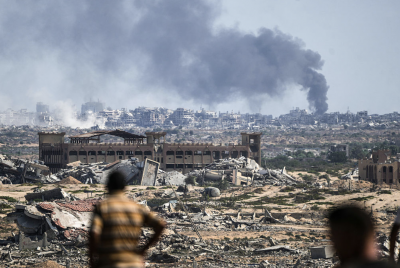
American plan at the heart of diplomacy
Resolution 2803 endorses the U.S. 20-point plan, negotiated with mediators from Egypt, Qatar, and Turkey. The plan calls for a unified cease-fire, staged release of hostages, full demilitarization of Gaza, and the creation of a transitional administration known as the Board of Peace, led by U.S. President Donald Trump. The board would oversee reconstruction and prepare for the eventual return of a reformed Palestinian Authority.
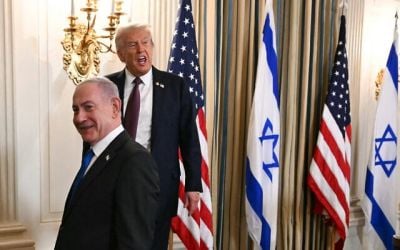
The vote marked a diplomatic shift. Russia and China, long prepared to veto Gaza-related resolutions, abstained. Moscow nonetheless criticized the measure as “vague” and “imposed.” Russian Ambassador Vasily Nebenzya called it “a sad day for the Council,” saying Washington had “twisted the arms” of several delegations. Beijing expressed similar concerns over the absence of explicit guarantees for a Palestinian state. The other 13 members, including France, voted in favor.
Washington claims a strategic victory
On the international stabilization force, he said it “will stabilize the security environment, dismantle terrorist infrastructure, disable weapons and protect Palestinian civilians.”
U.S. Ambassador Michael Waltz described the vote as a historic turning point. “Thank you for joining us to chart a new path in the Middle East,” he told the Council, praising coordination with Egypt, Qatar, Jordan, Saudi Arabia, the United Arab Emirates, Turkey, Indonesia and Pakistan.
Ambassador Waltz said the resolution offers “a real, concrete and operational path toward lasting peace.” He emphasized the central role of the Board of Peace, the “cornerstone” of the plan, which will coordinate humanitarian aid, reconstruction and the creation of an apolitical Palestinian technocratic committee.
On the International Stabilization Force, Waltz said it “will stabilize the security environment, dismantle terrorist infrastructure, disable weapons and protect Palestinian civilians.”
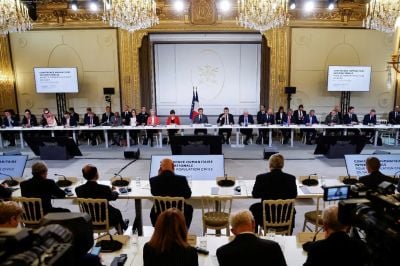
“This will stand as one of the most important approvals in the history of the United Nations,” the president said on Truth Social, thanking the countries sitting on the Security Council, including Russia and China.
He added, “A vote against this resolution would have been a vote for a return to war.” In a press statement, he said, “The U.N. has proven it can once again be a beacon for peace,” and under Trump’s leadership, “a stable, safe and prosperous region is finally within reach.”
President Trump welcomed the resolution, saying it “will bring more peace to the world.”
Guterres calls for 'action', France offers cautious support
U.N. Secretary-General Antonio Guterres called the resolution “an important step” in consolidating the cease-fire while stressing the need to “turn the diplomatic momentum into concrete and immediate measures on the ground.” The U.N. is committed to scaling up humanitarian aid and supporting the mechanisms outlined in the text.
French Ambassador Jérôme Bonnafont praised “the commitment of the United States” and its “decisive efforts with Egypt, Qatar and Turkey” that enabled a cease-fire, hostage releases and resumption of humanitarian aid. Paris voted for the resolution “to respond to the most urgent needs of the populations and support ongoing peace efforts,” he said.
Bonnafont outlined France’s priorities: immediate, unrestricted humanitarian access; rapid deployment of an International Stabilization Force; durable reconstruction of Gaza, “now in ruins”; disarmament of all armed groups; and addressing Israel’s security alongside “the Palestinians’ legitimate aspirations for self-determination.”
He emphasized the importance of anchoring the resolution in a solid political context: a two-state solution along the 1967 borders, the return of a “reformed and strengthened” Palestinian Authority, unity between Gaza and the occupied West Bank, and rejection of any unilateral territorial or demographic changes.
“By voting for this resolution, France chooses responsibility,” he concluded, urging the Council to remain attentive.
Between hopes and uncertainties: A new framework, an uncertain future
Despite the overwhelming vote, many questions remain: the composition of the Board of Peace, the acceptability of U.S.-led transitional governance, the actual demilitarization process, Hamas’s willingness to comply and Arab states’ long-term commitment, despite their public opinion’s caution.
The meeting between Trump and Saudi Crown Prince Mohammed bin Salman is expected to clarify Riyadh’s stance, considered crucial for reconstruction and potential regional normalization.
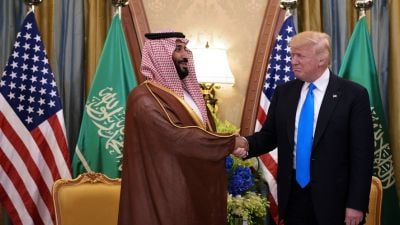
Resolution 2803 establishes a new framework. It does not guarantee peace but redraws the balance of power and creates a structure that, for the first time in years, brings together Washington, Arab capitals, and — through abstention — Moscow and Beijing.
Whether Gaza, battered by two years of war, can become the laboratory for peace the Security Council envisions remains to be seen.
This article was originally published in French in L'Orient-Le Jour.

 Midday news recap: Hebron attack sparks Israeli crackdown, international meeting in Istanbul for regional 'de-escalation'