






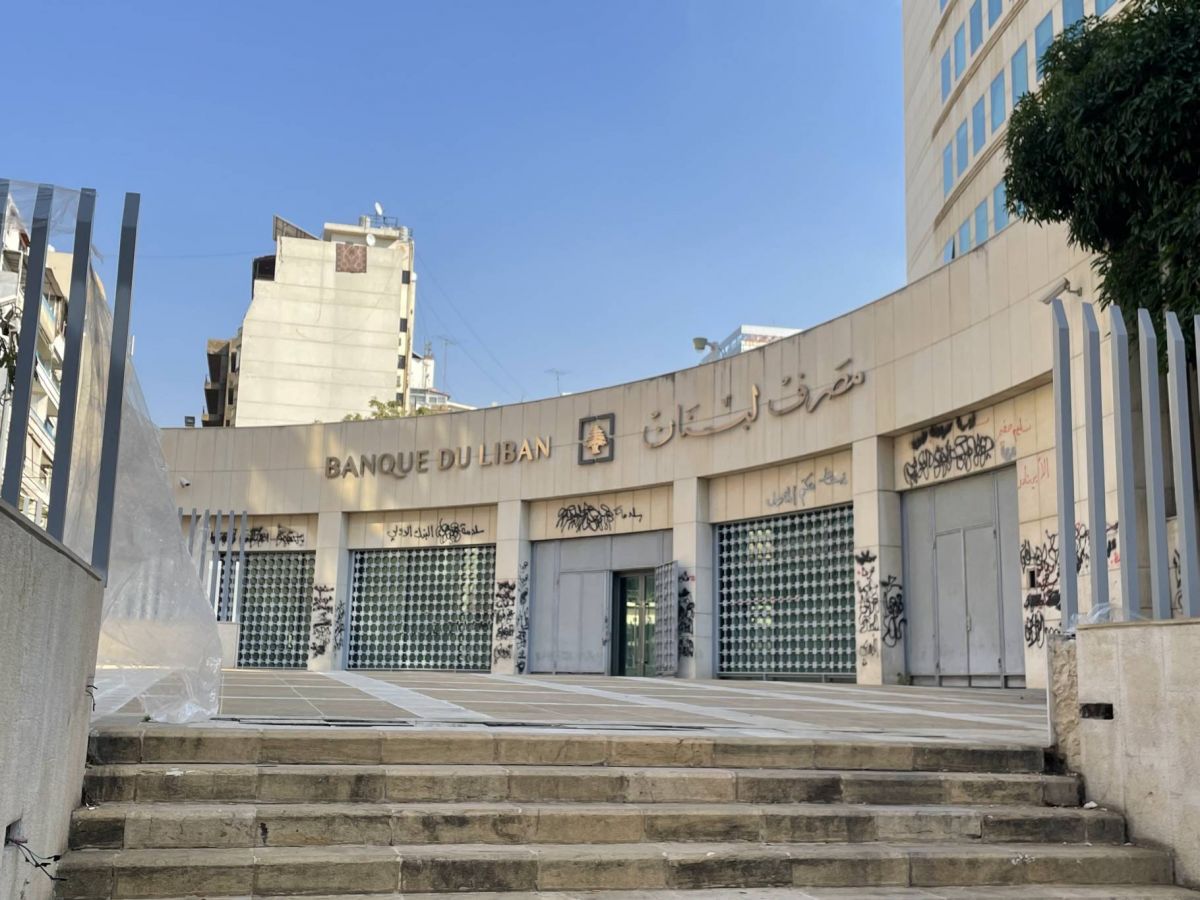
One of the secondary entrances of the Banque du Liban, in Hamra, Beirut. (Credit: Photo P.H.B./L'Orient-Le Jour)






BEIRUT — The Banking Control Commission (BCC) — Banque du Liban's (BDL, central bank) banking watchdog — issued a memorandum on Nov. 4 for banks to regulate fees and commissions imposed on customers and to reactivate a pool of dormant accounts.
Since the onset of Lebanon’s economic crisis in 2019, commercial banks have imposed wildly inconsistent and often arbitrary fees on customer accounts — while depositors have remained illegally barred from accessing their own funds.
Legal experts have repeatedly filed complaints with the BCC over these practices.
In June, shortly after the appointment of Governor Karim Souaid, BDL issued Circular No. 964, requiring banks to disclose all fees, commissions, interest rates, expenses and other charges imposed on clients. The measure was intended as a data-gathering step to detect unjustified discrepancies across financial institutions and subsequently take the necessary corrective actions.
The BCC’s latest decision marks the first concrete step in that process.
Disclosure of all bank charges
Under the new directive, Lebanese banks are barred from imposing any new fees and commissions or raising existing ones on “non-cash funds deposit accounts” — a category that includes balances that are not immediately cashable — beyond amounts applied prior to Oct. 31, 2019.
Banks are required to clearly publish and display a detailed and updated schedule of all fees applied to individual and corporate deposit accounts. According to the memo, this should also include “the value or percentage of commissions and fees as they were applied to accounts on Oct. 31, 2019,” the date after which banks began imposing illegal restrictions on client accounts.
The full breakdown of fees must also be published on each bank’s website, “and made available for download and use in Excel,” with a clear, easily accessible link on the homepage.
The memo fails, however, to order retroactive refunds for fees levied in violation of earlier regulations.
Reactivating dormant accounts
The decision also introduces new rules concerning dormant accounts (or those that have not had any client-initiated activity for an extended period).
Banks must automatically reactivate all “non-cash funds accounts” that were classified as dormant after Oct. 31, 2019, within a maximum period of one month from the date of issuance of the memorandum — without requiring clients to physically visit a branch or initiate any action.
According to the document, no account may be classified as dormant unless the bank has exhausted all available channels of communication with the client, “including SMS messages, emails, phone calls and account statements”.
The BCC also prohibited banks from modifying or increasing the fees charged on accounts deemed dormant. In parallel, it required banks to publish awareness notices on their websites and social media channels, explaining their dormant-account policies and the steps clients were expected to follow.
Could banks try to find loopholes?
Before the crisis, banks generated profits primarily through lending and borrowing. But when the economy collapsed in 2019, many turned to fees and commissions as an alternative revenue stream.
To survive, they began charging for even the most basic services (from issuing account statements to processing routine transactions), using these fees to cover their operating costs.
A source familiar with the matter told L’Orient Today, on condition of anonymity, that the move has raised concerns within parts of the sector, as several banks may struggle to secure funding and could seek to oppose — or circumvent — the decision.
“Banks could try to find loopholes by inventing new categories of fees, or by charging for digital services that didn’t exist before 2019 and therefore lack any prior benchmark,” he explained.
While this “step does not solve the deposits crisis, it does curb the draining of accounts through excessive fees and forces banks to adopt greater transparency,” the source nonetheless estimates.
