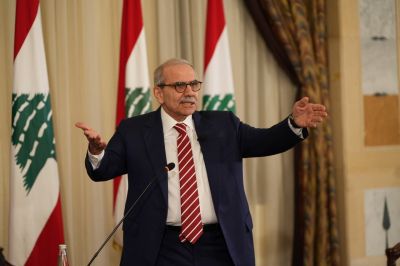
Prime Minister Nawaf Salam during an interview with L'Orient-Le Jour at the Grand Serail, on Sept. 14, 2025. (Credit: Mohammad Yassine/ L'Orient-Le Jour)






Prime Minister Nawaf Salam said in an interview on LBCI that his government is working “day and night to ensure a complete Israeli withdrawal” from Lebanon and that he “will not compromise” on the monopoly of weapons.
The interview — in which Salam also discussed the Palestinian cause and his activist past — drew wide reaction on social media, with many users praising his “honesty” while others criticized his remarks.
Salam said his Cabinet continues to seek Arab and Western support to end “the Israeli occupation and its daily attacks on Lebanon, as well as to secure the release of our detainees.”
He added, “We have reiterated our commitment to Resolution 1701 and our right, as a state, to defend ourselves. There is consensus within the government on this position.”
South Lebanon and weapons
Responding to criticism that he has neglected south Lebanon since taking office — particularly from Parliament Speaker Nabih Berri — Salam cited his visits to the region and efforts with international donors to fund reconstruction.
“How could the South not be one of my priorities when my first visit after forming the government was to that region?” he said.
“I am working hard to mobilize the necessary funds for reconstruction. If someone has a better method, let them propose it... I am not responsible for the destruction,” he added, referring to Hezbollah, which opened a front in support of Gaza from south Lebanon on Oct. 8, 2023.
Salam also emphasized his push to restore state authority “over decisions of war and peace,” saying Lebanon must have “one army, one decision and one law.”
“These are principles on which my government will not compromise,” he said, noting that he maintains “channels of communication with all parties, including Hezbollah.”
The Salam Cabinet has pledged to disarm militias, and the Lebanese Army has begun implementing its plan. So far, the army has disarmed Palestinian factions linked to Fatah inside refugee camps and partially dismantled Hezbollah’s infrastructure in southern Lebanon. However, the party still refuses to fully disarm while Israel continues its strikes and occupies positions in the South.
Threats of civil war
Salam also spoke about the challenges of working within Lebanon’s stagnant political system, hampered by what he called “the weight of old habits.”
“I am aware that change is not easy, but the country cannot recover without real transformation — deep and structural change,” he said, acknowledging “disagreements” with other senior officials.
“Cooperation continues, even when differences arise, which is natural. We’re not in the Soviet Union,” he said.
In addition to Berri’s sharp criticism of the government, moments of tension have emerged in recent months between Salam and President Joseph Aoun, notably over the appointment of the new Banque du Liban (BDL, central bank) governor and over how to address the controversy surrounding the illumination of Beirut’s Raouche rocks, in honor of late Hezbollah leader Hassan Nasrallah, at the end of September.
Salam dismissed efforts to derail the army’s disarmament plan south of the Litani River, particularly from Hezbollah figures who have warned that enforcement could provoke “civil war.”
“Everyone has been scarred by civil war, and I don’t believe anyone is ready to drag the country into a new one,” he said.
“If enforcing the law is seen as stubbornness, then yes, I am stubborn. I do not accept threats or intimidation in the name of civil war,” he added, again alluding to the Raouche affair.
The prime minister also highlighted his Cabinet’s “broad reform agenda” in the financial and economic sectors and confirmed that preparations for legislative elections, scheduled for the coming spring, are underway.
“Part of our credibility depends on holding the vote on time. We are determined to ensure the election is conducted with the highest degree of transparency and impartiality,” he said.
Salam reflected on his youth as an activist for the Palestinian cause, admitting he had “made a mistake” in his position at the time. “Many of us in my generation let our empathy for the Palestinian cause lead us to support the fedayeen’s freedom of action, to Lebanon’s detriment. We placed a burden on the country that it could not bear."
"On the other hand, those who believed Lebanon’s strength lay in its weakness were also mistaken,” he added.
“I have neither a bank, nor a militia, nor a political party," he concluded. "All I have is the people’s trust, which I cherish. Lebanon’s main problem is the loss of that trust — the deep gulf between the state and its citizens.”