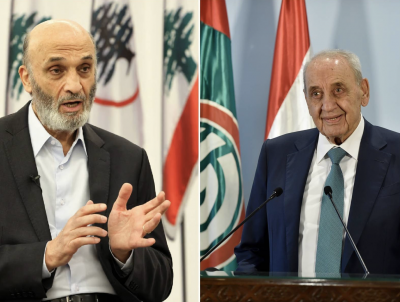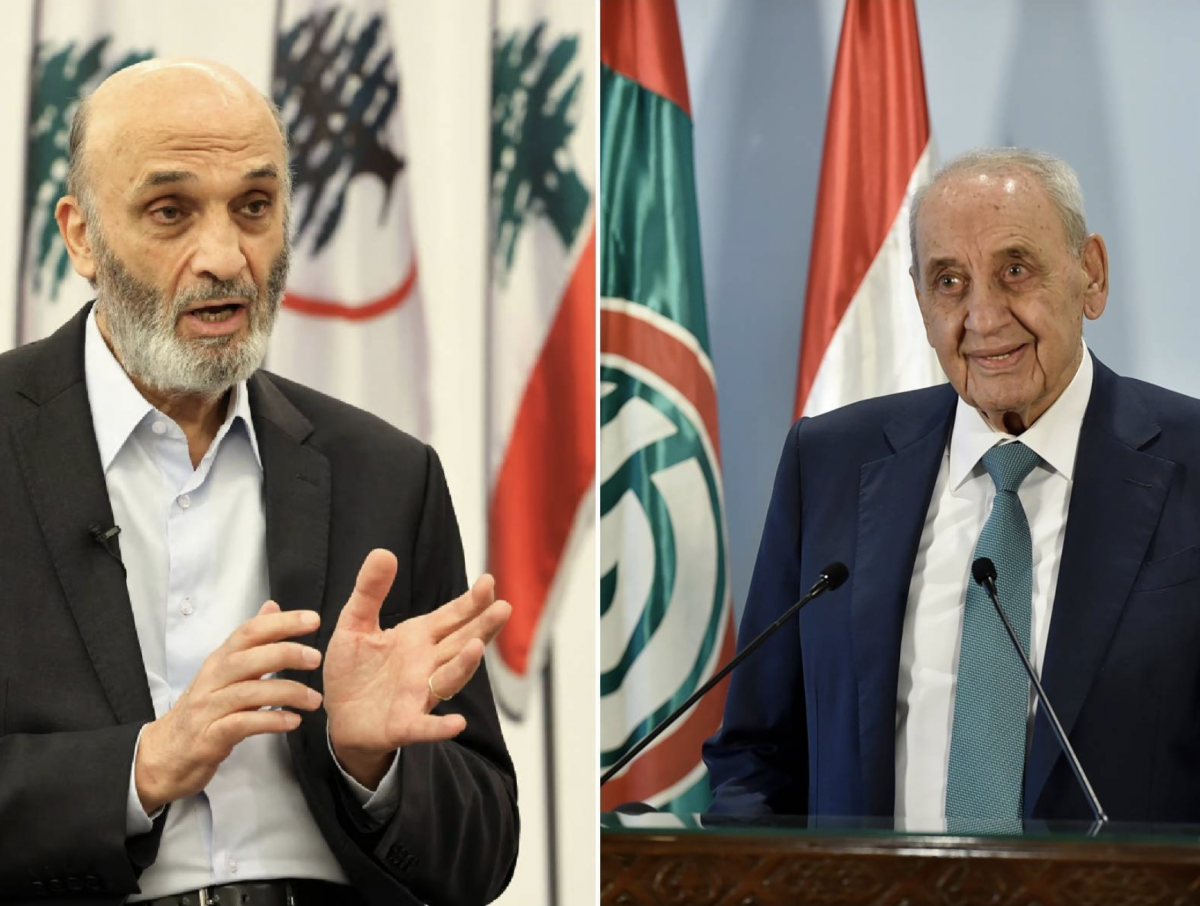
The leader of the Lebanese Forces, Samir Geagea (left), and the Speaker of Parliament, Nabih Berri. (Montage of photos by AFP and the Lebanese Parliament)






The head of the Lebanese Forces (LF), Samir Geagea, deemed “totally false” the statement by Parliament Speaker Nabih Berri on Tuesday, asserting that Hezbollah “fully respected the provisions of the cease-fire agreement,” in a statement published Wednesday and addressed to Berri.
“You say that the ‘resistance’ [Hezbollah] fully respected the provisions of the cease-fire agreement, but this claim is totally false,” Geagea asserted. “The cease-fire agreement of Nov. 27, 2024, negotiated and approved at the time by your government, headed by Nagib Mikati, clearly and explicitly stipulates, in most of its articles and especially in its preamble, the dissolution and dismantling of all illegal military organizations,” Geagea explained.
“This agreement names the authorized institutions allowed to possess legal weapons in the country, namely: the Lebanese Army, the Internal Security Forces (ISF), General Security, State Security, Customs and the municipal police. Everything else is considered illegal arms,” said the LF leader, quoting the agreement’s preamble.
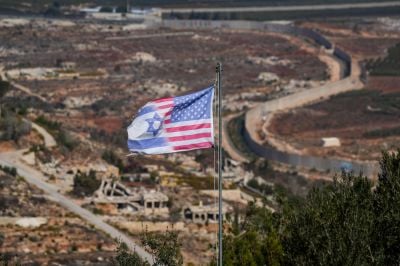
Hezbollah, for its part, believes the agreement applies only to the area south of the Litani River, which lies about thirty kilometers from the border along the coast. Berri, Hezbollah’s main political ally, stated that Hezbollah “fully respected the terms of the cease-fire agreement”, which notably calls for the dismantling of its arsenal, starting with south of the Litani, a region where the Lebanese Army was able to deploy “more than 9,000 soldiers and officers,” according to Berri. Geagea considers this information “correct, but incomplete, since Hezbollah fighters are still present south of the Litani.”
In his statement, the Christian leader declared he had “never wished to enter into a media controversy with [Berri],” but felt compelled to respond this time due to the “particular circumstances the country is going through.” Lebanon is under pressure to accelerate the disarmament of the pro-Iranian formation, as Israel is said to have decided on military escalation, arguing that Hezbollah has restored its military capabilities and rebuilt its strength.
'Hezbollah acts as a faction dependent on the Islamic Revolutionary Guard Corps [IRGC]'
The LF leader then criticized the “resistance” role claimed by Hezbollah, as highlighted by Berri. “Regarding your astonishment toward the positions of certain Lebanese actors concerning the ‘Resistance,’ the reality is that these positions reflect the majority of domestic Lebanese opinion.” He went on: “Because, while it is true that Hezbollah was able, in some very distant times, to play a resistance role, it has, on the other hand, during all other periods, acted as a faction dependent on the IGRC, serving the interests of the Iranian state, and this at the cost of thousands and thousands of Lebanese martyrs, to the detriment of the state and all Lebanese.”
Hezbollah unilaterally opened a “support front” for Gaza and Hamas on Oct. 8, 2023. The ensuing war in Lebanon resulted in more than 4,000 deaths and 16,500 wounded, according to official Lebanese figures, following the signing of the cease-fire agreement on Nov. 27, 2024. Since then, the Israeli army has continued its deadly attacks on Lebanon, killing more than 300 people, according to our count based on data from the Health Ministry and the U.N.

Geagea also addressed Berri’s remarks that negotiations with Israel, as requested by Washington and considered inevitable by President Joseph Aoun, could be conducted through the cease-fire monitoring committee (called the “Mechanism”), with possible participation from “civilian or military” experts. “You know, Mr. President [Berri], that this will change nothing, will resolve nothing, while Lebanon continues to sink ever deeper into escalation, instability and confusion,” he wrote.
The LF leader also recalled that the reconstruction of areas destroyed by the last war, especially in southern Lebanon, urgently called for by Berri, who lays the responsibility on the state, is conditioned by the international community on the disarmament of Hezbollah. “Reconstruction requires two essential elements: firstly, stability in the south, and unfortunately, we are very far from it; secondly, the availability of necessary funds, as reconstruction requires billions and billions of dollars, amounts that Lebanon does not possess and will only obtain when the Lebanese state becomes a true state, holding the sole monopoly on arms and the decision of war and peace, in deeds and not just words,” Geagea stated. The final bill for damage caused by clashes between Hezbollah and Israel, stands at $11 billion, according to a World Bank report published last March.
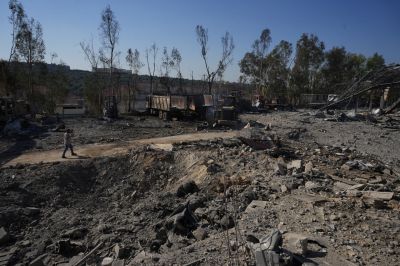
Geagea finally mentioned the first high-level meeting on reconstruction, held in Msayleh on Tuesday, aimed at “launching the process,” according to the speaker: “it will not, unfortunately, ensure stability in the South nor provide the necessary funds for reconstruction,” he concluded. The meeting was an opportunity for the Shiite tandem Hezbollah-Amal to insist on including, in the state budget for fiscal year 2026, a clause for financing reconstruction projects in the South, without which Hezbollah and Berri’s Amal movement will refuse to adopt it.