






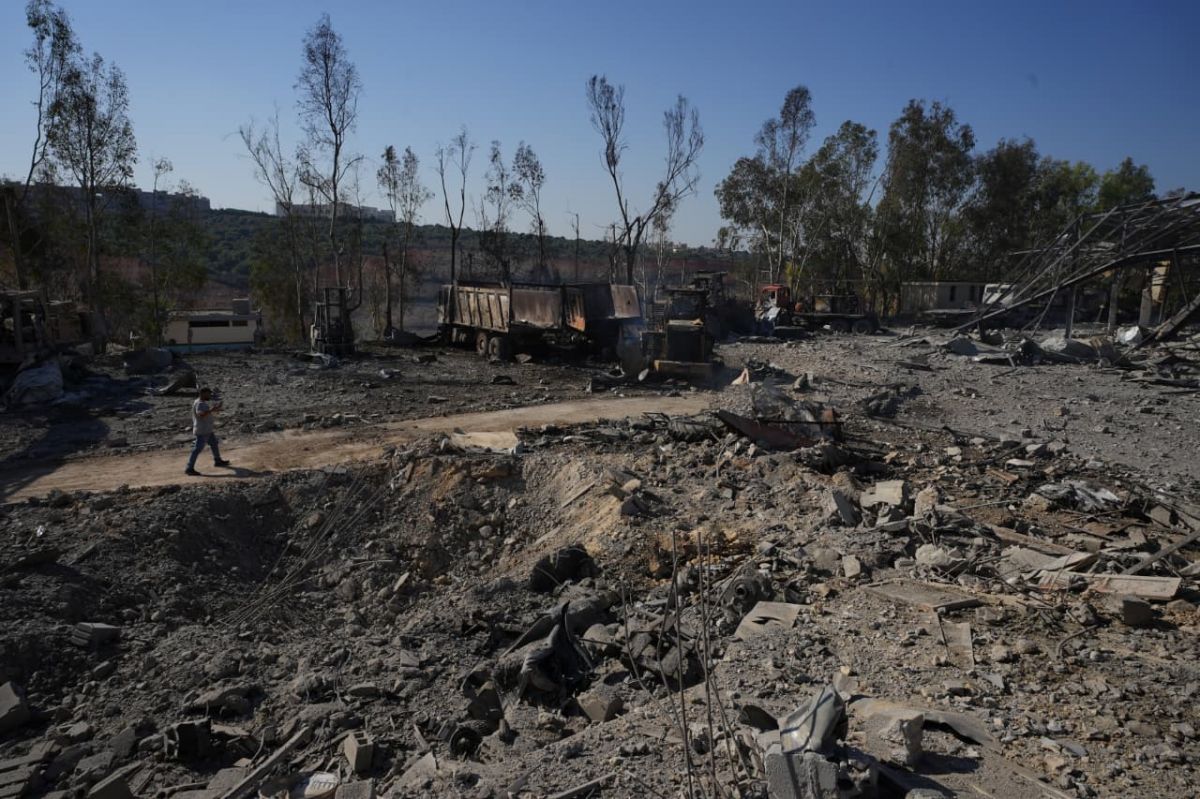
A man stands next to the rubble of a construction equipment storage site near Ansar, southern Lebanon, on Oct. 17, 2025. (Credit: Mohammad Yassin/L'Orient Today)






The first high-level meeting on the reconstruction of southern Lebanon reconstruction was held on Tuesday in Msayleh, nearly one year after the cease-fire with Israel came into effect and just weeks after Israel bombed the southern town — one strike in constant stream of attacks since the truce — destroying millions of dollars worth of construction equipment.
The meeting, which was aimed at "exchanging ideas" among stakeholders on how to proceed with reconstruction efforts, was held at the request of Prime Minister Nawaf Salam.
Parliament Speaker Nabih Berri, head of the Amal Movement, Hezbollah's ally, did not attend but did, however, comment on the event during a meeting in Ain al-Tineh, saying it marks the "beginning of the process of developing a plan" to launch reconstruction.
The occasion allowed the Amal Movement and Hezbollah to push for the 2026 state budget inclusion of a clause to fund reconstruction projects in the South — without which the political duo will not support it.
Attendees included Finance Minister Yassine Jaber, Health Minister Rakan Nasreddine, and Environment Minister Tamara Elzein — all three of whom are close to Amal and Hezbollah — along with Agriculture Minister Nizar Hani and Public Works Minister Fayez Rasamny and a number of Hezbollah and Amal MPs.
Also among the participants were representatives of the World Bank, the United Nations, UNIFIL, the Lebanese Army, the Council for Development and Reconstruction (CDR), the Council for the South, and the heads of several southern municipal councils.
Salam organized the meeting after repeated pleas for the government to begin reconstruction. The choice of location is not insignificant: Msayleh was hit on Oct. 11 by Israeli strikes that targeted and destroyed nearly 300 tractors and bulldozers. Berri is adamant that reconstruction of the South become a priority despite continuing Israeli attacks.
Speaking to participants, Hezbollah MP Hassan Fadlallah delivered firm remarks urging the authorities to include a "clear" clause on reconstruction in the 2026 budget, otherwise the finance law "would not be adopted by Parliament."
"We ask the government to allocate a budget for funding reconstruction ... we insist that this issue is given absolute priority ... while blood is being shed in the south of the country," he stressed, referring to ongoing Israeli attacks, which have killed more than 340 people since the cease-fire came into effect.
‘It's not possible to wait years’
According to a statement released by its attendees afterward, the meeting resulted in the assertion that reconstruction should accelerated via the government's ministries and the adoption of any necessary measures to facilitate the process.
Meeting members "invited Cabinet to hold a special session on the South, with the participation of all state institutions, to establish a clear mechanism for the reconstruction program."
They also insisted that reconstruction not be tied to "political and international positions." The U.S. has conditioned financial support for the devastated southern areas of Lebanon to Hezbollah's disarmament, which the Lebanese Army is currently in the process of carrying out south of the Litani. However, the U.S. and Israel have expressed dissatisfaction at the speed at which the state monopoly on arms is being implemented.
"The reconstruction file should be universal," the statement reads, "from the Bekaa to the South, passing through the southern suburbs." They also called for a broader conference to be organized with the focus of tending to southern residents' most urgent needs.
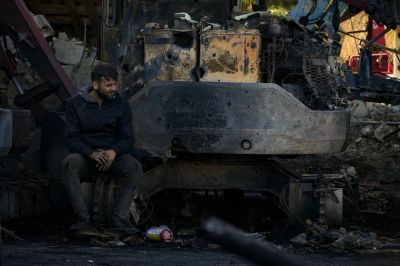
"It's not possible to wait years for compensation and reconstruction," attendees wrote, calling for a "precise timeline" that lays out the various stages of work to be done. The government should "remove obstacles related to donation and aid laws, support the displaced, and include in the annual budget a specific section for reconstruction."
Among more specific recommendations were an increase to the budgets of the Council for the South and the Higher Relieve Commitee, support for hospitals, and funding for municipalities so they have the capacities to fulfill their roles, village-by-village.
As for ongoing Israeli attacks, the meeting attendees called for some kind of guarantee "via international organizations" that a minimum level of security be maintained in the south so that the Council for the South could continue its work clearing rubble from Israel's massive bombardment campaign last year.
Jaber: Rebuilding homes requires international funding
The finance minister said that "rebuilding homes in southern Lebanon requires an international conference," calling the issue "complicated for the Treasury." "We are not skimping on funding," he said, adding that "the government is financing the Southern Council for Reconstruction."
"Despite the circumstances and the war, schools have been restored and reopened, and hospitals continue to treat people," said the finance minister, who announced that "$50 million will soon be made available to farmers through the Kafalat (agricultural loan) program."
Jaber also announced the launch of an initiative with the World Bank to assess the damage caused by Israeli bombing and begin infrastructure repairs. "Half of the World Bank's board of directors will be in Lebanon this week and will travel to the south on Saturday to assess the damage," he said.
Nasreddine: Health Ministry covering 100 percent of health-related costs from war
Finally, the health minister reiterated that his ministry continues to cover the full cost of treating the wounded from Israel's war on Lebanon. He has closed the case of those wounded in Israel's pager attack, "with all hospitals having obtained their rights."
He called for the strengthening of public hospitals, particularly in the south and the Bekaa, announcing that the Qatari and Iraqi authorities had been informed of the damage suffered by private healthcare centers.
His remarks echo those made by Berri in mid-October. The Hezbollah MP lamented that "only one initiative has been taken so far by the authorities in southern Lebanon, namely the clearing of rubble." "Yet it is the government's responsibility to manage reconstruction, especially the central issue of residents' destroyed homes," he insisted. He noted that "the government is not required to include the total amount for reconstruction in the budget, but it must at least provide clear compensation for destroyed homes so that citizens feel the government cares about reconstruction."
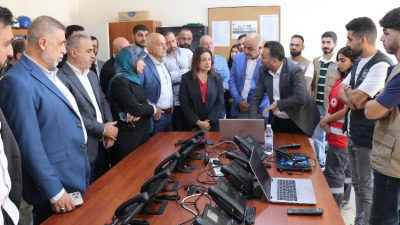
Representing the Parliament Speaker was his political ally MP Mohammad Khawaja who announced Berri's determination "to ensure the success of the reconstruction process." "Reconstruction is at the top of Berri’s priorities. The Parliament Speaker is striving to guarantee its success, and he has vowed not to rest until what has been destroyed is rebuilt," he said, adding that this initial meeting is "an opportunity to exchange ideas."
"This meeting is part of national efforts to rebuild what the Israeli war machine destroyed in Lebanon," the lawmaker added.

