


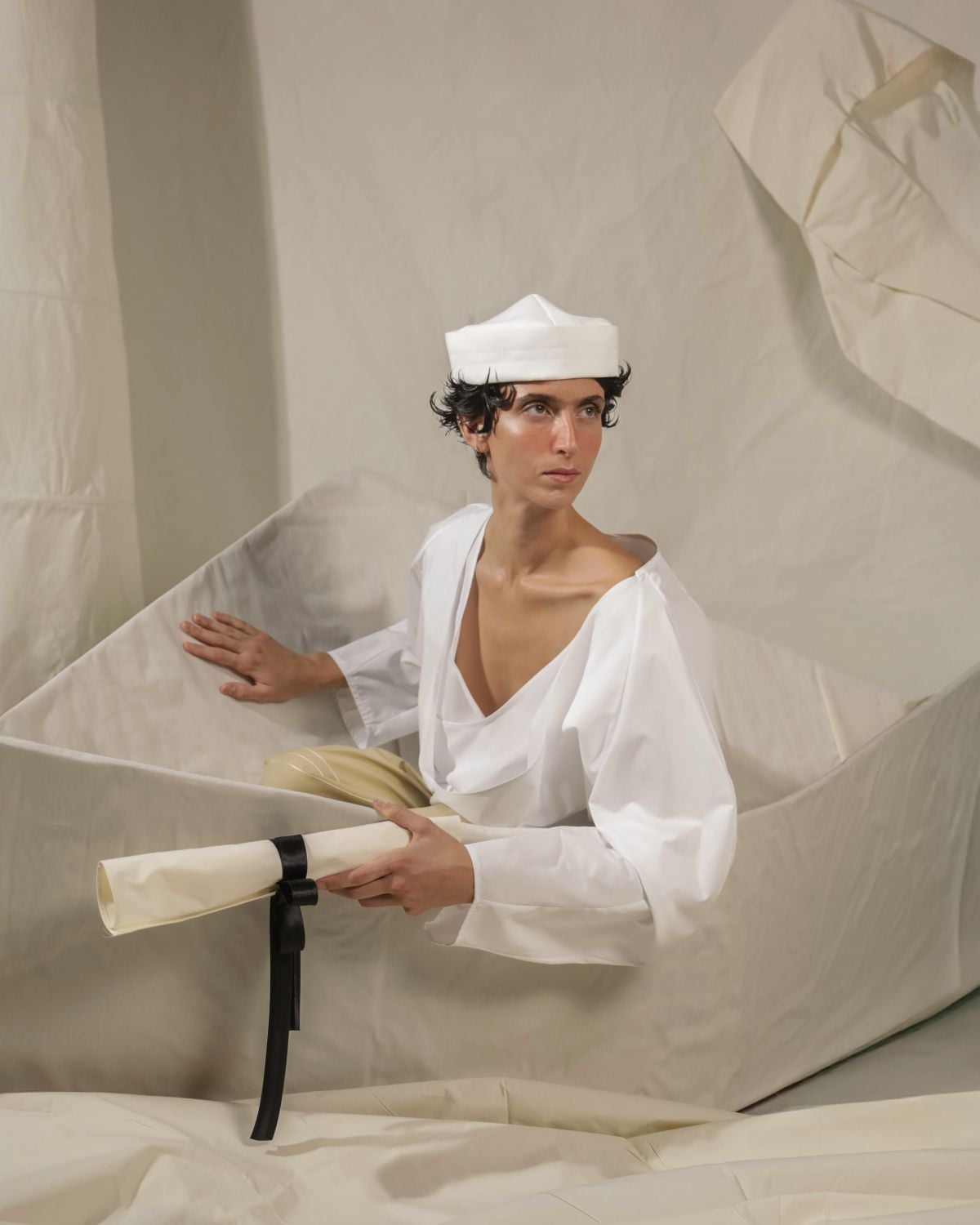
The designer's new collection, Horizon, is inspired by a song by Salwa Al Katrib. (Credit: Courtesy of Ahmad Amer)






Since his beginnings in 2017, Ahmad Amer has conceived clothing as a manifesto. His collections denounce, in turn, the abuse suffered by land, corruption, or poor governance that led to Lebanon’s collapse.
He works with deadstock fabrics, favoring upcycling and intention over frantic production. His silhouettes, fluid and ambiguous, refuse any gender assignment. For him, clothing is above all language, but also a shifting territory where everyone may find themselves — or lose themselves.
Winner of the 2023 Fashion Trust Arabia prize in the ready-to-wear category, Amer has established himself today as one of the most singular voices on the Lebanese and Arab creative scene. Trained at Creative Space Beirut — a free fashion school founded by Sarah Hermez with the help of Caroline Simonelli — he came to fashion via interior architecture, before giving in to the temptation of seeing his drawings leave the page to unfold in the movement of clothing.
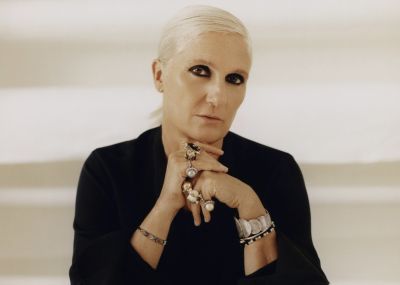
For him, sewing and line come together in the same quest, that of an artist exploring memory, loss, and the possibility of beauty in a broken world.
His new collection, Horizon, is inspired by a song by Salwa al-Katrib: Chou fi khalf el-bahr (What’s Beyond the Sea?) A poetic wandering around memory, distance, and the unknown.
For Amer, this collection is first and foremost the result of an intimate ritual: escaping to Beirut’s corniche, standing before the sea, letting his gaze dissolve into the horizon. Amid the chaos of the city, this moment is a breath, a way to survive. “It’s the place where I release my anxious thoughts into the waves and let the sea breeze soothe my soul,” he says.
The Horizon line from the Lebanese designer thus finds its source in a personal space, but it is also rooted in the collective. The sea, omnipresent in the lives of Beirutis, here becomes a confidante, a mirror, a liquid memory.

It listens, carries our stories, reflects our emotions. Many turn to it in difficult times, searching for respite, clarity, or simply a moment of silence: “Put me on a ship, let it take me to countries of light,” the song goes. Amer wanted to give form to this shared relationship with the sea because, he says, “it belongs to all of us.”
The collection translates this emotion through poetic landscapes, a marine aesthetic, and dreamlike visuals. It is almost a waking dream: the designer imagines himself turning into a fish, diving deep, seeking answers, shedding his burdens, or simply floating.
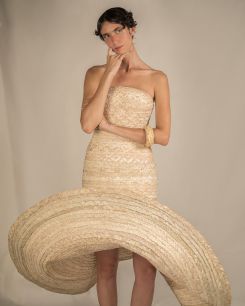
This inner journey, this meditation on fragility, healing, and the human capacity to reinvent oneself, is expressed in a palette of blue, pink, and sand. Wardrobe elements borrow their silhouettes from the vocabulary of the sea, between sailor shirts and overalls, but also from the movement of the waves in ruffled dresses echoing the wondrous ebb and flow of spray, or from sand, as in the extraordinary sheath cut from hat straw, flared like a tongue of beach beneath a parasol.
Clearly, as the lines and stitches unfold, Amer’s drawing captures its ink in the depths of human experience, where the individual is most vulnerable, where one drowns, floats, or learns to adapt to helplessness or guilt.

His creations extend this dialogue between surface and depth, between the visible and the invisible. The war in Gaza reopened an old wound in him, bringing him back to his first passion: illustration. But the line quickly became thread, and pain, embroidery. Each stitch became a prayer, each seam an attempt to mend what war tears apart. It is in this tension between beauty and injury, sea and memory, that Amer builds his work, at once anchored in reality and traversed by dreams.
Thus, his Horizon collection does not designate only the distant line where the sea meets the sky. It embodies that inner place where loss is transformed into poetry, and where, faced with the violence of the world, continuing to create is the only way to preserve one’s humanity.

 7 p.m. recap: 1 person killed near border with Lebanon; 200 kilos of explosives carried by mules; Riyadh shuts its airspace