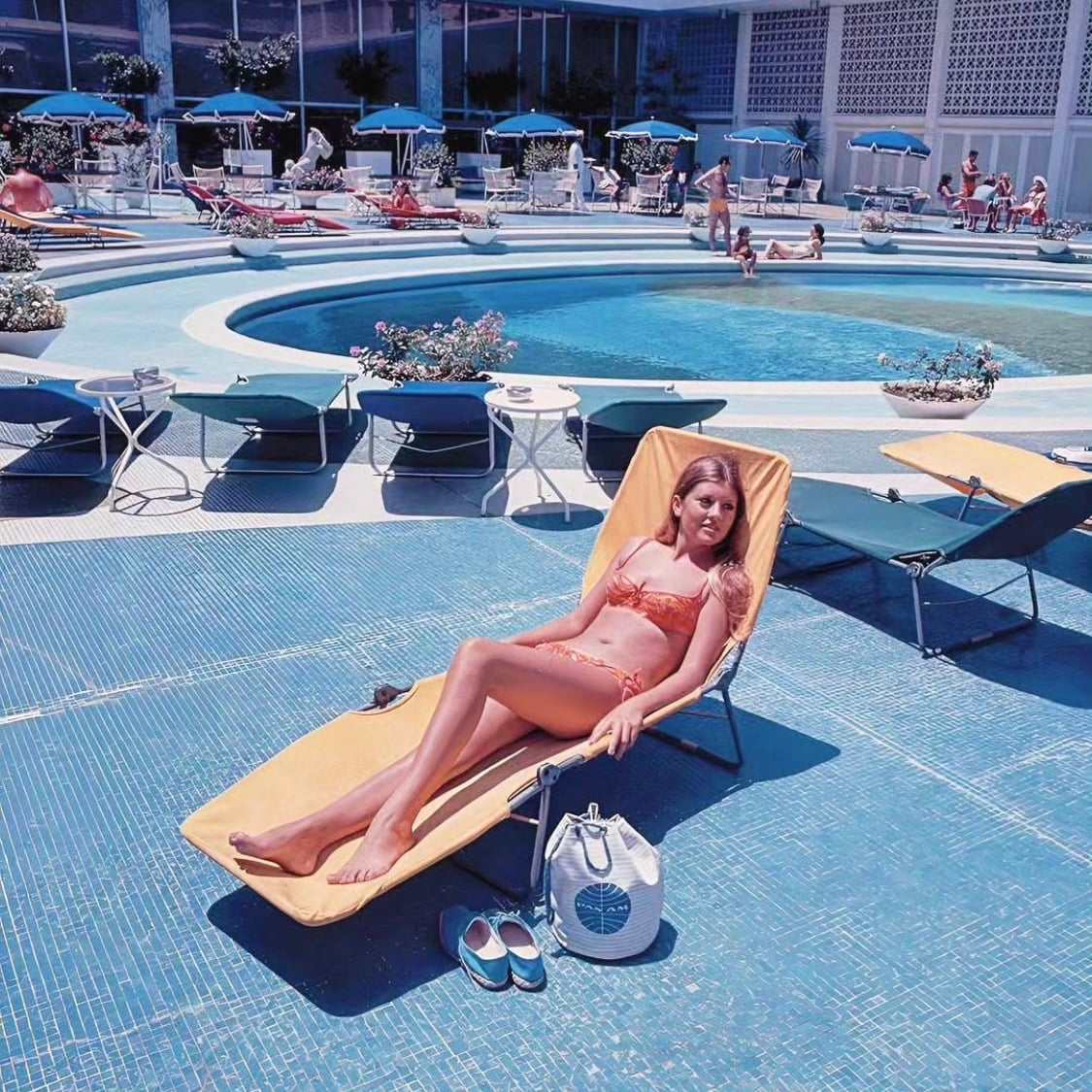
Georgina Rizk at the Phoenicia Hotel in 1971. (Credit: Instagram account @oldbeiruthlebanon)






He invites me to spend a few days with his family in the small town in southern France where he grew up.
That’s where he comes from. That’s where his family tree’s roots are planted and branch out.
That's where his parents were born, grew up, met and eventually got married.
It's also where his grandparents had built their lives.
He shows me their home, whose decor hasn't changed, where they are now growing old peacefully.
He shows me the hospital where he was born. The public school he attended was the same one his father had attended before him — both are intact, there forever.
He takes me to a seaside restaurant his family has been eating at for three generations — it hasn't changed either.
He shows me his familiar landmarks — the local PMU [betting bars in France], the bakery, the public pool, the old movie theater — all the places that make up his youth's landscape and where his parents, just like him, had made their own childhood memories.
When M., his dad, and his mom recall their memories in this little town, there’s no melancholy, regret or a glimpse of pain. To them, the past is simply a safe, preserved place — a place you can always return to because it still exists.
Nostalgia is a foreign concept to them. It’s a feeling they don’t seem to be too familiar with.
I watch them look through their family albums, talk about those places from before that M. had me discover, and I am struck by their ability to revisit the past with humor and lightness.
I’m almost impressed by the uncomplicated, easy relationship they have with the past.
It’s probably because I come from a country where we can't approach the past without awakening a wound or the gates of grief.
Lost worlds
For as long as I can remember, at every Sunday dinner, Christmas, and whenever I spent time with my grandparents or older relatives, their stories from "back in the day" were a cornerstone of our gatherings.
Their conversations always focused on the past. In fact, the past was the one who had left them behind, yet, strangely, it still lived inside them.
Thinking back in hopes of going back, they were obsessed, and it was a complicated, exhausting and painful process.
They could recall the most minor details of those days — the smell of the locker rooms at Saint-Georges, the thrill of a first joint behind a bush at Coral Beach or the feel of the seats at the Piccadilly Theater.
A sigh, an “akh” of lament, sorrow and regret would always punctuate the conversations.
They never recovered or healed from that supposed golden age.
Later, I noticed the same symptoms in my parents’ generation: nostalgia for the vague but cherished prewar era, nostalgia for the war years, which they insist were better than now, and the bitterness of the present.
For a long time, I questioned this constant grief for the past, this inability to let go and move forward that afflicted generations before us.
It was only in 2020, when the economic crisis and then Aug. 4 swallowed up the world of my youth in an instant, that I discovered what it's like to witness the disappearance of your own past for the first time, and our elders' behavior suddenly made sense.
When you’re Lebanese, this feeling isn’t just a romanticization of a bygone time, just saying “things were better back then.”
Our nostalgia contains anger, and, more than anything, a kind of disappointment that hits when you realize everything you thought was eternal vanishes before your eyes — for nothing.
What is may never be again
Over time, the Lebanese build worlds of dreams, desires and promises for a future. Every time, those visions that they had thought were untouchable faded away silently.
Maybe that is why nostalgia has felt like a responsibility to us. It's the only outlet we have to hold on to what little is left of our devastated memories.
So, when our grandparents can’t help but dive back into the past, it’s not because "things were better before. " It’s their way of resisting and reclaiming what was taken from them.
Our parents keep going over the same old stories like crucial evidence of what once was.
Successive generations of Lebanese people have been driven out of their own homes. Our photo albums, landmarks, landscapes, and faces alike fade away despite us.
What once was would always end up no more. Today, my generation knows that what is may never be again.
So all that’s left is this incurable nostalgia, preserving our memories of a home that may not exist tomorrow.
This article was translated from L'Orient-Le Jour.