





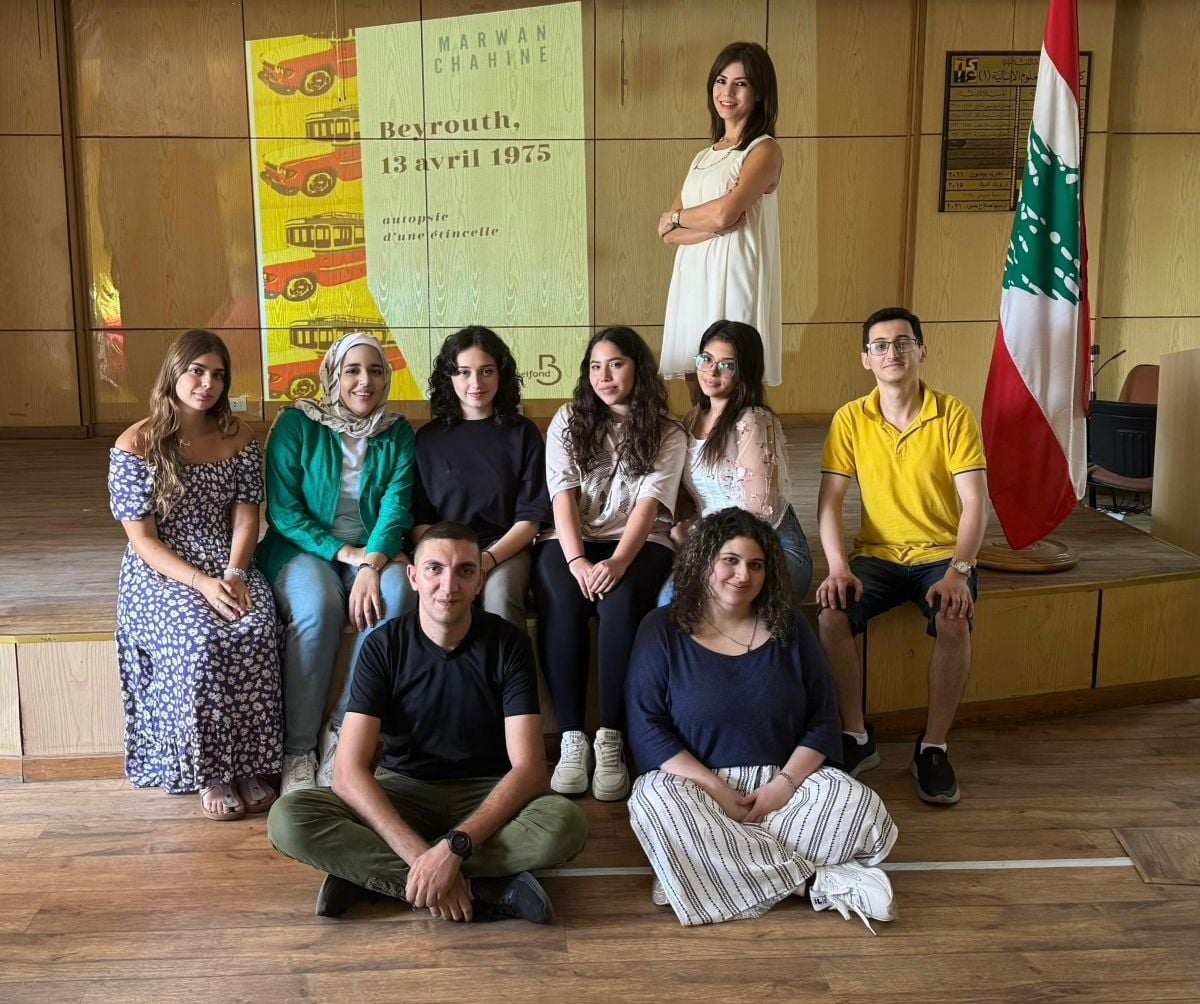
Carole Medawar and the students, from left to right, Amal Korok, Zaynab Afif, Lynn Kazan, Jana Aoun, Nour Rabaa, Georges Farah, as well as Ahmad Hamedeh and Vanessa Ghazi. (Credit: Hamid Awwad)






Touched by the "great sensitivity" of specific passages, Carole Medawar, professor of French literature at LU — who usually steers clear of historical narratives — ended up staging a performance of Marwan Chahine's “committed narrative,” author of "Beirut, April 13, 1975: Autopsy of a Spark," which lasted over an hour.
Medawar was determined to "convey the complexity of the narrative," to "transform it and bring it to life."
What started as a simple planned meeting between the author and students evolved into an adaptation of his work.
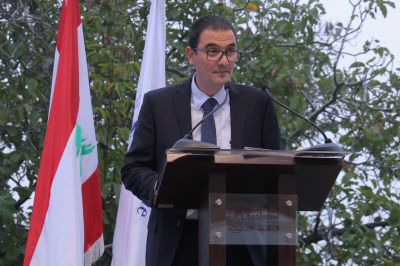
“Sensitive to the writing style,” and wishing to involve her third-year undergraduate and master's students actively, she decided to bring to the stage “the investigation that the writer conducted through the heart to reconnect with his paternal roots, as well as with the country.”
Having also experienced exile in her youth, she was intrigued by the account's focus on the origin of “this war we cannot understand,” as well as the “distorted memories.”
“Lebanon is still plagued by this endemic evil, marked by negligence, religious and political fanaticism,” says Medawar.
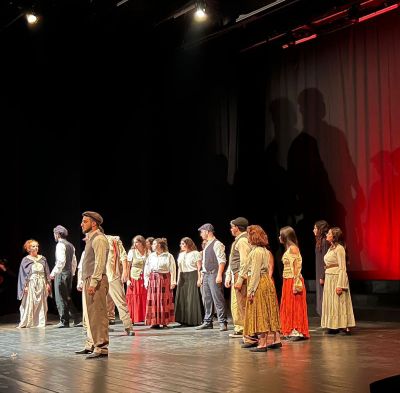
In this context, she adds that “the narrative and its adaptation call for us to break free, to liberate ourselves from what prevents us from thinking for ourselves. It’s a first step. We need to awaken the younger generation, arouse their curiosity,” so they might leave the play, “perhaps with at least the willingness to reflect on this past.”
Furthermore, the adaptation does not seek to impose any truth, according to the professor. Its aim is “to create a space for dialogue, a site of memory,” a cathartic space as well.
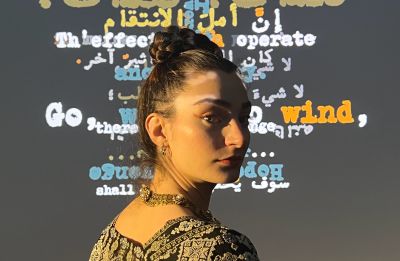
Thus, “watching this play is to heal and reflect on our wounds. We are all wounded, the new generation being touched by other wars. The play serves as a mirror to a society in constant fracture and healing, and rebuilding,” affirms Medawar.
For one of the students participating in the play, Zaynab Afif, age 26, a master's second-year student in literary studies, it is an “invitation to consider our history without complacency, to acknowledge our wounds, but also to learn tolerance.”
Finding markers in maze of conflicting accounts
To adapt a narrative of more than 500 pages, Medawar, stage director since 2004, had to “select, condense and above all, translate the rhythm and depth of the writing into theatrical language,” preserving “the humor, lyricism, irony and critical eye of the author, all within a cohesive stage structure and a plot that can captivate the audience,” explains the professor, who also teaches theater theory.
The director also relied on key passages “that give pause for thought,” in which witnesses from both sides recount the same scene from their perspective.
“These multiple viewpoints allow the audience to understand the complexity of history, the distortions and fractures of memory,” emphasizes Medawar.
Also noting the narrative's polyphony, Afif admits to perceiving a common thread: “that of a fragmented people, torn by wars but always searching for meaning, understanding and reconciliation.”
By assigning several roles to each student, Medawar enabled them “to find markers in a maze of conflicting versions,” but also “to identify with characters with whom they may not necessarily agree,” to appropriate their roles while taking a step back.
“It’s a mask that they will put on and take off, then put on another to embody a different character. Therefore, they will have a critical view of the various standpoints of the characters they play. That’s the importance of theater,” she says.
To fully embody the characters, the students had to speak with their parents — who lived through the civil war — as well as engage in research and a deep understanding of the text, in order “to capture every symbolic and emotional nuance,” as Nour Rabaa, 23, a third-year undergraduate linguistics student, states.
“I worked on the character’s language, on the words they use and how they convey their wounds and hopes.
With Dr. Carole Medawar’s help, we learned to analyze our roles as we would a literary text: in-depth, attentive to meaning and what is left unsaid,” adds the student.
Adapting the account as a restorative process
For her part, Lynn Kazan, 23, a second-year master's student in literary studies, tried to imagine the character's personality and backstory. Particularly in this narrative, “emotions play a central role in creating certain characters.
"In fact, the character I portray in one of the final scenes witnessed as a child the Ain al-Rummaneh bus tragedy, which left heavy emotional scars into adulthood. So, to embody the role, I absolutely had to imagine that moment, have empathy and try to express those emotions. Yet, I sometimes feel that this exercise is, unfortunately, not so difficult for us who have also lived through war — not the same one, surely, but the pain is similar,” confides Kazan.
She also admits that what struck her most about the characters she plays is that they “embody real lives, directly or indirectly connected to the Lebanese Civil War.”
This rekindled her empathy for these traumatized characters, “victims of atrocity and the darkness of war.”
Kazan adds that it is the burden of memories weighing on one of her characters that has stayed with her most: "This inability to escape a troubled past that, despite the years, remains forever ingrained.”
Ultimately, undertaking this project with the students has helped them change their perception of the civil war.
“This experience allowed me to move from intellectual knowledge to a sensitive understanding. Studying the civil war in a text is one thing; embodying it on stage is another. Through literary language, I could feel the pain, fear and hope of a whole generation,” says Rabaa, emphasizing the importance of “bringing literary language to life,” which can “also come through voice, gesture and performance.”
As for Afif, she considered her participation in the production not only an “artistic choice” but also “a commitment, a duty of remembrance.” For her, it is about making our past known, and “contributing so that our collective memory comes alive.”
“It’s a way of saying that, despite the divisions, our history deserves to be heard, understood and, above all, passed on, so that memory is no longer a burden, but a light that illuminates the path of tomorrow.”
This article was translated from L'Orient-Le Jour.

 7 p.m. recap: Iran warns Egypt, Israeli soldiers vote in south Lebanon, Haret Hreik responds to Kataeb