


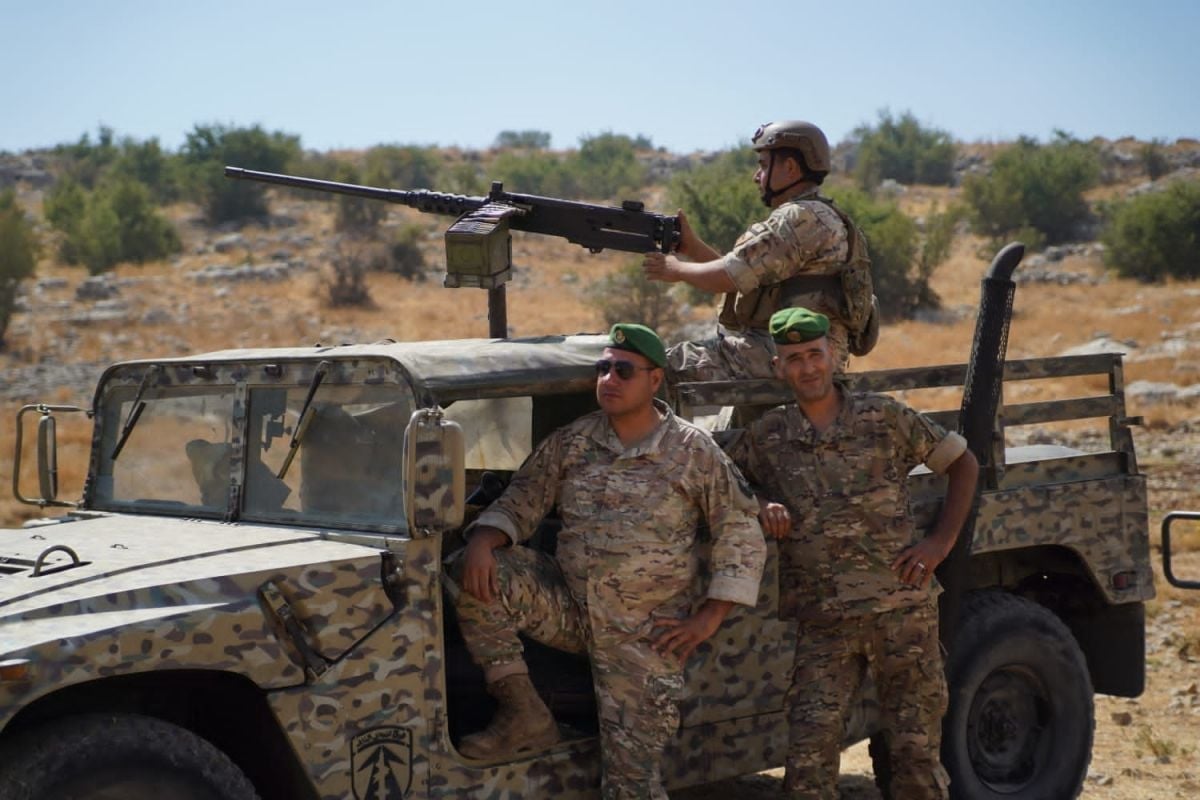
Lebanese soldiers pose in front of their vehicle in Kfar Shuba, southern Lebanon, on Aug. 26, 2023. (Credit: Mohammad Yassin/L'Orient Today)






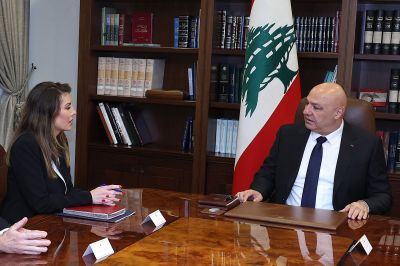
SOUTH LEBANON — U.S. envoy Morgan Ortagus, during a meeting of the cease-fire monitoring committee in southern Lebanon on Wednesday, urged the Lebanese Army to "fully implement" its plan to disarm Hezbollah.
“We continue to monitor developments in Lebanon and welcome the government’s decision to bring all weapons under state control by the end of the year,” Ortagus told the committee members. “The LAF [Lebanese Armed Forces] must now fully implement its plan.”
Later that same day, in a relatively rare incident, Israeli soldiers crossed over the Blue Line into Lebanon and shot at a Lebanese Army military vehicle. There were no injuries in the attack.
Ortagus also met with several Lebanese officials, reportedly conveying the message that the U.S. believes Lebanon should align itself with the regional dynamic, which she claimed is now focused on dialogue and negotiations.
She suggested putting in place a negotiation mechanism, either by expanding the cease-fire monitoring committee to include political figures; creating or reactivating joint commissions with civilians and not just military and technical experts (as discussed last spring); or by raising Lebanon’s representation to a diplomatic or political level.
‘Mitigating’ cease-fire violations
The committee, which is made up of representatives from Lebanon, Israel, UNIFIL, the U.S. and France, met at UNIFIL headquarters in Naqoura, the southernmost Lebanese coastal town to discuss ways in which to mitigate cease-fire violations. It was the first meeting under the leadership of U.S. General Joseph Clearfield, who took the position of committee chair earlier this month.
"Participants agreed that this issue would remain a standing item on the agenda for all future meetings, as part of the collective effort to maintain peace and enhance accountability under the cessation of hostilities agreements," a statement from the U.S. embassy reads. "The Mechanism [another name for the committee] continues to play a central role in monitoring and verifying the commitments made by Israel and Lebanon, and in contributing to their implementation."
Committee members "agreed to organize meetings more systematically," announcing that the the next four meetings would be held before the end of the year.
"Formalizing the meeting timetable guarantees convergence of all participants, keeps them fully informed, and ensures their willingness to provide transparent updates to the international community," Clearfield stated. "This approach enhances operational effectiveness and establishes the mutual trust needed to build lasting peace in Lebanon."
Israel violates the cease-fire it agreed to with Hezbollah last November on a near daily basis and has killed more than 330 people in Lebanon since the supposed truce began. Israel claims its attacks are targeting members of Hezbollah working to reconstitute the party's arsenal but more than a third of the victims have been confirmed by the U.N. to be civilians.
The cease-fire calls for Hezbollah's withdrawal from the area south of the Litani River. According to the Lebanese Army, who has been tasked with disarming the party, around 80 percent of Hezbollah's arsenal in this area has been dismantled and the army has extended its deployment throughout the territory.
“The LAF’s professionalism and commitment is notable,” Clearfield said. “I have observed them conduct a wide range of operations, from providing escorts for olive harvesting to carrying out complex operations to locate, dismantle, and neutralize an underground facility believed to be used by malign actors. Their performance reflects the strength of Lebanon’s Armed Forces and their resolve to secure their nation’s future.”
During the meeting, the embassy's statement details, the army presented the committee with a detailed operational update, highlighting in particular a recent mission to clear an underground facility near Wadi al-Azieh.
In September, Cabinet adopted a plan drawn up by the Lebanese Army (at the request of Cabinet) for disarming Hezbollah. The first stage, which involves the party's disarmament south of the Litani, is to be completed by the end of the year, while the party's country-wide disarmament does not have set timeline, but is laid out across a subsequent four stages: the area between the Litani and Awali rivers, followed by Beirut and its southern suburbs and surroundings, then the Bekaa, and then all remaining districts in Lebanon.

 7 p.m. recap: Netanyahu seeks mastermind behind Flydubai incident; Washington sanctions 2 French nationals; Ben Gvir's 'I want to kill you' threat