





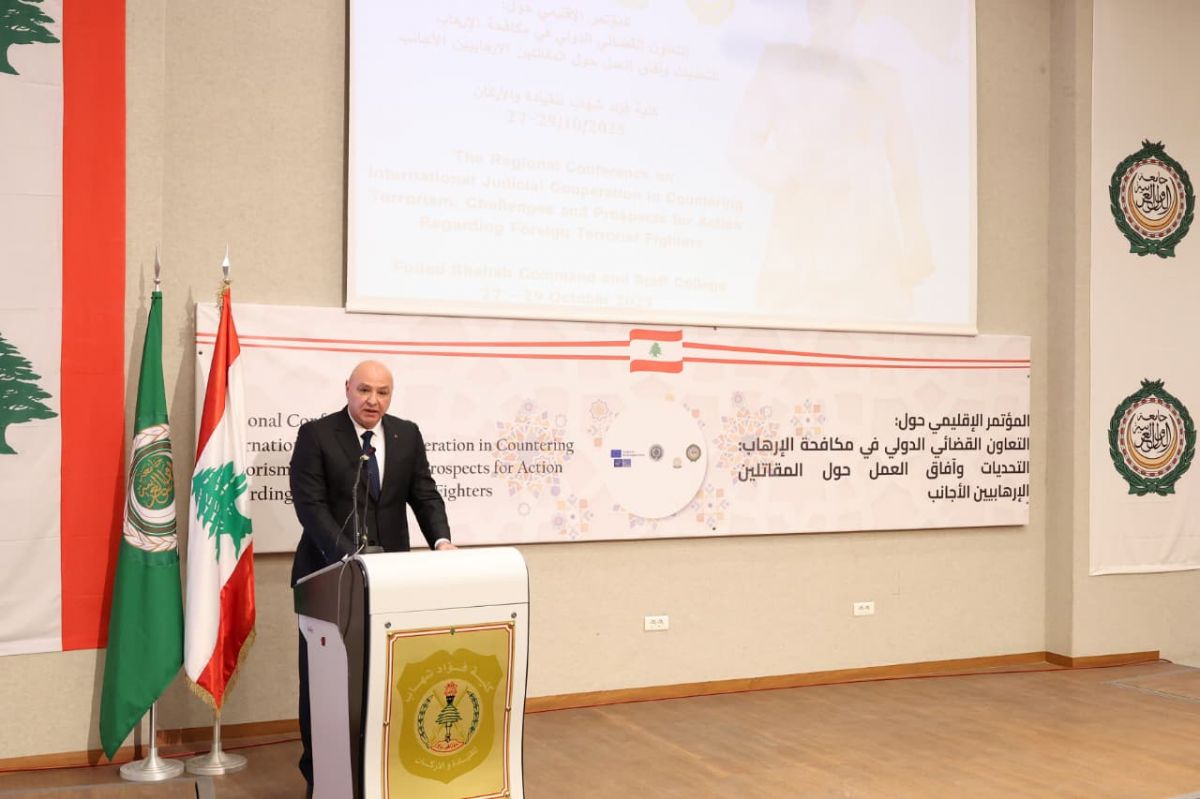
The President of the Republic, Joseph Aoun, at the conference on international judicial cooperation for the fight against terrorism, Oct. 28, 2025. (Credit: Press office of the presidency)






BEIRUT — President, Joseph Aoun, stated Tuesday that Lebanon had "defeated terrorists" every time its armed and security forces had faced them, calling for combating terrorism at its "ideological" root.
In his speech, delivered at the opening of a conference on international judicial cooperation in the fight against terrorism, the head of state affirmed that "the Lebanese Army, like all the nation's armed forces, has made enormous sacrifices in facing terrorists, we have defeated them every time."
"We have beaten them militarily, on the security front, but also ideologically, culturally, and within the community," he stressed at the event, which was also attended by the secretary-general of the Arab League, Ahmad Aboul Gheit.
Aoun was army commander during the last major battles that pitted troops in 2017 against jihadists from the al-Nusra Front (a dissident branch of al-Qaida), who had been entrenched for several years in the Qaa and Ras Baalbek highlands on the border with Syria.
These few days of fighting, as well as earlier clashes between Hezbollah and Islamic State jihadists in the hinterland of Ersal, ended with the fighters being sent to Syria in exchange for information on the location of the remains of Lebanese soldiers killed by the Islamists.

Combating perpetrators and orchestrators
Emphasizing that "nothing, absolutely nothing, justifies attacking innocent civilians" in terrorist attacks, he noted the importance of "knowing" the enemy — "its causes, its roots, its motivations, its methods, and its means," which requires increased resources.
Referring to a "complex terrorism, with groups operating across several regions and driven by extremist ideologies," he called for combatting not only the "perpetrators" of attacks but also their "orchestrators and the ideologues who manipulate them."
"It is not only about cutting off the finger that pulls the trigger, but extinguishing the idea that brainwashed someone into believing that committing an atrocity is a virtuous act," he declared.
Aoun also highlighted the "moral and intellectual responsibility of religious, community, and political leaders, who must oppose extremism within their own communities."
The head of state also praised Arab countries' efforts to develop a judicial, security and informational partnership to counter new forms of terrorism, particularly cyber and biological terrorism. He then advocated for "better institutionalization of regional and international mechanisms for information exchange, mutual legal assistance, extradition of suspects, and execution of court decisions."
During the summer, Lebanese security services increased announcements of arrests of cells suspected of connections with jihadist groups. Reports of a potential resurgence of the jihadist threat in Lebanon then fueled fears of a return to attacks.
For factions opposed to Hezbollah, the party is said to encourage such a climate as justification for refusing to disarm, at a time when its neighboring ally, the regime of Bashar al-Assad in Syria, was overthrown in December.
The latter was toppled by a coalition of forces led by Islamists during a lightning offensive led by Ahmad el-Chareh, the current interim Syrian president.
Although less present than in Syria or Iraq, the Islamic State group and other jihadist movements have fought the Lebanese Army and Hezbollah over the past decade, mainly in the north and east of Lebanon. They were largely defeated in the country in 2017.

 7 p.m. recap: Iran warns Egypt, Israeli soldiers vote in south Lebanon, Haret Hreik responds to Kataeb