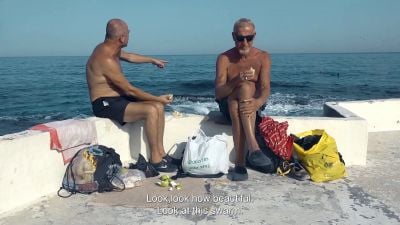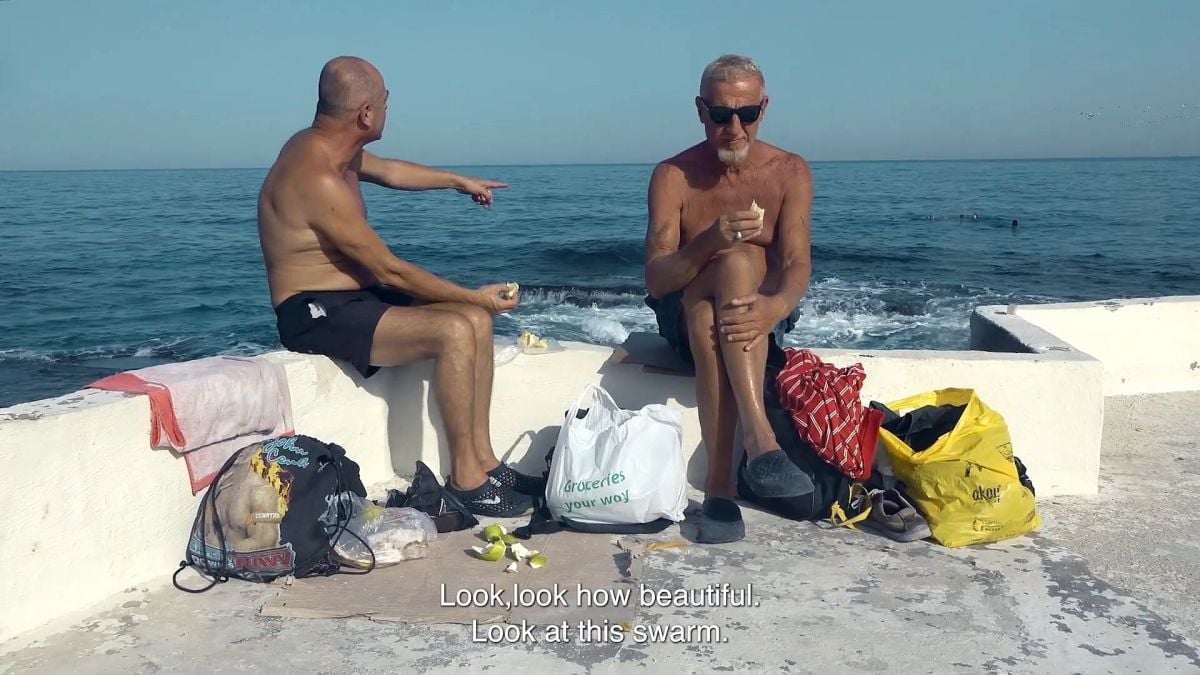
Two men on the Beirut corniche, where “And the fish fly over our heads” finds its inspiration. (Credit: Dima al-Horr/Orjouane Productions/Mareterraniu Production)






The article below is part of L’Orient Today’s selection of pieces translated from L’Orient-Le Jour’s special L’Orient des Écrivains (Writers’ edition) on Oct. 23, 2025 edition, produced for the ‘Beyrouth Livres’ Festival (annual book fair), in which the newsroom was opened to a group of writers, in partnership with the Institut français du Liban.
A city, the sea, men. The sea, men, a city. Men, a city, the sea. It works in any order, so much so does Dima al-Horr’s film fuse these three elements into a single cinematic body, a physical, mnemonic, and poetic organism — a strange alloy from which "And the Fish Fly Over Our Heads "(Arabic title: Wal asmak tatir fawka rou’ssina) draws its majestic melancholia.
Blue and fluid, captured in the flow of its folds, the sea is the film’s essence, its flesh and movement; it is there, always there, both archaic and contemporary, without beginning or end, filmed as pure matter: it is the sea of the Odyssey and of migrations, the one that swallows men and the one that saves them.
It is also a changeable sea, transformed in the crash of waves, showing another face — brutal, irascible, and powerful. Its surf steals and reveals, covers and exposes, whitens and darkens, yet always returns, embodying the motion of memory, the unveiling of recollection breaking into time. Sometimes narrative, sometimes dreamy, the Mediterranean, through the filmmaker’s eye, always works as a cypher like an ever-unfolding story.
This story is that of Beirut, discovered from the sea, a wall of gray buildings under a stormy sky.
One lands there on the flow of waves but never ventures into its inner thicket — except to follow in the footsteps of Reda, one of the film’s three protagonists. The entire film stands on this threshold, on the coastline.
In Horr’s lens, Beirut is gray, damp, gloomy — a city of great winds with the feel of an Atlantic town, especially in a beautiful tracking shot where the ground is but a long roadway reflecting black umbrellas and wild palm trees.
A city, finally, where the scars of war have left traces on the architecture and on memories — bullet holes on the façade of the Holiday Inn, the memory of a young militiaman thrown from the 26th floor, who crashed "where we are walking" — and in men’s silences. An archetype of the shore-city, a fringe-city, a border-city, condensed entirely into its legendary corniche, Horr’s Beirut stands as a "seafront" which, like any frontline, structures the fate of its men.
And the men. They have claimed this platform between city and sea, a strange, battered margin, at times desolate and at others sunlit — a bivouac of folding chairs where groups sunbathe. When the weather cools, only three remain who come daily to this concrete beach: Reda, Qassem, and Adel.
Three men who seem to be waiting for something to return, to be restored to them: their city, their country, their brother, their ruined leg, their poems, their joie de vivre.
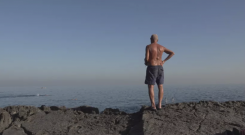
The film’s beauty lies in the voice Horr adopts to address each of them — a voice clear and true — and in her gaze, whether set at a distance or, conversely, brought up close, camera at skin level — on the freckles dotting Reda’s shoulders, on the scar on Qassem’s belly, in the wrinkles at Adel’s eyes.
She weaves these spaces and emotions together, with a mixture of gentleness and directness, never interpreting, only acknowledging.
The hero of this suspended gesture is Reda, the athletic mason whose body is faded by years, whose mere presence lets Horr "edit" two eras, and create a sense of duration: he was already there twenty years ago, at the same spot on this corniche, when the filmmaker met him for the first time.
From then on, filming this man is to resume the conversation interrupted right where it stopped, and inscribe a tragic continuity on this shore: here, time has stopped. Thus, every day, in all weather, Reda leaves Burj al-Barajneh to walk to the sea, cigarette in mouth, and the filmmaker accompanies him so attentively that she counts his steps.
Reda moves to the city’s edge as if to the world’s edge, immerses and dries himself looking at Beirut, then visits the cemetery on the way home, to the graves of his parents and his brother, the first martyr of the war. By filming this daily loop, Horr reveals the link between swimming in the sea and the memory of the dead, echoing the flow of water and that of memory.
Beside him is Qassem, who does not love the sea, nor its color, its salt, or the noise of waves. He loves the mountains, and what he once loved was writing, but his manuscript vanished when his scooter was stolen, with it inside.
Qassem has lost his words, his poem, and will write no more. Filmed from a distance, limping, disabled, he still insists on descending the corniche’s ladder with his cane to swim with Reda, after which he lies on a bench, cold. He is always cold.
Finally, there is Adel, an enigmatic character, broken by the violence of war’s images — Adel, a nurse at the hospital, who photographs himself daily to prove he exists, and dreams he is a fish, eyes open, forced to watch a story repeating itself.
A meditation on disappearance as much as on what endures and stays alive through time, "And the Fish Fly" rises above a low-tension chronicle to become a poem of a never-ending postwar, a poem dedicated to men battered by war and haunted by death, trapped in cyclic time like the movement of waves.
As often, escape comes through dream: in an extraordinary ending, dream reverses the order of the world — and against the melancholy weighing on the shore, against the inevitability of violence, it overtakes reality: the city flips upside down and fish fly in the sky.
The film "And the Fish Fly Over Our Heads" by Dima el-Horr, coproduced by Orjouane Productions and Mareterraniu Production with the support of the Red Sea Film Fund, had its world premiere at Visions du Réel (where it won the Zonta Prize). It also screened in 2025 at the Lebanese Film Festival of France, Cinemed in Montpellier, and the al-Gouna International Film Festival, which supported it via CineGouna.
Maylis de Kerangal, author, won the Prix Médicis in 2010. Latest work published: Jour de ressac (Éditions Verticales, 2024).