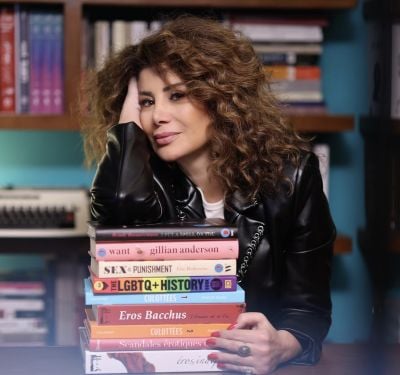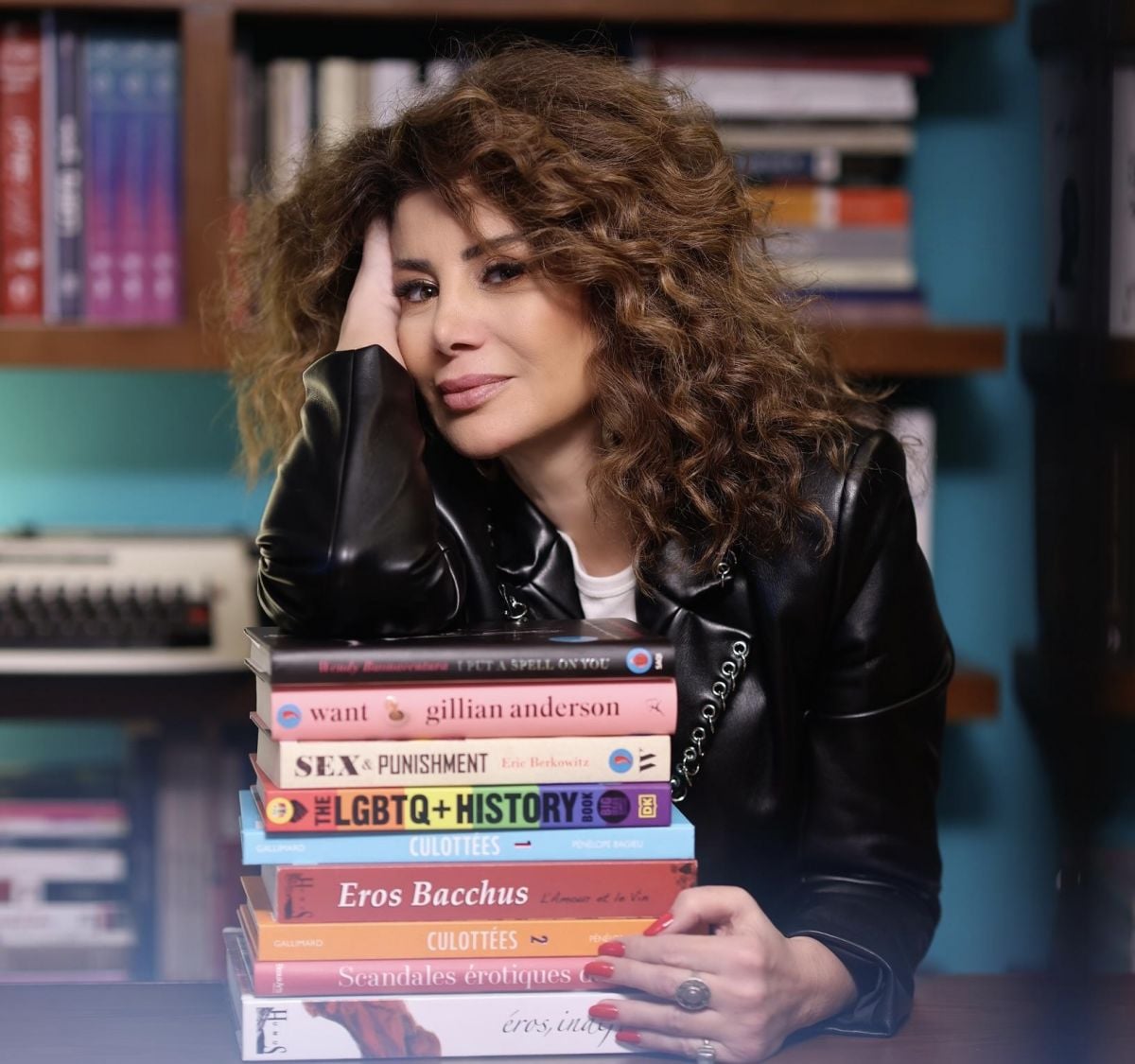
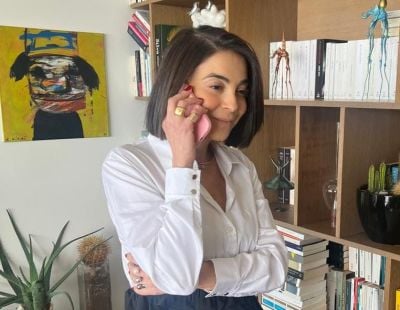
Joumana Haddad, writer and avid reader. Photo Mario Bou Monsef






The article below is part of L’Orient Today’s selection of pieces translated from L’Orient-Le Jour’s special L’Orient des Écrivains (Writers’ edition) on Oct. 23, 2025 edition, produced for the ‘Beyrouth Livres’ Festival (annual book fair), in which the newsroom was opened to a group of writers, in partnership with the Institut français du Liban.
With a hint of apprehension, I made my way to Cafébrairie 33 at the bottom of Rue Monnot to meet the owner, who, in her manifesto “I Killed Scheherazade” (Actes Sud), described herself as “an angry woman speaking to the Westerner” and “not particularly known for making life easy for others.” I was, however, quickly reassured about her peaceful intentions when I saw her arrive right on time — no excuses, as she lives just a stone’s throw away — wearing a small pair of heart-shaped glasses perched on her nose, a straw hat on her head, and her signature smile lighting up her face.
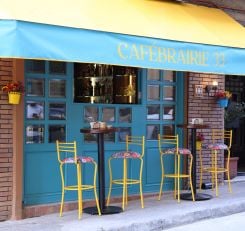
In addition to being a poet, author, and journalist, Haddad — yes, her — has just opened, together with her partner, a café-bookstore with a décor inspired by Latin American aesthetics, reflecting her personality perfectly: colorful, welcoming, warm and festive.
Yet it is far from shop windows and bookshelves that Haddad’s voice was truly forged. Her career in journalism began in 1997 at An-Nahar daily, where she worked until 2017, after she was appointed director of the cultural section in 2005.

“I learned the art of transgression,” she told L’Orient-Le Jour ten years ago, “because we live in a society where many things are often forbidden, especially if you are a woman. But I learned that there can be alternatives to which we are entitled.” This guiding principle has remained unchanged to this day.
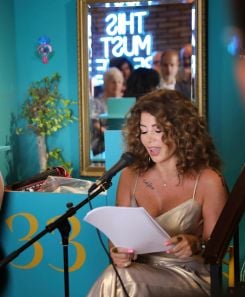
This freedom of expression is very much present today within the walls of Cafébrairie 33, where the books she selects herself reflect her ideas and struggles.
“I wanted to create a space that combines my passion for books with my love of hedonism,” she said. A quick glance at the shelves lining one of the café’s walls confirms this: essays on feminism sit alongside books on sexuality, collections of erotic poetry stand next to studies on gender.
“These are, for the most part, foundational works in my intellectual development and in my life as a woman,” she said.
This mother of two sons, now grown and pursuing their careers, describes this new space, which opened its doors in April, as her “new baby.”
“I wanted to create a place that combines my passion for books with my love of hedonism,” she said.
A quick glance at the shelves lining one of the café’s walls confirms this: essays on feminism sit alongside books on sexuality, collections of erotic poetry stand next to studies on gender and more.
“These are, for the most part, foundational books in my intellectual development and in my life as a woman,” she said.
While it was through French that she built her literary foundation, Haddad — who speaks no fewer than five languages and is preparing to teach Italian — said that she now reads more in English, though she continues to publish in all three languages.
Among her recent favorites, she mentioned authors Janet W. Hardy, Roxane Gay, Alain de Botton, and Mona Eltahawy, all of whom, of course, are available in her bookstore.
After her latest novel, “the Book of Queens,” — originally published in French, “Le livre des reines” (Actes Sud), — she has just finished two books written in Arabic: “Victim 232” (Naufal Editions), begun before the port explosion — a tragedy that shaped the ending of the main character’s story — and “Shehrazad’s will” (Naufal Editions), a sequel to the previously mentioned work.
So, what has become of her 15 years later? “I still bang my head against walls, like all women in the Arab world. Yet I do perceive changes — especially in women’s ability to make themselves heard, notably through NGOs and social media.”
She continues, moreover, to receive numerous letters from readers of all ages and backgrounds, impressed by her boldness and her refusal to shy away from taboo subjects.
A committed woman, Haddad once ran in the elections on Beirut Madinati’s list. Reflecting on what was, unfortunately, a failure at the time, the writer harbors no regrets.
“This experience — which I do not regret in the slightest, quite the opposite — allowed me to take a step back and become aware of what I can and cannot change, both individually and collectively.” Today, she describes herself as an activist of the written word.
Soon to become a grandmother, Haddad, in her fifties, who has the words “love” and “freedom” (among others!) tattooed on her arms, insists that she has “always been 16” and has no intention of stopping here.
She is currently writing a play, directed by Lina Abiad, titled “La Mama,” in Arabic and Lebanese, as well as a new novel on the theme of polygamy — which she is keen to distinguish from polyamory! — based on her childhood memories.
“I spent my vacations with my father’s family in Yaroun, in the South, and in the village, there was a man who owned a four-story building where his four wives lived, one on each floor. That’s the starting point of this story,” she says, though she did not want to reveal more.
When she’s not writing in the evenings, you can find her at her café-bookstore, where she organizes a weekly concert when she’s not dancing or singing at the top of her lungs. Yet even amid the festivities, the focus always returns to books: the coasters feature famous book covers, and the bill is presented to customers tucked inside a book. An obsession, as we told you.
Emmanuel Villin is a writer and journalist. His most recent work: Le tarbouche magique, illustrated by Zeina Abi Rached (L’École des loisirs, 2025).
This article was originally published in French in L'Orient-Le Jour and was translated by Joelle El Khoury.