





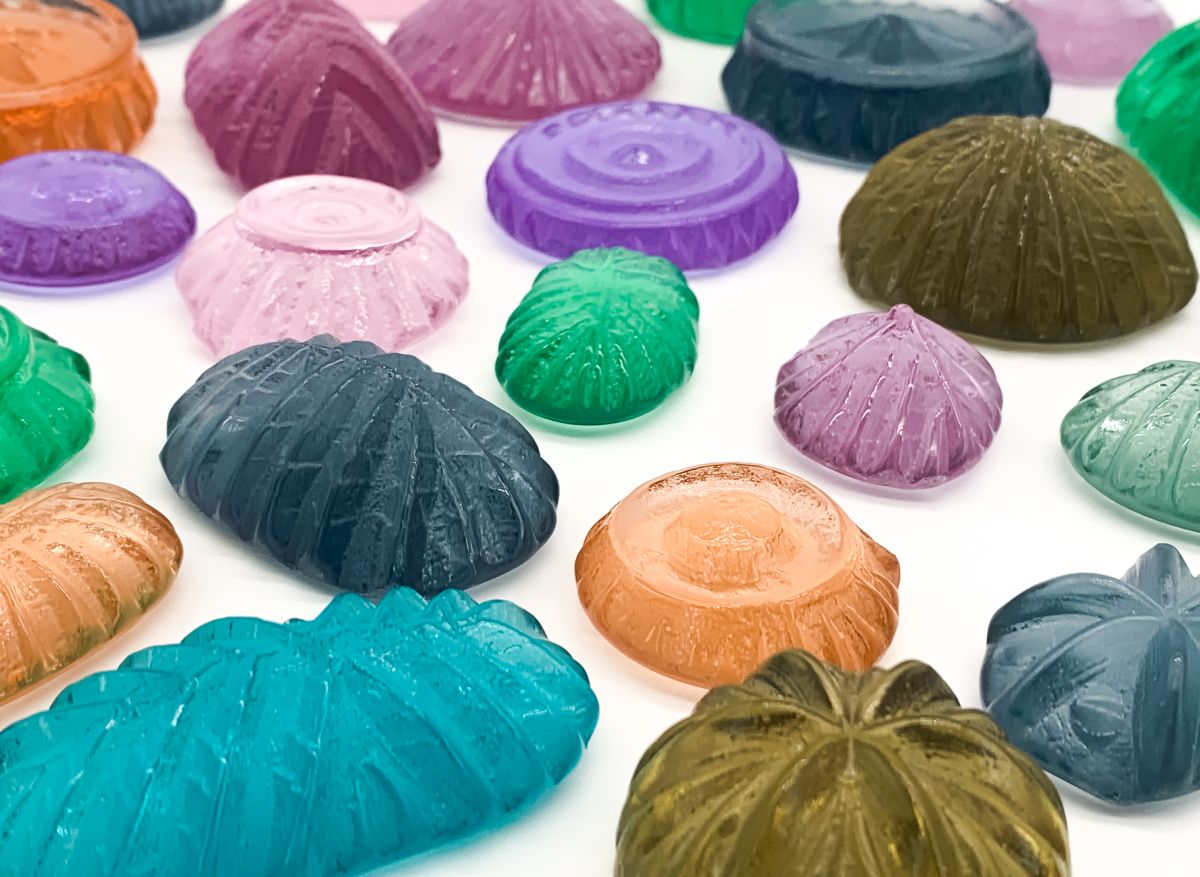
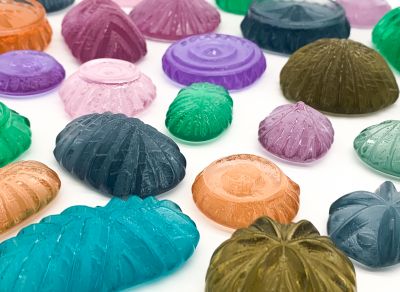
Detail of "Not Your Martyr," 2023. (Credit: Courtesy of the artist)






As part of the London Design Fair, the Victoria & Albert Museum in Kensington is displaying an iconic work by multidisciplinary artist Ramzi Mallat — who lives between London and Beirut — through Oct. 19.
"I am moved to see my work exhibited at the V&A. Creating this piece took two years; in making it, I relived the trauma of the port explosions by breaking glass, while wanting to speak about a collective experience.
"The work resonates with other contemporary pieces in the festival, but also with a museum piece by Rana Haddad and Pascal Hachem, inspired by images of glasses shattered during the explosion. My work is more metaphorical in its approach and raises the question of non-memorials in Lebanon," the young artist explains.
Previously displayed at London’s P21 Gallery in October 2023, "Not Your Martyr" offers a plastic reflection that stimulates and imagines a space for dialogue and resonance, questioning a Lebanese identity shaken by events and the difficulty of confronting the notion of memory.
"Unfortunately, I wasn’t able to show my anti-memorial in Beirut; it concerns a topic that is too controversial. The exhibition at the V&A coincides with five years since the explosions and 50 years since the civil war: It is about creating a union between these two anniversaries on an artistic level," he adds.
'I knew more about the French Revolution than about our own country'
According to Mallat, his taste for meaningful plastic art dates back to early childhood, when his parents, to keep him occupied at restaurants, would give him bread dough to play with.
"At 15, I started painting, and I had converted a room in the house into a studio. These moments were very important to me. I later went to art school in Lancaster," says the former Jamhour student, who chose higher education in England to diversify the methodological approaches in his research.
"After graduating high school in 2014, I knew more about the French Revolution than about our country! In England, I developed other critical tools for analysis, but I lacked a deeper understanding of our culture. So I returned to Lebanon in 2017 to address the dissonance between individuality and heritage, a hallmark of the post–civil war generation," explains the artist, who began exhibiting in Beirut over time, notably at UNESCO Palace and the Cervantes Institute.
A field artist, he launched a Lebanese tour, setting up with a camping stove and a rakwe (oriental coffee pot) in various places: the Bekaa, Sour, Nabatieh and Tripoli.
The idea was to offer coffee to strangers, read their fortunes and keep the swirls at the bottom of the cup, which he saved to "archive the future," aiming to "enter the country’s consciousness."
Mallat enjoys artworks that echo dates. From 2019 to 2021, he made a documentary stretching from the first day of the revolution to the first anniversary of the explosions, screened Sept. 19 at the V&A, reflecting his commitment to civil society.
'Not Your Martyr': Memory in a mold
In 2021, Mallat returned to London for a Master’s degree in sculpture at the Royal College of Art; he opened a studio and exhibits regularly, including last spring in Beirut at the Take Over gallery with "Suspended Disbelief."
"Through a reflection on the evil eye, I worked on an immersive installation combining drawings of bombed mountains in the south and little-known relics of the Nabu Museum. One has to ask who is in charge of our heritage. What is transmitted is a spiral of the unknown. The need to believe in the evil eye makes sense in a society riddled with corruption and injustice; it’s the translation of our inability to act," he laments.
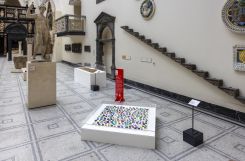
In the London medieval and Renaissance gallery, knowledgeable visitors will recognize on top of Mallat’s piece a multitude of colored and chiseled geometric shapes reminiscent of traditional maamouls [traditional Arab pastries].
After the shock of the explosion and days spent clearing rubble, Mallat went back to work. "There was so much to document, I was afraid we would no longer be able to contain our grief, and I thought of a memorial. These explosions are the first trauma my generation has lived through, after months in which we were full of hope. I wanted to create a piece that wouldn’t be politicized or co-opted, which is why I turned to our collective heritage, with maamouls, which celebrate both Christian and Muslim holidays," the sculptor explains.
"I wanted to recall the joy we have known in our country, and pay tribute to the victims without using the term 'martyr,' which instrumentalizes them. The maamoul also evokes the diaspora, who take their cuisine with them when they leave," he notes.
On an artistic level, the interplay of shapes and symbols assumes its full meaning. "These are architectural figures that evoke sea creatures, fossils, flowers, leaves, suns... They recall universality in the celebration of mourning and joy, with the necessity of remembrance," Mallat observes. The artist has traveled across the country seeking different cake molds.
"Not Your Martyr" recalls spring festivals, regeneration and its ephemeral dimension. "The flowers, these are what we offer our dead. The anti-memorial can become a tool for collective memory, one that does not reduce us to mere resilience. We are still in a state of mourning and loss; the installation allows us to formalize an action, and I hope it can be shown in Lebanon," he concludes with emotion.
This article was translated from L'Orient-Le Jour.

 Evening recap: Netanyahu announces West Bank offensive; 7 killed in Jordan church shooting; tents burned in south Lebanon
 US strike on Iran this weekend? ‘Absolutely,’ says Barrack; ‘I have no idea,’ says Trump