


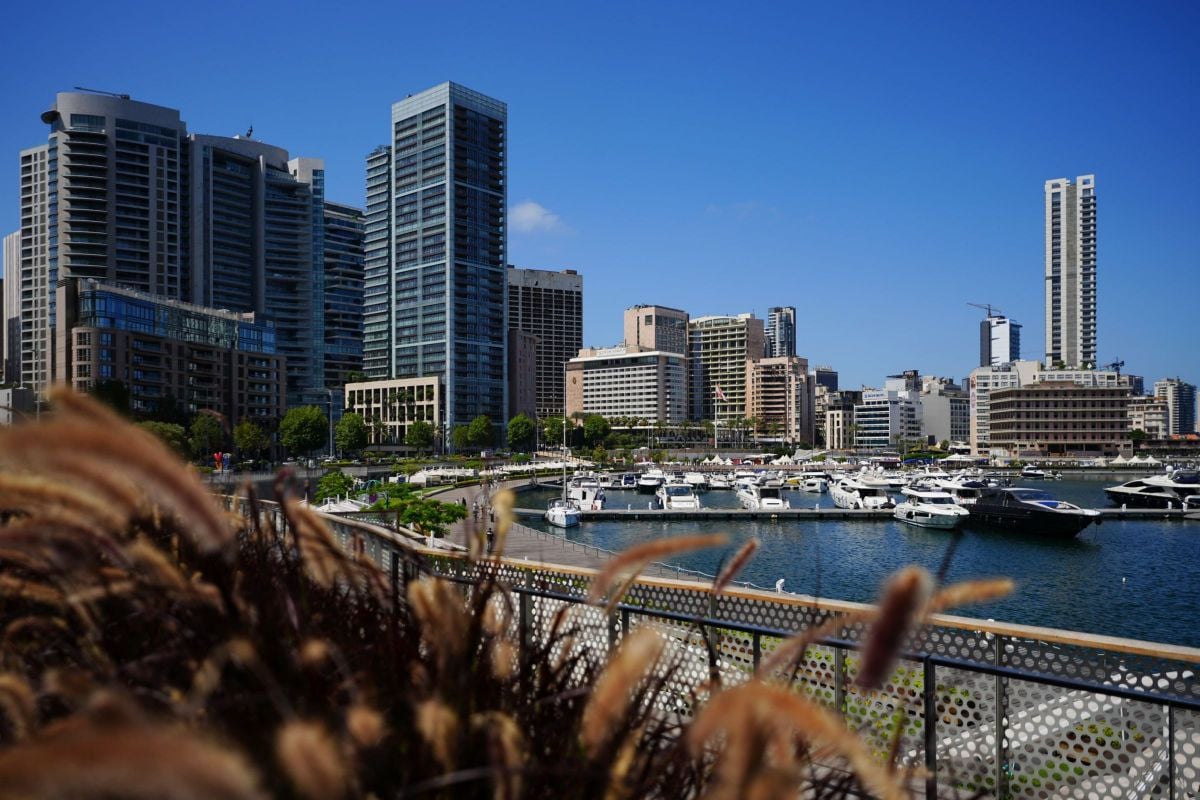
Zaytounay Bay in downtown Beirut's Ain al-Mraisseh district on July 7, 2025. (Credit: Mohammad Yassin/L’Orient Today)






The article below is part of L’Orient Today’s selection of pieces translated from L’Orient-Le Jour’s special L’Orient des Écrivains (Writers’ edition) on Oct. 23, 2025 edition, produced for the ‘Beyrouth Livres’ Festival (annual book fair), in which the newsroom was opened to a group of writers, in partnership with the Institut français du Liban.
The scale of Lebanon’s crisis has resonated around the world. The World Bank was right to classify it among the most severe financial collapses globally since the mid-19th century.
Combining three interlocking dimensions — banking, currency, and sovereign debt — the crisis continues to devastate the Lebanese economy and society six years after it began: GDP shrunk to a fraction of its former size; the banking sector is effectively paralyzed, enforcing informal capital controls that prevent depositors from accessing their dollar savings and performing only minimal lending functions; the national currency has lost over 98 percent of its value; and multidimensional poverty has exploded.
This disaster was compounded by a series of subsequent shocks — from the COVID-19 pandemic and the Beirut Port explosions to the recent war between Israel and Hezbollah.
Above all, and unlike most of the major financial crises of recent decades — such as those in Greece and Iceland beginning in 2008, or Cyprus in 2012–2013 — the severity of Lebanon’s collapse was deepened by the total absence of a political response.
Throughout much of this period, the country operated without a functioning executive authority, leaving the root causes and consequences of the crisis unaddressed and international donors unconvinced to provide the financial lifeline Lebanon so desperately needed.
The eventual restoration of political institutions — with the election of Joseph Aoun as president and the appointment of Nawaf Salam as prime minister — did send a strong signal of renewed will to adopt and implement structural reforms to set the economy back on track. Chief among these was the long-awaited overhaul of the banking system.
Yet, despite this momentum, most of these crucial reforms remain unfinished to this day.
What has happened in Lebanon is deeply rooted in the country’s specific historical and political context. Yet, the story of its crisis also carries universal lessons. It reveals, by contrast, both a model of development to be avoided and the blind alleys in economic and political practices pursued elsewhere in the world.
The latest in the BDL-IMF stalemate
Why the central bank may, once again, derail a deal with the IMF
The dead ends of an outward-looking model
In the aftermath of the 1975-90 Civil War, Lebanon largely embraced the economic path championed by the 1989 Washington Consensus, which was marked by privatization, the attraction of foreign capital, and the promotion of free trade.
As a result, the country neglected to develop its own productive and industrial specializations and entered into unbalanced trade agreements — such as the 2002 Association Agreement with the European Union — which undermined several domestic sectors, notably furniture manufacturing and agriculture.
Worse still, Lebanon’s constant need to attract a growing influx of foreign capital to offset its chronic trade deficit produced deep structural distortions.
The policy inflated a bloated financial sector — sustained by exorbitant interest rates — and fueled land and real-estate speculation, making Beirut increasingly unaffordable over time. This dynamic effectively crowded out investment in, and financing for, the country’s productive economy.
This, in particular, is where the Lebanese crisis offers a lesson for the European Union itself. More than twenty years of systematic promotion of free trade left Europe’s own economy exposed to major vulnerabilities — including the takeover of segments of its industrial base by emerging powers such as China.
In this way, Lebanon’s experience underscores the urgent need to rethink development strategies around more self-sustaining models that prioritize domestic needs and provide young people with tangible prospects, making emigration a choice rather than an escape.
The same imperative can be seen elsewhere: China, Germany, and the United States are all striving — through very different means — to restore domestic demand and internal economic activity to a central place in their growth models.

Reclaiming the notion of the common good
The economic policies pursued over the past 30 years worldwide have tended to benefit a privileged minority at the expense of the majority. Tax cuts have eroded the financing of essential public services and, in doing so, deepened inequality.
Looking back at the 2019–2020 protests in Lebanon and their aftermath, civil society repeatedly voiced its desire for genuine public services, in healthcare, education, energy supply and waste management.
Here again lies a lesson of global relevance: the need for strong public institutions as a foundation of national cohesion can no longer be postponed. The recent protests by Moroccan youth, echoing similar frustrations, reinforces this very argument.
In sum, Lebanon’s tragedy speaks volumes to the world.
It shows, first, that an economic model built on the erosion of national specializations, driven by speculation and financial deregulation, and sustained by an artificially inflated currency, has no future.
It also demonstrates that the establishment, or restoration, of robust public services is a fundamental condition for prosperity, while recalling one of the oldest lessons in economic history: unequal growth is never sustainable.
Yet perhaps the greatest lesson Lebanon offers lies in its extraordinary capacity for resilience, in the vitality of its civil society, in the ingenuity of its citizens, and in a youth capable of remarkable creativity.
Lebanon can rightfully make its own the words of poet Andrée Chedid: “Youth, listen, your dreams are not in vain.”
Thomas Porcher is an economist and professor at the Paris School of Business. His latest book is “Le vacataire” (Stock, 2025).
