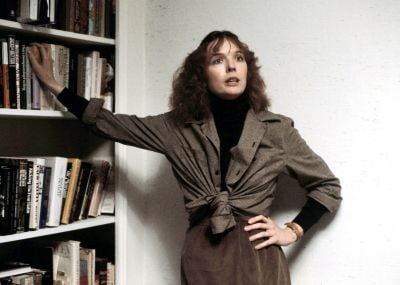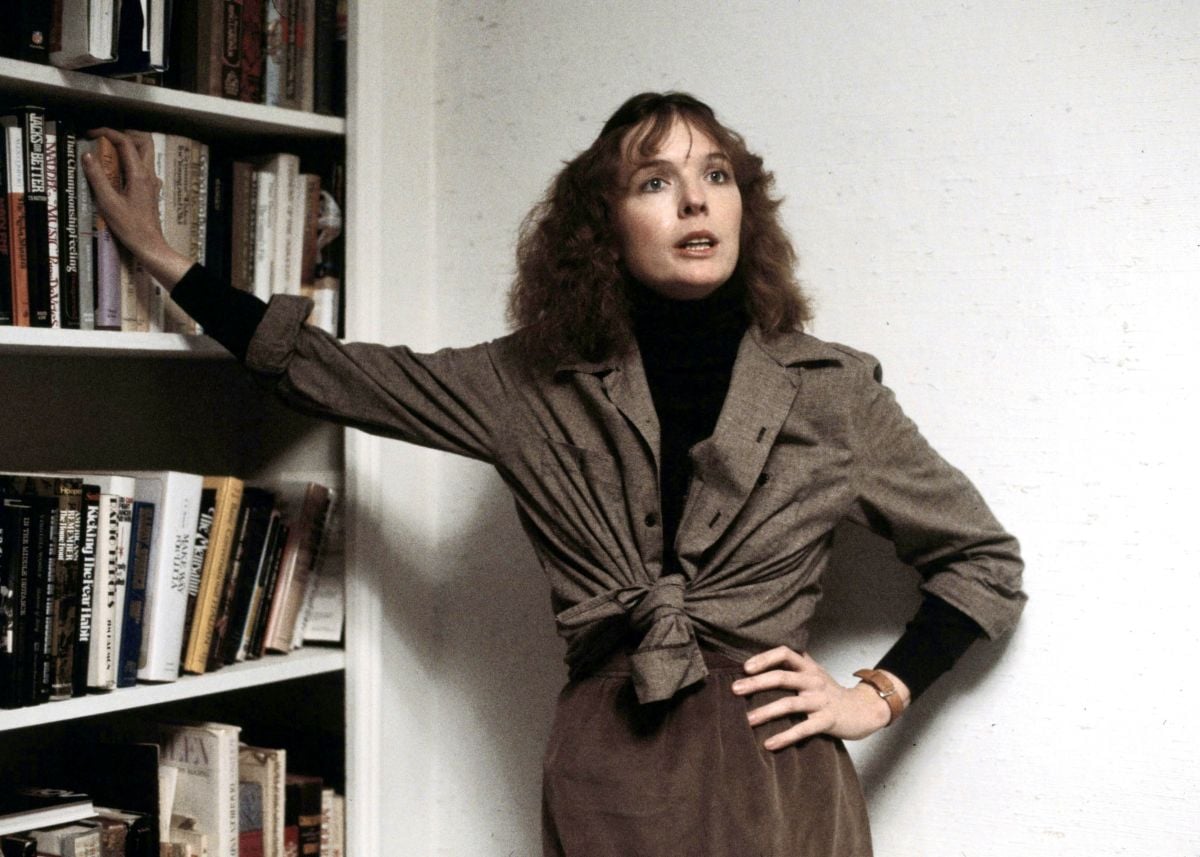
Diane Keaton in the early 1980s. Photo Reuters






In her Upper East Side apartment, a pile of scripts sits untouched, their pages blending together. After several days of seclusion, Diane Keaton stares at a torn copy of Vanity Fair featuring a lengthy piece about her past romances with Woody Allen, Al Pacino and Warren Beatty. Mustering what little energy she has, she calls her agent and says she wants to go back to the sunshine of California.
It is November 1983. Keaton, 37, has a solid career behind her and a growing desire for change.
Typecast in dramedies, the Oscar winner — who took home the award in 1978 for “Annie Hall” — is appearing less frequently on screen despite numerous offers, focusing instead on decorating her bright interiors.
“She needed a project that matched her desire to prove she could do more than neorealism,” says Angela Sakellaropoulou, a former Los Angeles Times contributor who witnessed the actor’s self-doubts. “When I interviewed her privately six months after this semi-depressive episode, she confided that one role, just one, managed to pull her out of her gloom: that of 'The Little Drummer Girl,'” the columnist recalls.
Far from the sweeping vision of Francis Ford Coppola — with whom she had already worked on the first two “Godfather” films — the most intellectual of New York’s artists accepted director George Roy Hill’s offer to play, unexpectedly, an actress known for her anti-Zionist views. At the time, Yitzhak Rabin’s government in Israel was grappling with deep budget cuts and an unprecedented economic crisis.

“It was risky to take on such a character in an ultra-tense Middle Eastern context. Everyone advised her against it, starting with her publicists and friends in the industry. All worried about the impact on her image,” Sakellaropoulou confides. She adds that many actresses had turned down the role. “The script was offered to Faye Dunaway, Jessica Lange, Sally Field, among others. All politely declined for fear of repercussions,” she notes.
All except Diane Keaton, who in March 1984 began filming yet another production full of clichés and generalizations about an already fractured Orient.
Lebanon from Bavaria
Adapted from the novel by British author John le Carré, “The Little Drummer Girl” tells the story of Charlie, a drifting 30-something woman with clear pro-Arab sympathies. Deeply involved with far-left movements in London’s 1970s underground, she is recruited by Israeli intelligence to infiltrate a Palestinian group active in Europe — only to plan to betray Tel Aviv’s orders at the last moment.
The role — which many commentators say was loosely inspired by the activism of Vanessa Redgrave — explores themes of loyalty and manipulation within a romanticized thriller.

“Let’s say it was a film of its time. Some will say Diane Keaton, like unfortunately many stars of her stature, was not fully aware of what was really happening in that part of the world,” remarks Anne Lindsey, a retired film critic. “For her, the constant presence of blood and Kalashnikovs in every scene was enough to make the story seem credible to the American public.”

Convinced she can save lives by becoming the fake accomplice — and then lover — of a high-ranking agent in Ramallah, Charlie manages to win over the Palestinian Liberation Organization (PLO) and infiltrate the group as a spy, before traveling to Beirut to attend a training camp.
But in a bloody final twist, just as she believes she can fulfill her mission and aid PLO leader Yasser Arafat’s allies, the young woman — traumatized and confronted by the scale of the Lebanese tragedy — becomes complicit in the destruction of a Palestinian camp. Shattered by the experience and marked by the Israeli manipulation she thought she could control, Charlie struggles to resume her career, engulfed by the despair of a war with no end in sight.

The film, shot largely in Bavaria, Germany and across various regions of the U.K., attempts to recreate the atmosphere of Beirut ravaged by hostilities, haunted by tanks and overshadowed by war. When director George Roy Hill tried to secure a permit through a phantom Information Ministry during President Amine Gemayel’s term, he quickly encountered insurance issues and enormous logistical costs.
“And imagine sending someone like Diane into a war zone? All the hills of Beverly Hills would have trembled,” quips Sakellaropoulou, referencing the so-called “two Oscars rule,” which in fact pushed Keaton to do everything she could to win the part.

Popularized in entertainment circles by Bette Davis, this informal — now obsolete — rule suggested that an actress needed more than one Oscar to firmly establish her reputation and gain real freedom in choosing roles. Only a handful of legends — Katharine Hepburn, Meryl Streep, Ingrid Bergman — could claim such an honor. Diane Keaton, believing “The Little Drummer Girl” would provide the dramatic turning point encouraged by her artistic circle, banked on the boldness of her unexpected performance to enter the ranks of screen immortals.
“Except that the critics were merciless — scathing, even. The press unanimously agreed the production relied too heavily on pathos at a time when armed conflicts in the Arab world interested only a few marginalized intellectuals in early Reagan-era Hollywood,” Lindsey says. The second Oscar never materialized for Keaton, despite nominations in 1997 for “Marvin’s Room” and in 2004 for “Something’s Gotta Give.”
Still, she became a silver-screen legend, recognized for her classical style and her ability to blend social engagement with satire. The muse of the controversial Woody Allen never truly took a stand on the Israeli-Palestinian conflict, declining promotional invitations to discuss Roy Hill’s now-forgotten creation in favor of the feminist comedies she produced from the late 1990s until 2024, her final film appearance.
“Diane preferred letting others speak for her instead of courting controversy,” Sakellaropoulou concludes as a well-informed spokesperson. “True legends have no need to say a word to prove their place.”
This article was originally published in French in L'Orient-Le Jour.