


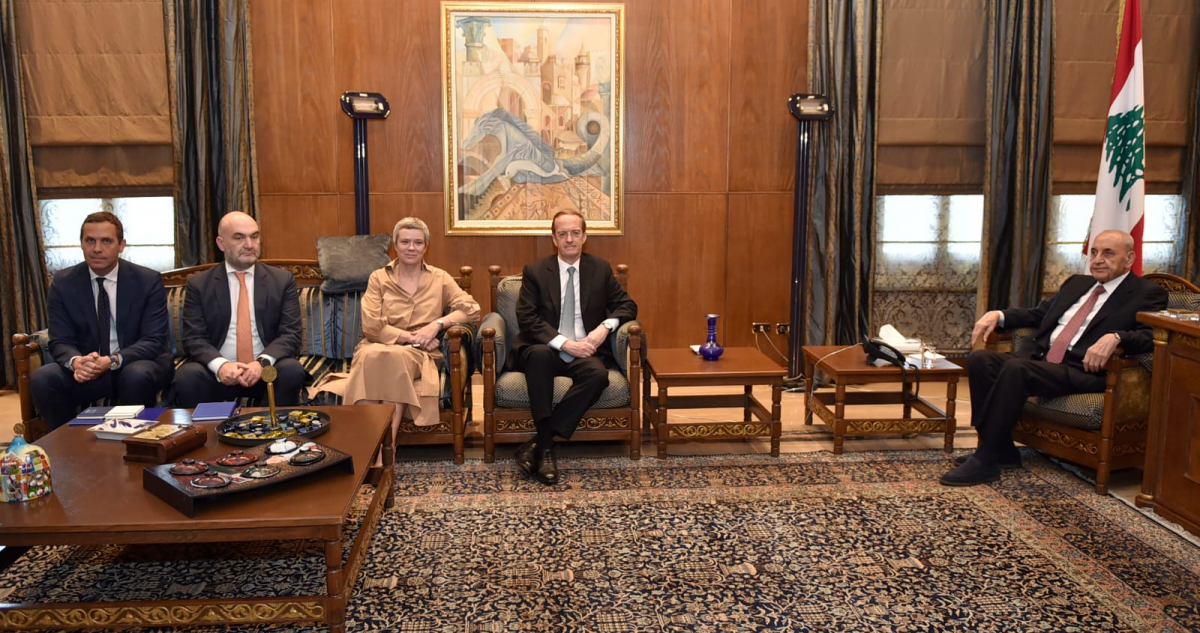
Speaker of Parliament Nabih Berri (R) meets with Deputy Secretary-General for Peace, Security and Defense at the European External Action Service Charles Fries, and an accompanying delegation, and European Union Ambassador to Lebanon Sandra De Waele. (Credit: NNA)






BEIRUT — During a meeting with the Association of Economic Journalists in Ain al-Tineh on Thursday, Parliament Speaker Nabih Berri criticized the government for "not even greeting residents of southern Lebanese border villages" when they returned home after the Hezbollah-Israel cease-fire, according to the state-run National News Agency.
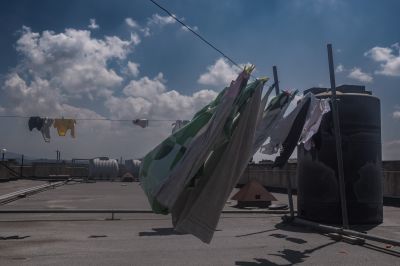
"Is it conceivable that the Lebanese government did not even say 'Hello' to the residents of the border villages — Aita al-Shaab, Kfar Kila, Houla, Yarin, Marwahin, Dhaira, Mais al-Jabal, Blida, Khiam, Yaroun, Maroun al-Ras, and all the other devastated villages — who have returned to cultivate their fields and live amid the ruins of their homes?" Berri said.
"Sadly, it is as if the South is not part of Lebanon!" he criticized. "The government, through all its ministries, must be present, at least minimally, so that the returning southerners do not feel that the South is not part of the country."
Despite a cease-fire agreement reached in late November 2024, following more than 13 months of war between Hezbollah and Israel, parts of southern Lebanon and the Bekaa Valley remain under near-daily Israeli strikes, and the Israeli army continues to occupy at least five areas in the region.
"Everyone must act in Lebanon’s interest above all. Lebanon is too small to be divided. The Lebanese people, who stood united during the Israeli aggression, proved themselves more patriotic than some of their politicians. Under no circumstances should the government link the reconstruction file to any political price," the speaker added.
Salam ‘very surprised’
Prime Minister Nawaf Salam responded to Berri’s criticism of his government, saying in a statement that he was “very surprised” by the remarks.
“I would like to remind, if this statement is accurate, that the first action I took with several of my fellow ministers — less than 48 hours after our government won Parliament’s confidence — was to visit Sour, Khiam and Nabatieh to assess the situation of our compatriots in the South and listen to them," Salam said.
"I would also like to recall that, in the absence of any external support for well-known reasons, and within the limited capacity of the state, the Social Affairs Ministry has provided monthly financial assistance to 67,000 families affected by the war and announced monthly rent stipends for 10,000 displaced families," he pointed out. "Not to mention that the Telecommunications, Public Works and Electricity ministries have begun necessary repairs to restore services in affected areas.”
Salam added that the Cabinet transferred the needed funds to the Council for the South and the Higher Relief Committee to "speed up their work."
The Cabinet has also secured a 250 million dollar loan from the World Bank to rebuild infrastructure damaged by the war. "However, the benefit of this loan remains pending Parliament’s approval of the corresponding law,” the statement added — a thinly veiled jab at Berri.
“We therefore hope that Parliament will soon resume its legislative work to approve this law and allow our residents in the South, as well as other regions affected by the war, to benefit from it," Salam added. "And as I have repeatedly said, reconstruction for me is not a promise but a commitment.”
Gaza peace deal
Berri also commented on the first phase of the Gaza peace agreement, saying: “We will be happy if the genocidal war that the Palestinian people have endured for two years in the Gaza Strip comes to an end.”
However, he stressed the need to be cautious about "Israel’s potential reversal of the agreement," noting: “Israel has always accustomed us to violating every agreement and commitment it has made, the latest being the cease-fire agreement with Lebanon last November."
“Since Nov. 27, 2024, the resistance has not fired a single shot, while Israel, instead of withdrawing, releasing prisoners, and halting its aggression, has occupied new areas and destroyed entire villages,” he added.
Berri asked: “What comes after Gaza? The answer must certainly be to move toward Lebanon to implement the agreement that was reached and for the international community, especially the countries that sponsored the cease-fire agreement, to assume their responsibility in compelling Israel to fulfill its obligations."
Berri added that there can be no economic recovery in Lebanon while the situation in the South "remains as it is."
Parliamentary elections
Berri also commented on the electoral law of the parliamentary elections, which are scheduled to take place next year if not postponed: "Some look at this law as though it were a woman who fell in love with a man, married him, and the next day asked for a divorce. Those who made this law and insisted on it now don’t want it."
He reiterated that the elections "must be held on time" according to the current law in effect, passed in 2017.

The debate over the electoral law, especially concerning the voting rights of Lebanese abroad, continues to divide political actors and stokes fears of a possible postponement of the polls. The bloc opposed to Hezbollah is pushing to amend the 2017 law to allow expatriates to vote for all 128 MPs. Conversely, the Hezbollah-Amal alliance and the Free Patriotic Movement (FPM) want to maintain Article 112 as is, limiting diaspora representation to just six MPs.
"I confirm that we are against any extension [of the parliament's mandate]," Berri said.
As for his relationship with the president, the prime minister and other political figures, Berri said, “My relations with everyone are good, and my relationship with the president of the republic is excellent.”
He added, “Is it reasonable that the issue of Raouche Rock has sparked and continues to spark more debate than the reconstruction file has attracted attention?”
Salam had taken a strong position after the illumination of the Raouche Rock by the Hezbollah-affiliated NGO Rissalat, in an event previously banned by the Beirut governor, to mark the Sept. 27 commemoration of Hezbollah leader Hassan Nasrallah's assassination by Israel.
Finally, regarding the 2026 budget, Berri said that he has not reviewed it yet, but he stressed that this "budget will not pass unless it includes a clear clause related to reconstruction.”
Berri also received in Ain al-Tineh on Thursday Deputy Secretary-General for Peace, Security and Defense at the European External Action Service Charles Fries and the accompanying delegation, in the presence of European Union Ambassador to Lebanon Sandra De Waele. The meeting reviewed developments in Lebanon and the region, as well as the latest political and field updates.

 1 p.m. recap: Salam in Nabatieh; up to 10,000 more US troops heading to Middle East