


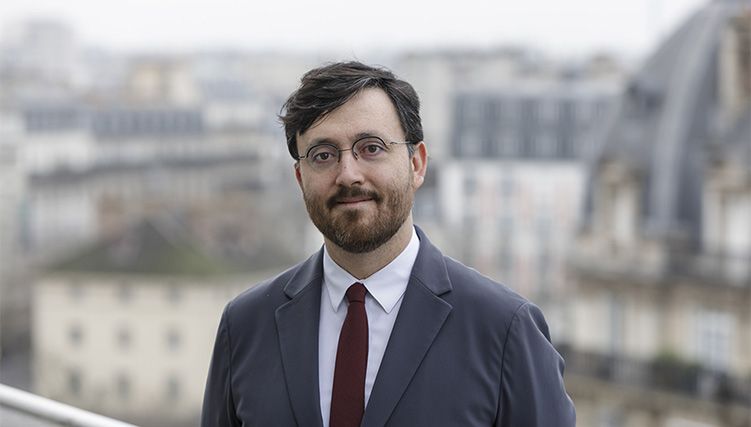
The president of the National Center of Cinema (CNC) in France, Gaëtan Bruel. (Credit: CNC)






Fourteen years ago, it was just a detour from Damascus. Then a student at the École Normale Supérieure, Gaëtan Bruel left Syria as the situation deteriorated and spent two weekends in Beirut. From that short stay, he recalls a city that felt light, almost carefree — in contrast to the tragic images often associated with Lebanon.
Now he returns as president of France’s Centre National du Cinéma et de l’Image Animée (French National Centre of Cinema, CNC), for an official visit that will also take him to Damascus. Between personal memory and public roadmap, his message is clear: cinema is not just a victim. It can — and must — be part of the solution.
Bruel does not come from the film industry, and he says so openly. His career has zigzagged through four ministries (Defense, Culture, Foreign Affairs, Education), cabinet roles (speechwriter, then chief of staff), and cultural leadership posts, including overseeing the Arc de Triomphe and the Panthéon and leading French cultural services in the United States. The common thread is culture.
At the Defense Ministry, he launched a cinema initiative, including support for the hit series Le Bureau des Légendes. In the United States, he founded Villa Albertine, with cinema as its first supported discipline. At the Education Ministry, he worked on arts education — from theater in schools to visual arts and cinema.
His passion for film began at 14, when a documentary by Nicolas Philibert introduced him to auteur cinema. Seven months into his role at the CNC, he says his job is not to impose personal tastes but to address the challenges facing cinema and audiovisual creation.
A crisis that is economic and civilizational
Between 2019 and 2024, global movie theater attendance fell about 40 percent, from 8 billion to 4.8 billion admissions. France weathered the drop better (about minus 15 percent, compared to nearly minus 60 percent in South Korea), but 2025 has started slowly. In Lebanon, however, trends appear to be improving compared to last year.
Bruel sees both short-term causes (Hollywood strikes, supply, timing) and deeper ones (competition from streaming and the omnipresent smartphone among youth). For him, the stakes extend beyond cinema — to health, the economy and democracy. Once a tool for opening minds, moving images on social networks have become a lever for isolation and manipulation.
His answer: media literacy. “We have never spent so much time in front of screens, and so little time in front of works of art. Cinema restores a more demanding relationship with images and brings people together — a neighborhood around its theater, a country around a film.”
Artificial intelligence, he warns, is primarily a financial challenge — producing more, faster and cheaper — before it is an aesthetic one. Without a cultural policy, it risks normalizing standardized content.
A model in France, a start in Lebanon
In France, the program Ma classe au cinéma has existed for 40 years, taking students from kindergarten to high school to theaters during school hours, with classroom resources for follow-up. Today it involves 80,000 teachers and 2 million students, generating over 5 million admissions annually. Its impact is proven, especially among younger children, but it reaches only about 15 percent of students. The CNC’s aim is to double that reach to 4 million students and 10 million tickets.
In Lebanon, a similar program, Tous au cinéma, launched by the Institut Français du Liban, Metropolis, and the Agency for French Education Abroad, has already brought 13,000 students to theaters in a few months, with another 19,000 slots opening. The model is inclusive and pragmatic: school screenings in the morning, a time slot that both engages youth and helps theaters financially.
'Lebanese cinema never died'
Bruel rejects the idea of a “resurrection” of Lebanese cinema: “Lebanese cinema never ceased being alive; it was support that was lacking.” The challenge today, he says, is its rediscovery by Lebanese audiences.
In a small, Beirut-focused market of about 1.3 million admissions last year, Bruel sees strategy working on three levels: offering everything from blockbusters to low-budget films, supporting theaters through public-private partnerships, and promoting media literacy to rebuild moviegoing habits.
He praised Lebanese producers’ resilience in the face of inflation and cash shortages, and noted the roles of AFAC, Aflamuna, the Network of Arab Alternative Screens (NAS), and local festivals. But he also pointed out a paradox: “It is easier to see a Lebanese film in Paris than in Beirut.” His solution: more dedicated screenings and cycles, support for independent theaters, and expansion beyond the capital.
Backing Salameh
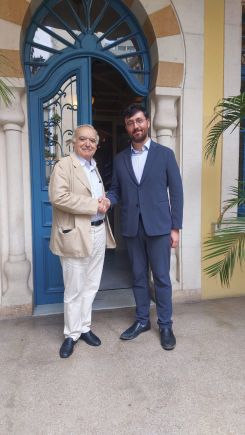
For Bruel, the method rests on three verbs: “Listen, align, act quickly.” He voiced explicit support for Culture Minister Ghassan Salameh, calling his appointment a “window of opportunity.”
“The state is back,” he said. “It’s up to us to be by its side, not speak for stakeholders.” He promised concrete results “in the coming weeks” alongside the French Embassy and CNC to support the ministry’s roadmap.
Funding remains an issue. France already provides access to its Aid for World Cinema, but Bruel said this support is not enough. The goal is a sustainable financing instrument in Lebanon, combined with producer empowerment — training, mobility, expertise and targeted funding.
As for distribution, Bruel dismissed the idea of opposing theaters and streaming platforms: “Not necessarily. The real adversaries are free platforms like YouTube, TikTok and Twitch, which monopolize attention — and piracy.” He noted that in France, regular moviegoers are also heavy streaming subscribers, showing opportunities for alliances to defend “premium” creation.
Still, theaters need protection. France enforces a four-month exclusivity window for cinema releases before they can move to platforms, compared with 30–45 days in the United States and none in Spain. “Protection is not enough,” he added. “We must invest proactively in audience development and media literacy.”
A broader vision
Bruel pointed to history: after World War II, France built a model combining cultural sovereignty and diversity, rooted in the 1946 creation of the CNC. “It’s not about closing off, but about guaranteeing plurality,” he said. He warned of an imbalance today, with American films holding 60 percent of Europe’s market share, while European films represent only about 1 percent of the U.S. market. In that context, he said, Lebanon and Arab cinema play a key role: preserving heritage, supporting talent, and uniting audiences.
On the production side, Bruel noted that France has doubled its studio and technical capacity in five years, thanks to tax incentives and France 2030. But, he added, “The goal isn’t attraction at any cost, but a sustainable model where the local ecosystem remains active.”
For Lebanon, the priority is not promoting French cinema but strengthening Lebanese cinema inside the country: reviving moviegoing, supporting independents, expanding access beyond Beirut, and elevating media literacy as a cultural and economic priority.
“Cinema isn’t just a victim,” Bruel said. “It’s part of the solution. In Lebanon as in France, that long-term policy has to start now.”
 1 p.m. recap: 3 injured in Houthi attacks on Saudi airports; Katz threatens Gaza ahead of Oct. 7 anniversary