


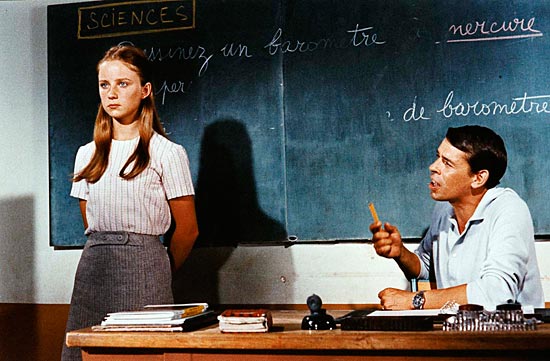
Delphine Desyeux and Jacques Brel in the film "Les risques du métier." (Credit: Gaumont)






Where the gavel meets the lens, the "Justice and Cinema" festival explores how film can question, reflect, and even reshape our understanding of justice.
Reina Sfeir, event coordinator for the Justice Ministry, details the program for the “Justice and Cinema” festival, which features both classics of French cinema and Lebanese works: "Les Risques du métier" ('Risks of the job') by André Cayatte (1967) presented Monday, Sept. 29 at 7 p.m. at Metropolis, followed by a discussion with Adel Nassar (Justice Minister) and Georges Schoucair (film producer), "Un crime" ('A crime') by Jacques Deray (1993), Monday, Oct. 6 at 7 p.m. at Metropolis, followed by a debate with Hervé Lecuyer (professor of private law) and Myriam Sassine (film producer), "12 Angry Lebanese" by Zeina Daccache (2009) Monday, Oct. 13 at 7 p.m., at the Montaigne cinema, Institut français du Liban, discussion with Zeina Daccache (director, actress and drama therapist) and former inmates, "Le Président" by Henri Verneuil (1961) Monday, Oct. 20 at 7 p.m., at the Montaigne cinema, Institut français du Liban, debate with Adel Nassar and Bechara Mouzannar (producer and director).
L'Orient Today: The “Justice and Cinema” festival was initiated by whom exactly, and how is the Minister of Justice concretely involved in this project that bridges culture and judicial institutions?
Reina Sfeir: The “Justice and Cinema” festival was born of a joint initiative by the Justice Ministry and the Institut français du Liban, in partnership with Metropolis. The idea was to create a space where culture and law intersect, to make justice more accessible and understandable to the general public.
When justice steps out of the courts and into the light of cinema, it regains the face of the citizen.
Justice Minister Adel Nassar is not simply the festival's patron — he is one of its architects. He has supported the project from the start, participates in some of the film-discussions, and encourages magistrates, law professors, and students to participate actively. His presence symbolizes a strong intention: To show that justice should not remain confined to the courts, but circulate within the city, confront citizens and find in culture an ally to win back their trust.
L'Orient Today: Your selection mixes French classics and contemporary Lebanese works. What guided this choice and how do you hope this Franco-Lebanese dialogue will shed light on today's judicial dilemmas?
Reina Sfeir: Pairing great French film classics with contemporary Lebanese works is no accident—it reflects a desire to cross perspectives. French films represent a tradition of critical reflection on justice, its grandeur as well as its weaknesses. Lebanese films, meanwhile, delve into our immediate experience, our collective wounds and our hopes for reconciliation.
This dialogue is even more meaningful considering that Lebanese law is heavily inspired by French law — in its codes and its case law. Placing these two cinemas side by side is also about confronting two legal systems, historically linked but facing their own challenges.
In this way, we aim to create a double-sided mirror: On one side, the depth of French experience, offering historic and universal perspective, on the other, the force of the Lebanese testimony, laying bare the dilemmas and urgencies of our justice system today. This crossing illuminates the challenges of judicial independence, the fight against impunity, and the trust citizens long for.
Thus, the festival invites viewers to travel between two cinemas and to reflect, across borders, on a shared universal question: How to make justice more humane, more accessible, more rigorous and truer to its promise.

L'Orient Today: You stress the influence of French law on Lebanese justice. In your view, can cinema help reconcile Lebanese citizens with an institution often seen as opaque or politicized?
Reina Sfeir: French law has profoundly shaped our judicial system, but cinema brings another dimension: It does not speak solely to jurists — it speaks to society as a whole. Cinema puts faces to principles, emotions to rules, stories to articles of law. It opens the doors of an institution often seen as distant, opaque, or politicized, and makes it human, close, understandable.
By screening films followed by discussions with legal and film professionals, we break down the symbolic walls dividing the judiciary from citizens. The viewer is no longer a mere spectator, but becomes an interlocutor. It is within this dialogue, fueled by image and word, that the Lebanese citizen's trust in the justice system can be rebuilt.
L'Orient Today: Each screening is followed by a discussion with jurists and filmmakers. Are you seeking to produce an educational effect, to foster civic debate, or to concretely influence judicial practice?
Reina Sfeir: The primary goal is to create a space for dialogue. By bringing the view of filmmakers together with jurists, we seek to make justice more intelligible, to take it out of its technical codes and render it accessible to all. This effort is pedagogical, but it goes further: It’s about fostering civic debate, giving a voice to those who often have no access to institutions, and raising awareness of the human dimension of justice.
As for legal practice, it can only be enriched by this dialogue. Participating magistrates hear the expectations, doubts, even anger of the audience. This does not directly shape decisions, but it nurtures a consciousness: That justice must stay close to citizens and attentive to their perceptions.

L'Orient Today: Many of the films address the presumption of innocence, rumor, or the memory of crimes. How do you prevent these cinematic representations from oversimplifying or distorting already complex judicial realities?
Reina Sfeir: Cinema allows for the condensation of complex dilemmas into embodied storylines and powerful images. This is its strength, but also its risk. To avoid confusion, each screening is followed by a debate where legal professionals and practitioners put the film in context and clarify what pertains to real judicial procedure and what belongs to fiction.
Rather than opposing cinema and law, we strive to make them converse: One sheds light on emotions and perceptions, the other reminds us of rules and guarantees. In this complementarity, the audience can grasp, without distortion, the richness and complexity of justice.
Cinema allows citizens to gain a more nuanced perspective on media cases, to realize that beyond artificial black-and-white thinking, the judge often faces legitimate questions overlooked by media turmoil.
L'Orient Today: Through the lens of the film “Les Risques du métier,” how does the festival tackle the sensitive issue of harassment and abuse in the classroom, and what parallels can be drawn with current debates in Lebanon regarding the protection of students and responsibility of teachers?
Reina Sfeir: "Les Risques du métier" is a visionary film: As early as 1967, it dared to depict accusations of abuse in the school environment and question the power dynamic between teachers and students. By programming it, the festival wishes to remind audiences that justice must not only adjudicate conflicts, but also protect the most vulnerable and maintain the balance between the presumption of innocence and the duty of protection.

This theme strongly resonates in Lebanon today, where debates about protection of minors, harassment and the responsibility of educators are more relevant than ever. Through this film, we seek to open discussion on prevention mechanisms, the need to listen to the voices of youth, and the importance of upholding the dignity of all actors within the educational community.
By confronting a French cinema classic with our current issues, the festival invites us to imagine a school that is a safe place, where trust among teachers, students, and families is guaranteed by vigilant and protective justice.
L'Orient Today: With “12 Angry Lebanese,” the programming opens the door to reflection on prison as a place of rehabilitation. Do you hope a film like this will inspire concrete reform in the Lebanese prison system?
Reina Sfeir: The documentary "12 Angry Lebanese" by Zeina Daccache is a cry of humanity. It shows that behind the prison walls there are people capable of transformation, creation, and self-reflection. By including it, we want to remind people that prison should not be only a place of punishment, but also a space for rehabilitation and dignity.
This film helped raise awareness and directly accompanied the implementation of Law 463 of 2002 on sentence reduction — a law that had lain dormant until the film’s release in 2009, when it was applied immediately afterwards.
This is proof that cinema can, in its own way, be an agent of reform. By including it in Justice and Cinema, we want to highlight that changing society's attitude is already a step toward concrete transformation of Lebanon's penal system.
L'Orient Today: Do you plan to make “Justice and Cinema” a recurring event? And beyond French cinema, might you one day broaden the program to include other film industries that probe justice and its gray areas?
Reina Sfeir: We hope that “Justice and Cinema” becomes a regular fixture, a much-anticipated space where justice and culture can meet each year to shed light on major societal issues. French cinema, with its legal and critical heritage, gives us a solid foundation. But of course other cinematic traditions — Arab, Mediterranean, international — also feature powerful narratives about the gray areas of justice, its hopes and its failures.
In the future, the festival might broaden this dialogue, welcoming new voices and images to show that the quest for justice is universal, and every culture brings its own illumination.
 2 Israeli soldiers injured in 'operational accident,' as army continues attacks in the South