


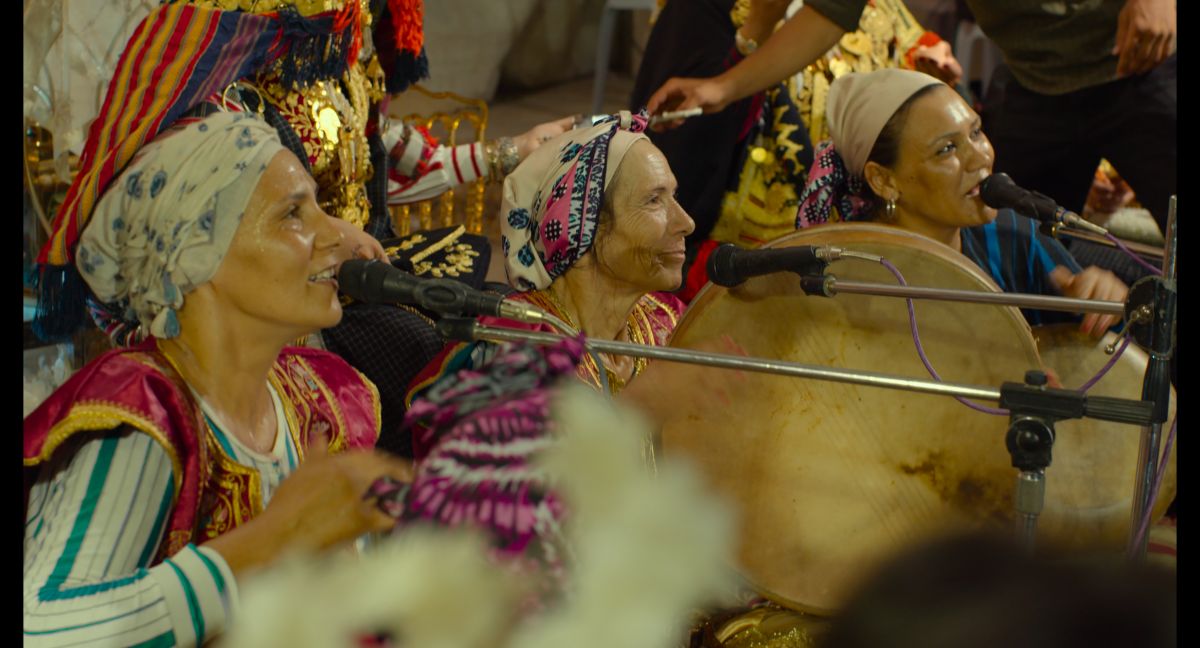
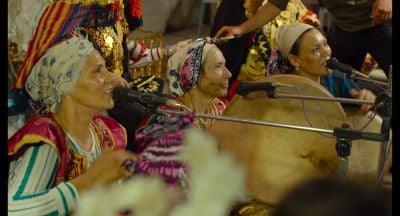
"Machtat" tells the story of three women, a mother and her two daughters, who are wedding musicians in a small town in Tunisia. (Credit: Khamsin films)






This is a film by women about women. The "machtat" are singers who perform at weddings in certain Tunisian villages. It is a documentary in which men are constantly talked about but never seen.
Is it a way to erase the traces of patriarchy and invite us to redefine the role of men today? Perhaps elsewhere, because in these Tunisian regions, traditions are stubborn and persistent. The women of "Machtat" grumble, mock their men, disdain them, but do not escape them.
A meeting of women behind the camera
These are the women director Sonia Ben Slama wanted to film without compromise. Her encounter with Tania Khoury, the Lebanese co-producer of the documentary, made her want to do something other than fiction.
Invited to Marseille for the Mediterranean co-production professional day, it was Ben Slama's selected project that won her over. "I had seen her previous film, loved it, and she had deeply moved me," recalls Khoury.

Back in Paris where she lives, she thought it over, then reached out to Ben Slama and offered to organize the Arab financing. The founder of Khamsin Films got involved early on in this project, drawing from her experience working with filmmakers such as Ghassan Salhab.
To support her, more women came on board: The Frenchwomen Cecile Lestrade and Elise Hug, from Alter Ego Production — known for supporting works that are both radical and sensitive — also believed in this story. That’s how "Machtat" became a documentary co-produced between France and Lebanon, directed by a Franco-Tunisian woman.
Wedding songs as cries of distress
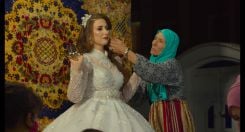
Ben Slama met these "machtat" while filming the story of her grandmother, repudiated by her grandfather in the 1950s, at the same time as her cousin's wedding.
These women, supposed to bring joy with their voices, are, deep down, voicing a collective cry of distress. It’s a cry born of working hard in the fields and enduring men's abuse.
Men are discussed throughout the film but never seen. "We had filmed them during the shoot, but in the edit, we couldn't find a way to put them in, which made it a film focused on women," says Khoury, who notes that seeing that everything is run by unseen men creates a sense of anxiety.
Behind the drums, the weight of daily life
The story takes place in Mahdia, a small coastal town by the Mediterranean, where Fatma and her daughters, Najeh and Waffeh, with their voices and drums, liven up weddings, set the dance rhythms, and bring blessings. In this region, they are indispensable to the ceremonies.
But once the festivities are over, the glitter faded, the colors vanished and the guests dispersed, all that remain are heavy hearts and the burden of daily life.
These are women who marry others when their own unions are struggling. "Machtat" narrates their fractures and desires without false modesty — but also their strength.
"These tough women, in a very conservative environment, intrigued me. The way Sonia spoke about them, her cinematic perspective, won me over," says Khoury. "These women stand strong in daily life and share an incredible joy in living."
The only difficulty this co-production may have posed for her is a cultural difference between East and West that affected the editing. "On the other hand, every fund we reached out to was very responsive to the project," adds the Lebanese co-producer. Their diverse perspectives give "Machtat" a unique dimension: A documentary that transcends borders.
Najeh, the eldest, divorced, seeks a husband in order to escape her brothers' guardianship. Waffeh, for her part, wishes to free herself from a violent husband. But both run up against the dictates of patriarchy.
Meanwhile, the children observe. Waffeh’s daughters listen, and sometimes imitate. They already carry within them the weight of arguments and shouting, repeating their father's insults in a low voice.
The siblings reproach their mother — though they are very close to her — for her apathy. The children are barred from school and must work to pay for their father's whims. Sonia's camera clearly prepares the viewer for a new generation of captive women. And yet, a crack appears, a voice rises. The distant echo of rebellion resounds.
Raw intimacy with suspended poetry
Ben Slama uses close-ups. Her heroines live, suffer, explode, laugh, and cry. The director had already explored women's destinies around marriage in "Tout est écrit" ('All is written') in 2015, but with "Machtat," she brings to marriage — its institution and celebrations — a raw intimacy she gained through the trust she established as a Franco-Tunisian woman.
There are those images that linger long in the memory: Swimming at dawn, a suspended moment when the women seem to catch their breath, far from the gaze of men.
Or the final scene, when Najeh and Waffeh let loose with a forbidden freedom, under the anxious but fascinated gaze of their children. These moments frozen in time create all the poetry of the film.
"Machtat" is not just the portrait of a family of musicians. It’s a cry, discreet but determined, against a society that imprisons, and a song, fragile yet bright, for the generations to come. And it’s in this same spirit that Ben Slama is now developing a new documentary project, "316 North Main Street," in the United States.
"Machtat" is part of the ACID Cannes 2023 selection. Premiered at Écrans du réel, it is showing exclusively at Metropolis.
In theaters since Sept. 22.
 2 Israeli soldiers injured in 'operational accident,' as army continues attacks in the South