


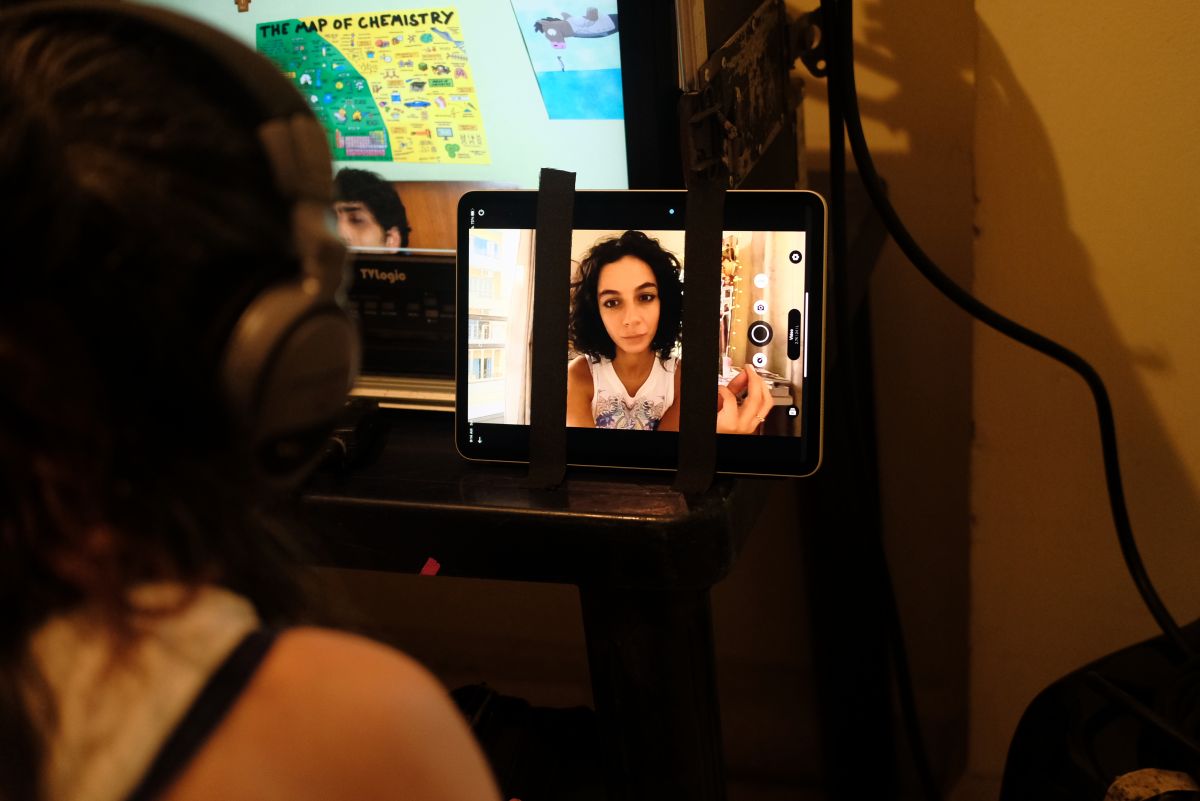
Photo taken during the filming of "BornStars," by Caroline Labaki.






When your name is Caroline Labaki and you happen to be Nadine Labaki's sister, an internationally acclaimed director and actress, comparisons are inevitable — especially for a first feature.
Yet it was with that same Nadine — whom Caroline describes as “very close” and “not a competitor” — and her extended family that Caroline held the premiere of BornStars (read: “porn stars,” Lebanese-style) at Vox Cinema in Hazmieh.
This film, however, does not mark Labaki's first steps in cinema. Trained at IESAV, she first worked alongside her sister before forging her own path: acting in award-winning films such as Where Do We Go Now? and Ghadi, and directing the poignant short #175 in the series Beirut 6:07, inspired by the Beirut port tragedy.

“Caroline is just wonderful — she has infectious energy. She pushed us to make this film while pregnant, in the middle of Covid and during the economic crisis,” says her husband, Chady Eli Mattar, a Lebanese American producer. BornStars is also Caroline’s third collaboration with her co-writer Tony Eli Kanaan.
Despite the title, BornStars is not a sex film — otherwise, it would have been censored. Instead, one of its central themes is censorship itself, told through a story that reflects a Lebanese youth fractured by exile, homecoming and cultural contradictions.
The film captures the mood of youth culture as it might have been filmed in the 1980s, but transposed into today’s world of shifting technologies and anxieties.

When absurdity becomes an option
At its core, BornStars follows restless youth searching for direction. Its original, wacky premise sets the tone from the very first scene — filmed in successive, jerky shots that establish a frantic rhythm mirroring the energy of today’s generation.
The protagonist, JD, urgently needs to raise $7,000 in 10 days to pay for his final year of college after his father loses his job. He drags his friends on an improbable quest: launching Lebanon’s first porn site. The scandalous idea is not treated as provocation, but as a symptom of a society so starved of prospects that the absurd becomes an option.
The director exposes Lebanon’s contradictions — between tradition and modernity, exile and rootedness, proclaimed freedoms and persistent censorship. The film humorously and tenderly explores the difficulty of imagining a future in a country that often seems intent on shutting it down.
Between laughter, censorship and rebellion
The film’s five central characters — JD (Tony Eli Kanaan), Mazen (Nour Hajjar), Sam (Elie Njeim), Ali (Ziad Saliba) and Chad, an American (Ryan Laia) — are fragile, funny and deeply human. Their friendship highlights the dual sense of belonging that almost all Lebanese youth carry today.
“I wanted to make a comedy to make Lebanese people, who are so tired of suffering, laugh. And what’s funnier, in a conservative setting, than a porn site? Even mentioning it makes everyone burst out laughing,” Labaki says.

She continues: “When you write a screenplay, you get caught up in wanting to please festivals, think about awards, and you forget that cinema is above all for audiences, who must find pleasure and connection in it. I made this film for viewers, but of course, I’d still be honored to win a prize.”
At the same time, she is critical of social media — the “fake-easy” tool of today’s youth — and of a society obsessed with appearances, which leaves the most vulnerable adrift, anxious and unsupported.
Labaki portrays them with boundless tenderness, lamenting that Lebanese cinema rarely produces films that represent young people. BornStars is her attempt to fill that gap.
If it took her this long to make her first feature, it’s because she wanted the project to be special. “I wrote, did costumes, directed, tried my hand at everything. I took time to live and to have experiences so I could come up with this film,” she says.
She also hopes it will open doors: “Not necessarily the doors of pornography, but those of censorship, so we can have more freedom in our messages.”
BornStars is a love letter to cinema as a space for truth and rebellion. A hybrid feature, it is both firmly rooted in painful Lebanese reality and open to universal imagination. A film about young people, for a generation that refuses to give up on its dreams.
In theaters starting Sept. 18.
 2 Israeli soldiers injured in 'operational accident,' as army continues attacks in the South