






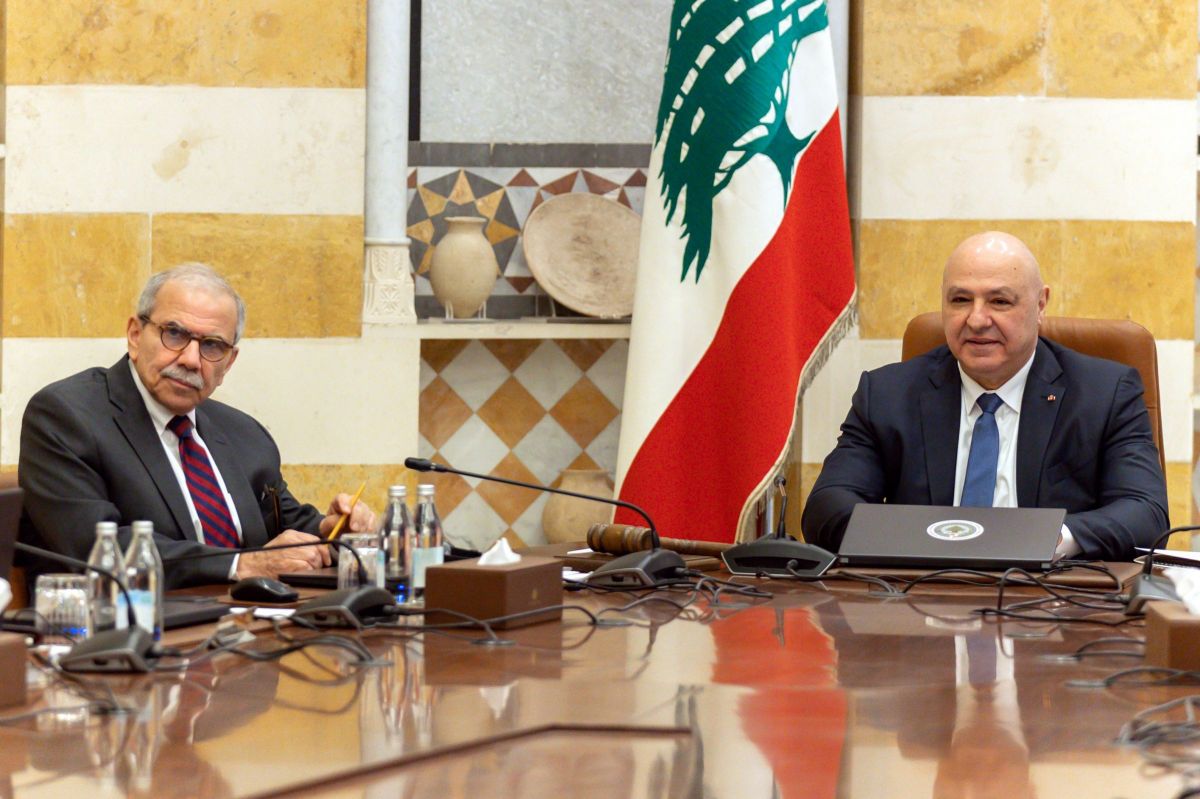
Lebanese President Joseph Aoun and Prime Minister Nawaf Salam at the Baabda Palace, April 17, 2025. Photo: Lebanese Presidency.






The Lebanese people are now more optimistic about their leaders than at any point since the launch of the Gallup World Poll twenty years ago. According to a survey conducted between May 5 and June 5, 2025, 62 percent of Lebanese adults, compared to just 16 percent in 2024, "approve of the direction of their country when asked in general terms," Gallup noted.
"This 46-point percentage increase is not only the largest ever recorded in Lebanon, but also among the highest year-on-year jumps ever seen in the World Poll," the institute added.
The Gallup World Poll is an extensive global survey on strategic leadership. Its results on the popularity of Lebanese leaders were published on September 25, 2025.

The survey was conducted a few months after a ceasefire between Israel and Lebanon in fall 2024 and the formation of a new government in February 2025. However, it excludes about 10 percent of the population, notably areas under strict Hezbollah control in the south, the Bekaa Valley, and Beirut’s southern suburbs.
Gallup points out that "Lebanese adults’ approval of their leaders has historically been among the lowest in the world, reflecting the country’s persistent political deadlock." However, "the new government may have sparked a rare sense of hope among many Lebanese."
Unprecedented popularity for leaders
The poll highlights that "the popularity of Lebanese leaders represents a major shift compared to 2019-2024, when most Lebanese (between 70 and 81 percent) disapproved of their leaders." That turbulent period, marked by economic collapse and the war with Israel, also saw the double explosion at the Beirut port in 2020.
As for President Joseph Aoun, his approval rating has reached 81 percent, "the highest level Gallup has ever recorded for a Lebanese leader." Prime Minister Nawaf Salam, former president of the International Court of Justice, also enjoys majority support (56 percent approval, 36 percent disapproval), "with many Lebanese viewing him as a reformer," according to the institute.
Confidence in elections rises, but not in the financial system
Nearly half of Lebanese (48 percent) now say they have confidence in the government, a figure that hadn’t surpassed 12 percent since 2020. Trust in other institutions has also improved, notably in the education system (67 percent up from 49 percent in 2024) and the judicial system (28 percent, up from 21 percent in 2024). Confidence in "the honesty of Lebanese elections" jumped to 45 percent, from 17 percent last year.
Despite these positive signs, the financial system remains widely criticized. "Only 4 percent of Lebanese say they trust the country’s financial institutions," Gallup notes, making Lebanon the worst-ranked country globally on this measure. About 1.3 million Lebanese bank deposits remain frozen or subject to restrictions, while international partners such as the International Monetary Fund continue to withhold desperately needed financial aid for the country’s reconstruction until key reforms are implemented.
The perception of corruption, while still high, has slightly decreased. According to Gallup, "the share of Lebanese who believe corruption is widespread in the government has fallen to 82 percent, down from 92 percent last year." "Perceptions of corruption both within the Lebanese government and the private sector also hit their lowest level in 20 years."
A fragile window of opportunity
The survey’s authors stress that "the weakened position of Hezbollah after the ceasefire with Israel has provided the country with a unique opportunity for change. For the first time in decades, the country has both a president and a government who are able and willing to pursue long-awaited reforms."
With parliamentary elections scheduled for May 2026, however, this window of opportunity may be brief and fragile. According to Gallup, "international actors now have the chance to engage with a government enjoying unprecedented domestic legitimacy, making this a crucial time to invest in partnerships, humanitarian projects, and institutional reform efforts."
