


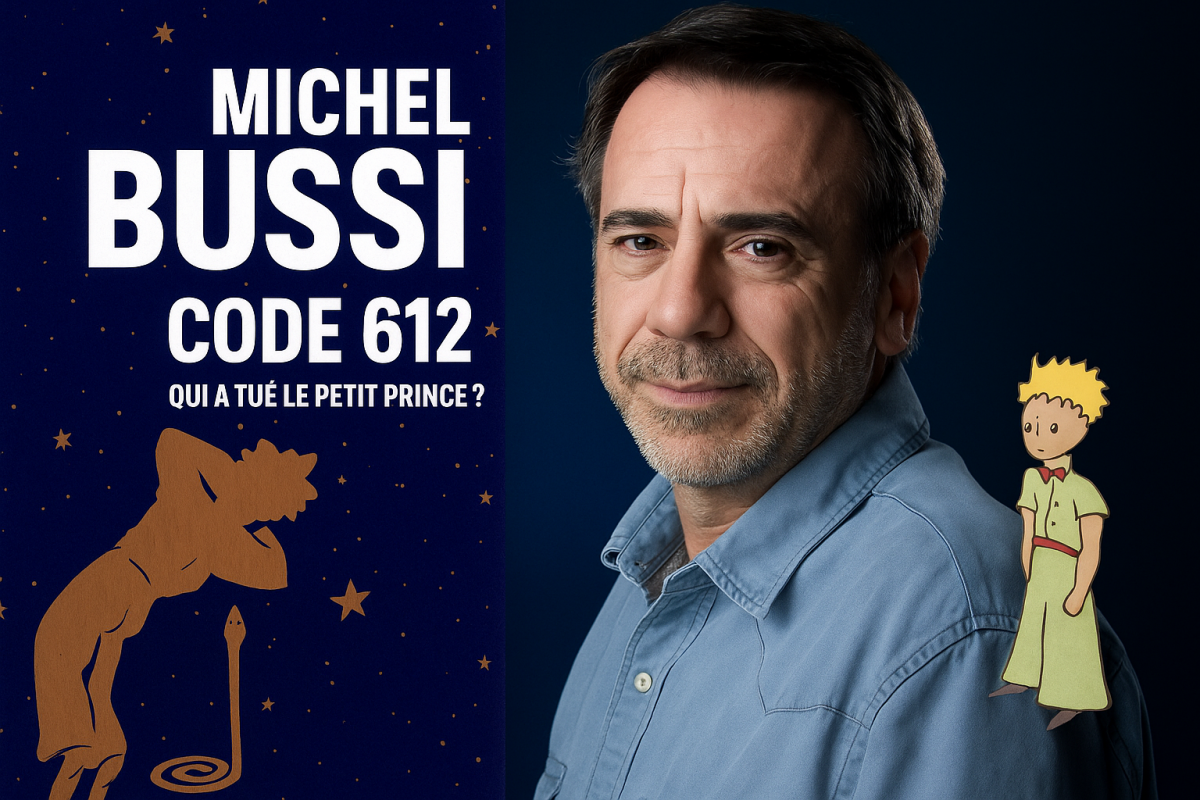
The writer Michel Bussi. (Credit: AFP/L'Orient-Le Jour montage)






Was the Little Prince murdered? Based on this idea, Michel Bussi starts an original story in his book "Code 612. Who Killed the Little Prince?" published in 2021 by Presses de la Cité.
The title itself is striking. It can send chills down your spine. How could this little blond-haired boy, so famously innocent and quoted around the world, who charms both children and adults, have been killed?
Three years ago, Bussi celebrated in his own unique way the 75th anniversary of the French edition of "The Little Prince" by Antoine de Saint-Exupéry, a work translated into 318 languages and dialects.

Enigmatic Saint-Exupéry
Sailing between reality and fiction, drawing parallels between the hero's journey and the aviator-author's life, Michel Bussi guides the reader through a maze of theories, presumed suspects, more or less plausible motives and revealing clues.
The geography professor, born in 1965, published his first novel, "Code Lupin," in 2006 at age 40. However, it was in 2011 with his second novel, "Black Water Lilies," that his career really took off.
After the "Crash" (2012), "Don't Let Go of My Hand" (2013), "Carved in Sand" (2014), "Maman a tort" (2015), his successes kept coming. Some were adapted into graphic novels, others inspired TV series. In 2024, he released his new book, "My Heart Has Moved," also from Presses de la Cité.

The author does not hide his particular interest in Antoine de Saint-Exupéry. He admits he has always been drawn to this adult, a war hero, who always claimed to keep his childlike qualities. "I recognized myself in him."
Starting with well-known facts, the investigation begins. Saint-Exupéry, who died in July 1944 during a mission over the Mediterranean under still-unknown circumstances, never saw the worldwide success of his tale, originally inspired by a crash he experienced in Libya in December 1935.

Well-crafted suspense
Michel Bussi's two investigators set out from Marseille, where parts of the plane and personal items belonging to the aviator-author were found: Neven, a failed pilot, and Andie, a young detective recruited by Oko, one of the members of Club 612.
This club, which bears the number of the asteroid from which the "Little Prince" comes, brings together eccentric characters, all of whom have a special connection with the book or its author. Their mission was to discover whether Saint-Exupéry really died in an accident, a crime or by suicide.
With boundless imagination, Bussi takes us on a journey from Manhattan in New York, passing through Conchagüita Island in El Salvador, the Orkney Islands in Scotland, Djedday Lighthouse in Saudi Arabia, and finally to the "geographer."
The presence of this Little Prince character is certainly intentional, reflecting Bussi's profession and his admitted identification with the character.
Mysteriously, each club member has received a white box with three holes, oddly similar to the sheep box drawn by Saint-Exupéry. This highly original idea introduces unexpected twists.
This story, although very mysterious, is easy to read and engaging. The poetic style closely resembles that of "The Little Prince" in many ways. For example, the sentence describing the young detective’s laughter: “Andie lowers her eyes to the water and bursts out laughing, as if the starfish had suddenly turned into little bells.”
"Code 612. Who Killed the Little Prince?" undeniably prompts you to search your library for "The Little Prince" to revisit its pages, which will make it a totally different experience, an unexplored context, than when you first read it.
This article was translated from L'Orient-Le Jour.

 7 p.m. recap: 1 person killed near border with Lebanon; 200 kilos of explosives carried by mules; Riyadh shuts its airspace