



The French writer Olivier Bourdeaut. (Credit: AFP)






"I knew a man, Bojangles, and he danced for you."
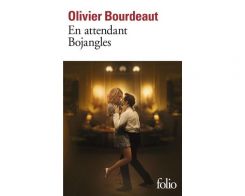
Lulled by Nina Simone's mesmerizing notes, a couple dances repeatedly, as if trying to freeze time with a waltz, under their son's amazed gaze: Welcome to Olivier Bourdeaut’s first novel, "Waiting for Bojangles," an invitation to drift, laugh and maybe shed a few tears between summer evenings.
Published in 2016, awarded the Grand Prix RTL-Lire and the France Télévisions Prize, translated into about 20 languages, the novel established itself as a literary phenomenon. It inspired a stage play and, more recently, a film directed by Régis Roinsard. But before becoming a publishing success, "Waiting for Bojangles" is above all a declaration of love for fantasy and excess.
Where the absurd becomes poetry
From the title, an obvious nod to Samuel Beckett, Bourdeaut roots his story in a kind of tender absurdity. At the core of this unrestrained passion is a unique couple: Georges, the father, is madly in love with his wife, whose first name remains unknown.
She fiercely rejects conformity, fearing boredom as others fear death. Every day, she insists on being called by a different first name: "Give me whichever name you like! But please, amuse me, make me laugh. Here, people all smell of boredom!"
Narrated mainly through the amazed and naive eyes of their young son, the novel takes us into a household where banality has no power. In this family, they don’t talk about the weather; they talk about ostrich feathers, improbable cocktails and endless love.
The outside world doesn't exist, and reality stays at the door, as shown by the overflowing mailbox. In the background, Nina Simone's song comes back like a refrain, telling the story of a man met in a jail cell who danced from bar to bar after his dog died.
If the novel is so moving, it’s also thanks to Bourdeaut’s writing: brief, rhythmic, musical, almost syncopated, it pulls us into this home like a dream. The sentences have the lightness of a dance step and the euphoria of a glass of champagne, but can also be sharp.
The alternating perspectives — the child’s, tender and innocent, and the father’s, more reflective and melancholy in his notebooks — create a narrative back-and-forth that echoes the waltz of emotions. Absurd humor blends with the most delicate poetry in a world reminiscent of Boris Vian.
When the music stops
But how much can you challenge reality when you choose to live while waiting for Bojangles?
As the melody plays, the sour notes arrive. For yes, this idyllic world is only a "splendid lie." When the narrator shifts, the pages from the father's diary reveal the family secret. The Fitzgeraldian atmosphere suddenly becomes tinged with a muffled, darker reality. The mother is not just eccentric: she is ill. After all, in "mad love" there is the word "mad."
Her psychological disorder is never explicitly named by her son, but a doctor’s words sharply reveal this enchanted bubble. Madness, initially seen as a charming oddity, becomes a trap. Like the character in Nina Simone’s song, imprisoned in a cell, the mother is trapped by her delusions.
The couple refuses to face reality and is determined to keep the party going, even if it means exiling themselves to a castle in Spain, where the illusion falters until tragedy inevitably catches up with them.
If there's one thing to remember from Georgette — or Louise, Renée, depending on her husband’s mood — it's: "When reality is banal and sad, invent me a beautiful story. You lie so well, it would be a shame to deprive ourselves."
Between bursts of laughter and heartache, Waiting for Bojangles is a whirlwind of emotions that can be seen as a luminous story or a family tragedy. When the music stops, it’s not just sadness that lingers: there’s the thrill of experiencing, for the duration of a song, mad love standing up to harsh reality.
As you close the book, Nina Simone’s music still echoes in your mind, and you picture the couple waltzing to delay the inevitable for just a little longer.

 7 p.m. recap: 1 person killed near border with Lebanon; 200 kilos of explosives carried by mules; Riyadh shuts its airspace