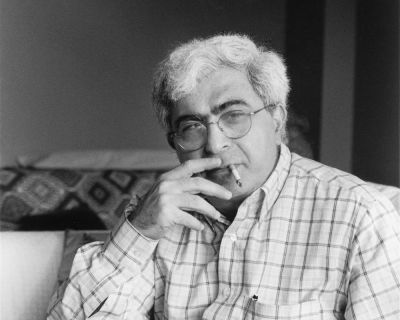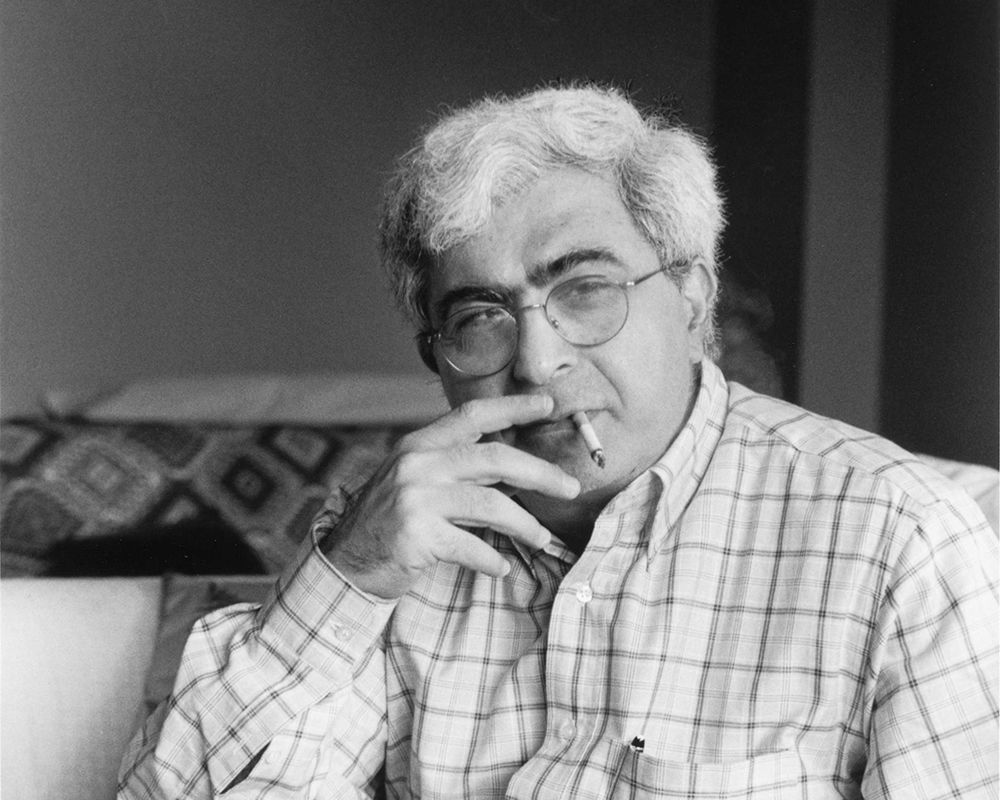
Novelist and intellectual Elias Khoury. (Credit: Anne Hall)






On the calendar, a year has passed since the death of Lebanese writer, thinker, activist and journalist Elias Khoury.
But the death of an author also marks another life opening up, one continually reborn through each reader who discovers or falls in love with his words.
On the political, social and human level, however, it is not just a year that has passed but an eternity saturated with successive pains: massacres, famines, genocides, wars and irreparable losses — from Gaza to Lebanon and far beyond.
It is an eternity of fractures and surrealism that Khoury himself could not have absorbed. He departed carrying Palestine as both his burden and his first breath.
His “first cause,” he wrote, “the Arabs’ first cause and their interpretation,” was always present, even when he glimpsed the humiliation and famine now inflicted on Palestinians in Gaza.
Despite the absurdity and cruelty of politics, his articles and novels always carried a ray of light: “In Palestine, we learned freedom, resistance and love, and we saw before us a horizon that none will ever close,” he wrote.
His relationship with Palestine was an eternal love story, both spiritual and political. Many believed he was Palestinian because of how existential his commitment was.
Palestinian poet Mahmoud Darwish called him “my brother,” and writer Liana Badr saw him as “the son of all Palestinian mothers.” For her, Khoury never retreated into silence, unlike many intellectuals. He embodied “the explosive vitality of truth, the stubborn refusal to abandon what he considered sacred.”
From the absurd to dystopia
Khoury himself described his era as a “carnival of death,” in a text written from his hospital bed.
“Aggression is not limited to weapons,” he wrote. “It targets the mind. It’s a war of total annihilation intended to break the resistance that has become the soul of the city.” This blend of absurdity and dystopia runs through all his work.
From Gaza to Beirut, today’s wars recall the bleak visions of his novels, such as White Faces (1981), where the city becomes unrecognizable and lost, where one can no longer distinguish the resistant from the corrupt, nor the executioner from the victim.
Beirut, Jerusalem, Haifa and Gaza — with Damascus, Baghdad and Cairo — were, for Khoury, torn and threatened places that he turned into scenes of resistance, fields of memory and hope.
Beirut never left his writing. It was his city, his “apple,” as he called it, even if wilted or broken. In his novels, Beirut is a wounded yet standing city that “mocks systems of death” and “tells its story by wrapping itself in its ruins.”
During the Civil War, Khoury worked hard to create an alternative cultural project: as director of Moultaka al-Masrah (Beirut Theater) in 1983, and later as editor-in-chief of the literary supplement at An-Nahar, he provided a free platform for a generation of Arab writers and artists, defending the principle that nothing should come before freedom of expression.
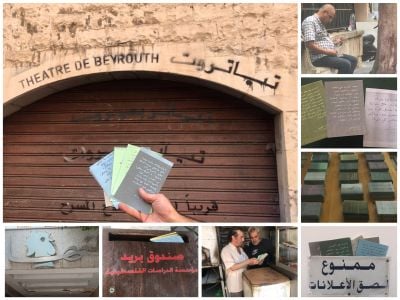
To his peers, Khoury was the example of an “organic thinker,” one who renounces neither causes nor victims. Badr recalled: “If integrity has a name, it’s Elias. If solidarity has a face, it’s Elias.”
Academic Ahmad Beydoun summed up his trajectory with a now-famous phrase: “Elias is incalculable.”
Khoury was also involved in all Arab struggles for freedom: Syria, Tunisia, Egypt, Iraq, Sudan. His texts on the Syrian uprising, in particular, remain cries of alarm and loneliness.
“You are alone,” he wrote to Syrians. “Alone in pain, alone in isolation. Alone in paying the price of the Arabs’ collapse and submission.” He left without having witnessed the fall of the Assad regime, a victory he would have celebrated with fireworks.
The legacy of a global writer
Novelist (Little Mountain, Yalo, Children of the Ghetto, Stella Maris), essayist and journalist, Khoury created a body of work where individual memory intertwines with collective tragedies, from the Nakba to the Lebanese Civil War. He gave voice to exiles, refugees, the nameless, building bridges between languages, identities and generations.
His humor, warmth and rejection of grandiosity made him immediately approachable.
Algerian writer Waciny Laredj described him as “a luminous and joyful personality,” whose loss has left a huge void: “With Elias Khoury, an irreplaceable voice of the Arab world and Palestine has fallen silent.”
A commemoration in Beirut
For the first anniversary of his death, the Culture Ministry, under the patronage of the prime minister, is organizing an event on Monday at 5 p.m. at the National Library in Beirut.
The program includes a visual and musical tribute with singer Rima Khsheish, as well as an overview of his work, testimonials from loved ones — including his daughter Abla Khoury — and friends, and a roundtable led by academic Maher Jarrar.
Participants will include Education Minister Rima Karameh, architect Jad Tabet, writer and director Mohammad Ali Atassi, journalist Jean Kassir and playwright and director Rabih Mrouweh.
It will be an evening to remind us that although Khoury has left this world, his writing remains an inexhaustible cry.