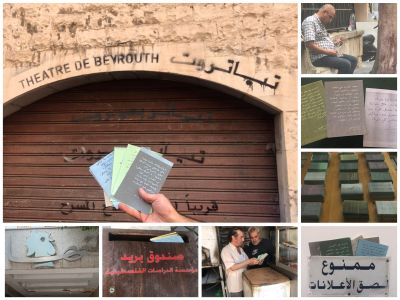
An anonymous hand has chosen to scatter fragments of literature around Beirut, in the very places where the late writer Elias Khoury used to frequent. (Credit: DR.)






Amid the rhythm of daily life, passersby have found themselves pausing — not for a call or a message, but for a small, colorful slip of paper that appears, almost magically, in their hands.
In front of Amal Bohsali’s pastry shop, at the entrance of the Sporting Club in Manara, in the shade of a humble restaurant in Sanayeh, at the base of the building that once housed an-Nahar newspaper, at the long-closed Beirut Theater in Ain al-Mreisseh, even in the Palestinian refugee camp of Mar Elias — a sentence by Elias Khoury has emerged like a secret left in the open. A quiet phrase from the late novelist and journalist, who passed away nearly a year ago, slips into the palm like a fragile gift.
This isn’t an official campaign, nor an institutional tribute. It’s something more intimate — a discreet, poetic, almost clandestine act. An anonymous hand has scattered fragments of literature across the city, choosing places where Khoury himself was known to walk. As though, through these scattered slips of paper, the writer were reclaiming Beirut — the city he never stopped roaming.
Words for everyone
The gesture was simple, but of a rare intensity: taking words from the libraries and dropping them onto the street, onto the laps of passersby, at a cafe’s corner or during an errand. Offering a phrase at random, to someone who had not necessarily set out to read, but who is suddenly seized by the brilliance of a thought.
In this way, culture is no longer erected as an elitist bastion: it enters daily life, on a street corner filled with horns, in the line at a pastry shop, in a refugee camp or on the doorstep of a press building.
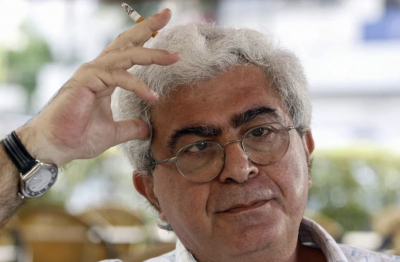
The choice of the Mar Elias camp, a prominent site of Palestinian memory, is no coincidence: it resonates with Khoury’s work, as he never ceased writing about exile, dispossession, and wounds transmitted from generation to generation.
Khoury, who passed away in 2024, remains a pivotal figure in Arab literature, a novelist of exiles and wounds, a tireless chronicler of wars and memories. The fact that his words resurface today, anonymously and without fanfare, probably says more about him than any solemn commemoration ever could.
The sudden appearance of these slips of paper has something ghostly about it, reminiscent of the benevolent specter of murdered journalist Samir Kassir, whose statue in downtown Beirut also distributed quotes that embedded themselves in passersby’s memories.
In a city haunted by its absentees, are writers its most vivid ghosts?
This quiet gesture, we're told, is just the beginning — a prelude to an event set for early September, meant to keep Elias Khoury’s presence alive in the heart of Beirut.