



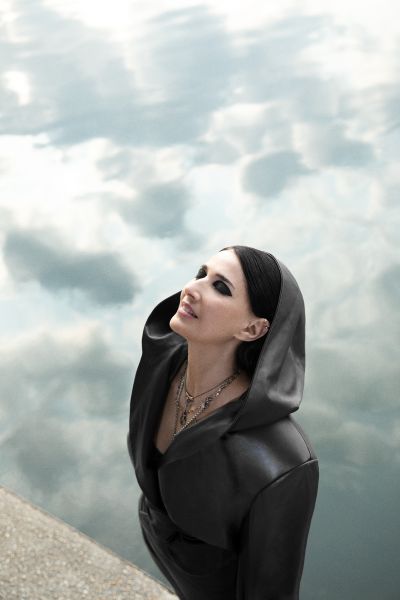
On stage at Metro al-Madina, Yara Lapidus will unveil an intimate repertoire, written far from home but dedicated to Lebanon, for one night only, on Sept. 20, 2025. (Credit: Alfredo Piola)






When Radio Liban host Wafa Khochen first heard Yara Lapidus' Arabic adaptation of the Bowie hit "The Man Who Sold the World," she was enamoured, listening to the track on repeat. Khochen set right to work to bring the French-Lebanese singer-songwriter, who shared with her the same roots in Sour, to Lebanon. "The first time you sing in Lebanon, it will be with me," she told Lapidus.
Wafa Khochen wants Lapidus' debut encounter with the Lebanese public to be intimate, like a romantic rendezvous; however, Lapidus is approaching the long-awaited event with her own set of concerns.
"I'm ready for this moment of mutual taming," she tells L'Orient-Le Jour. "This opportunity made me realize how deeply the East, and Lebanon in particular, has marked my musical journey over these last years."
"This type of concert is a first for me. In order to keep the project light and feasible for Wafa, I trusted my instincts. It wasn't about profit or business as a tour manager might demand, but above all, an emotional and sentimental approach."
Lapidus opted for a simplified version of her set, she explains. Usually, her performance involves a seven- or eight-piece band, but this time, she's chosen a "more electro touch." She'll be coming from Paris with a guitarist and rehearsing on site with a Lebanese violinist and keyboardist. "It's a first for me, born out of a burst of enthusiasm and shared excitement," she says.
'One's runway meets the other's stage'
Born in Beirut into the Wakim family of artists — a father who is an architect and sculptor, a mother who is a painter and guitarist, and a brother who's a musician — she left her city during the Civil War and arrived in Paris when she was 20 years old. She met her future husband, designer Olivier Lapidus, son of designer Ted Lapidus, at the ESMOD Paris fashion school.
But her career took a different path when she lost the use of her left arm in an accident. Having picked up her first guitar at age six, writing countless little poems that could be song lyrics, she finally unleashed her voice inyo the world, a voice her audiences would come to find very deep and moving.

Lapidus says her work as a fashion designer and then as a musician was essentially parallel and in many ways remains so. "Since childhood, I had two passions: the stage and fashion. The stage, never knowing exactly what I'd do there, but always seeing myself at its center, fascinated by the career of my uncle and godfather, Dudul, founder of Théâtre de Dix Heures. He's the one who gave me a taste for reading and words."
"Around 14," the now 53-year-old recalls, "I was already altering my dresses to transform them. I vividly remember one birthday night: I came downstairs to greet my friends in an outfit my mother had just given me... but which I had dared to cut up and recreate my way. I'll never forget my mother's look, both surprised and moved. She just smiled at me, as if she understood we were of the same spirit: indomitable."
Lapidus describes her transition from designing clothes to making music as a "journey from the shadows into the light." Designing clothes for her friends meant elevating them, bringing out their beauty and desirability. Being on stage meant putting herself out there instead.
"I've discovered a kind of boldness in this exercise: being at the center, putting myself forward, is almost against my nature," Lapidus says. Over time, I accept it. The stage requires you to lay yourself bare. There is a strong interiority, long hidden, that I now let come out."

Her husband plays his own role in supporting this vulnerability. He was the one who, after her accident, encouraged her to sing by reminding her of what she often said: "In another life, I would've written and sung my own lyrics."
When this "other life" took off, he designed her first stage outfit. "Stage and fashion have the same requirements: rhythm, silhouette, light, emotion," she says. "For Olivier, light is a true signature: from his first illuminated couture gowns to his patents, and his work in tech, he creates beauty through light. He is constantly envisioning stagings for me, with his avant-garde inventiveness. Ultimately, one's runway meets the other's stage... as if our professions are wordlessly responding to each other."

Written far from her homeland and dedicated to Lebanon
The artist, who co-wrote her sophomore album "Indéfiniment" with Gabriel Yared, describes the composer as a "craftsman."
"He recognized in me a singular writing style and a tone that deeply moved him. He would often say, 'I wish this voice could go around the world,'" she recalls. Other collaborations followed, emerging from friendships and artistic kinship, with Iggy Pop, Chico César, Adnan Joubran, Archive, and Gail Ann Dorsey.
Today, Lapidus dreams of a duet with Rosalia: "I love her fire, her singing passion, her voice, her personality. The way she uses her native flamenco and takes it toward electro-pop is exactly the kind of approach that inspires me."
In the meantime, on the stage of Metro al-Madina — which retains its vibe from the heyday of Hamra Street and the 1960s and early 70s — she will perform songs from her repertoire written far from — but dedicated to — her homeland. "No doubt they will resonate in a special way in Beirut," she says. "I hope to sing them without my throat tightening, as it so often does when I perform them in Paris or elsewhere. As a child of Beirut, I was uprooted from my city at 18, after episodes best left behind. Coming here to sing for the first time means facing a dizzying emotional burden; it's like walking a tightrope: oscillating between burning desire and visceral apprehension — a constant back-and-forth in my heart and memory. Of course, every artist gets stage fright, but here it takes on a whole new dimension."
Yara Lapidus, in her first concert in Lebanon, for one night only, on Sept. 20, 9 p.m., at Metro al-Madina. Reservations here.
 7 p.m. recap: Iran defies Washington over Hormuz; Bab al-Mandeb ignites, Israel strikes the Bekaa