





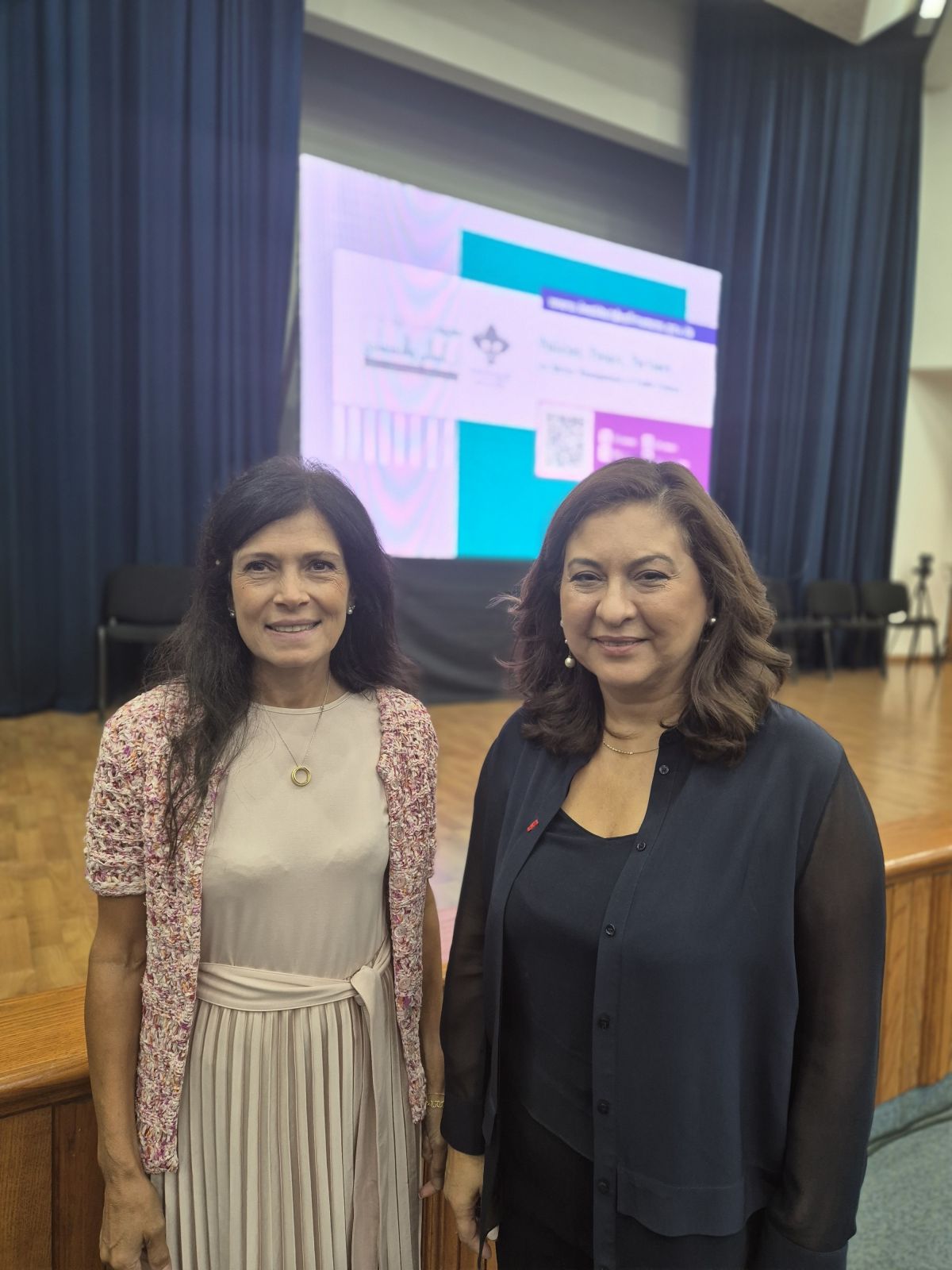
Yasma Fuleihan (left) and Lamia Moubayed at the Basil Fuleihan Institute of Finance in Beirut, Sept. 10, 2025. (Credit: Ghassan Nehme/L’Orient-Le Jour)






Marking its 29th anniversary, the Institute of Finance also commemorated 20 years since the passing of reformist minister Basil Fuleihan, one of its founders.
The ceremony, held under the patronage of Prime Minister Nawaf Salam and in partnership with the American University of Beirut, brought together former prime ministers, ministers, government officials, U.N. representatives and friends of the Institute for a moment of remembrance and recognition.
Despite Lebanon’s divisions, the event was filled with warmth, even across political lines. All present expressed their appreciation and fond memories of Fuleihan.
Fadlo Khoury, president of AUB and a childhood friend of Fuleihan, recalled that he embodied agápē — a Greek word for pure, unconditional love, whether for humanity, for God, or as a deep altruistic bond. In Christian and philosophical traditions, agápē is considered the highest form of love. Khoury announced that AUB will organize an annual lecture series every Sept. 10 in Fuleihan’s honor.

For his widow, Yasma — an active board member of the Fondation des Cèdres in Switzerland, which supports the Lebanese community abroad — the occasion was both emotional and symbolic. She received a decoration from Salam on behalf of the president.
Fuleihan, she said, was not only a husband but also a passionate reformer who saw freedom as essential for productivity and synergy as the key to success. "Today, I can see his legacy in reforms spreading throughout the state, in efforts to improve performance everywhere. It was never just about training; it was about building a holistic culture that ultimately became a way of life," she said.
Lamia Moubayed, head of the Institute of Finance, also delivered a heartfelt tribute, stressing that Lebanon is in desperate need of Fuleihan’s vision today. She said his work could be summed up in one phrase: core competence.
The Institute itself grew out of a Lebanese-French cooperation protocol in the 1990s, alongside ESA Business School and the French-Lebanese Hubert Curien Partnership with the CNRS. These institutions, she explained, were designed to rebuild Lebanon’s human capital after the Civil War.
"Today, after years of state erosion and decline in skills, we are once again in urgent need of the same vision," Moubayed said.
Both women emphasized that Fuleihan’s reformist drive was inseparable from his vision of active citizenship. Yasma called for a national dialogue to redefine Lebanese identity, give youth a stronger voice and empower new generations to foster a culture of responsible citizenship.
For Moubayed, Fuleihan was a role model: a man who returned after studying abroad to serve his country, building a diverse team at the Institute to strengthen public services and the economy when the idea of citizenship was still fragile.
On the economic front, Fuleihan was a pioneer in bringing private-sector efficiency into public institutions. He viewed the two as partners, not rivals. He spearheaded consumer protection initiatives, modernization projects and early digitization in ministries such as Finance, Economy, Customs and Cadastral Services.
He also promoted e-commerce and worked to integrate Lebanon into global markets. "Every modernization project he advocated for was preceded by deep consultations with the private sector," Yasma recalled, underscoring his belief in free-market principles and laissez-faire.
At the same time, Fuleihan waged difficult battles against monopolies and oligopolies, pushing to curb exclusive rights and encourage competition. Moubayed said he laid the groundwork for reforms that still resonate, including efforts tied to Lebanon’s eventual accession to the World Trade Organization and regional trade bodies.
This vision directly connects to the landmark Public Procurement Law of 2021 (Law No. 244), often described as the Institute’s brainchild. Both Yasma and Moubayed highlighted how the law can open markets to new providers, dismantle monopolies and restore trust in institutions by ensuring transparency and competition.
It also fosters innovation and growth among micro, small and medium enterprises, which make up nearly 90 percent of Lebanon’s economy.
"The time has come to dismantle outdated systems, like the classification of contractors that kept an exclusive club in power for decades," Moubayed said. "Reforms must be launched at every level to guarantee better services and a decent life for all Lebanese."
Two decades after his passing, Fuleihan’s legacy remains more relevant than ever: a call for freedom, competence and responsibility — values Lebanon urgently needs to rebuild its future.

 7 p.m. recap: Iran warns Egypt, Israeli soldiers vote in south Lebanon, Haret Hreik responds to Kataeb
I'm profoundly grateful to have read about Basil Fuleihan's career and how his legacy endures. I only knew him as a graduate student in the 1980s. As someone of a different department at Columbia University, but with whom he shared a key friendship, I cherish my memory of him. Always kind and witty but unassuming and profoundly intelligent, Basil and his dedication to a better future should be a model for all of us.
08 October 2025 16:10