





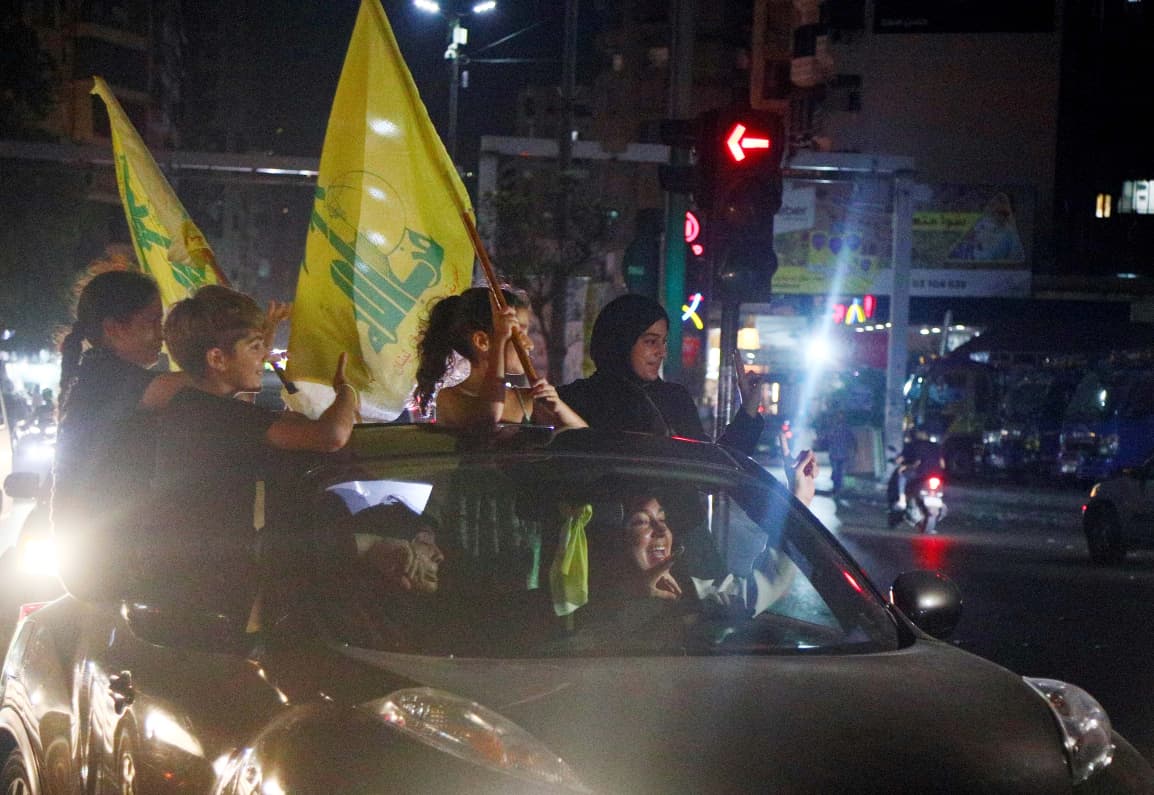
Hezbollah supporters in the southern suburbs of Beirut following the Cabinet meeting on Friday, Sept. 5, 2025. (Credit: Mohammad Yassine/L'Orient Today.)






BEIRUT — The divergence in interpretations regarding the Lebanese government's Friday decision to "endorse" the army's plan on the monopoly of arms continues to satisfy all parties.
Parliament Speaker Nabih Berri thus said Sunday night he was "reassured," while Foreign Minister Joe Rajji, who is close to the Lebanese Forces (LF), welcomed Monday morning the "decision on the state's monopoly on arms," rejecting any semantic ambiguity.
The Cabinet used a linguistic turn of phrase to avoid formally adopting the army’s plan while not fully alienating the Amal-Hezbollah alliance.
"The use of the formula that the government has welcomed the army's plan in the latest Cabinet statement is equivalent to an approval," Rajji said Monday on Radio Liban Libre. He noted that "in official statements, diplomatic expressions are sometimes used."
"The decision regarding the exclusivity of arms has been made and there will be no going back. We would have preferred that the deadline set by the Cabinet be respected, but we have great confidence in the army and are certain that it will do what is necessary," he concluded.
To reassure Hezbollah and avoid prompting it to take to the streets — or even trigger civil war — the government made concessions on Friday compared to the Cabinet decisions of Aug. 5 and 7. "In practice, the Dec. 31 deadline [for the effective disarmament of Hezbollah]) no longer exists," a government source told L’Orient Today.

Berri, a prominent figure within Hezbollah and Amal, said Sunday in an interview with an-Nahar newspaper that he was "reassured by the conclusions of the government's statement which made it possible to avoid major strife in the country," stressing that "internal unity remains essential."
Berri added that he told U.S. envoy Tom Barrack, who was in Beirut ten days ago, that "Israel is still at war, has not ceased its aggression, and has not respected the cease-fire agreement" that came into effect on Nov. 27, 2024.
According to our information, Berri had, in the days leading up to the Cabinet meeting, tried to push the government to simply take note of the army's plan in order to reassure Hezbollah.
"That's not what happened in the end, since we decided to welcome the army's plan and thereby begin its implementation, notably through the drafting of monthly reports," the aforementioned government source told our editorial team.

 Evening recap: Netanyahu announces West Bank offensive; 7 killed in Jordan church shooting; tents burned in south Lebanon
 US strike on Iran this weekend? ‘Absolutely,’ says Barrack; ‘I have no idea,’ says Trump