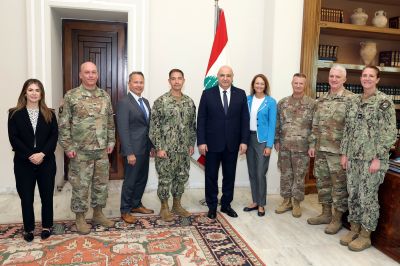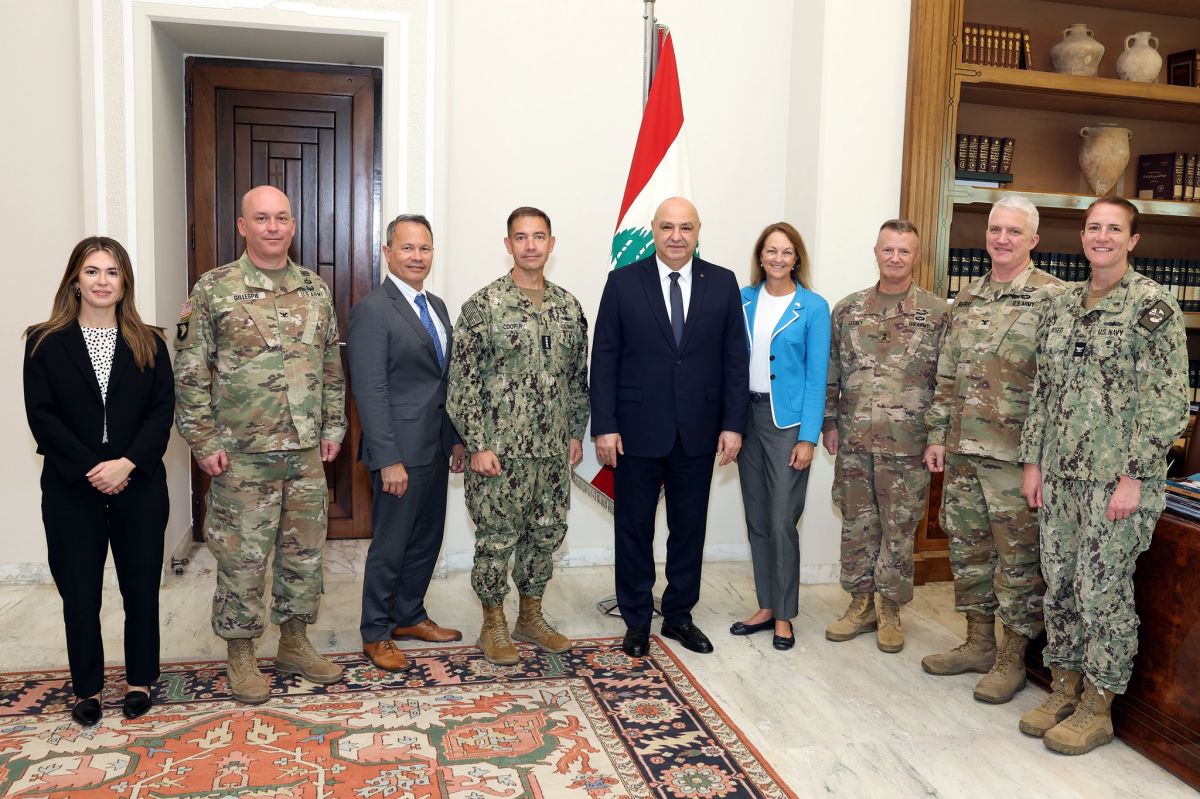
President Joseph Aoun receiving the new CENTCOM chief on Sep. 6, 2025, at the Baabda Palace. (Credit: NNA)






On Saturday, President Joseph Aoun called on the United States to pressure Israel to withdraw from the occupied territories in southern Lebanon, so that the Lebanese Army can complete its deployment along the border. The remarks were made during a meeting at Baabda Palace with the head of U.S. Central Command (CENTCOM), Admiral Brad Cooper.
The meeting, attended by U.S. Ambassador Lisa Johnson, came a day after a Council of Ministers session in which the Lebanese Army’s plan to disarm Hezbollah was “welcomed” by authorities.
During the meeting, Aoun requested the activation of the cease-fire supervision committee to ensure compliance with the terms of last November’s cease-fire, particularly regarding the cessation of Israeli attacks, the withdrawal from occupied hills in southern Lebanon, the return of Lebanese prisoners in Israel, and the full implementation of U.N. Resolution 1701, according to the Lebanese presidency. These measures “should help implement the Lebanese government’s decision regarding the monopoly of arms.”
President Joseph Aoun also emphasized to Admiral Cooper “the importance for the United States to continue supporting the Lebanese Armed Forces and providing them with the necessary equipment to carry out their missions on national territory, including maintaining security, preventing smuggling and terrorist acts, and controlling the Lebanon-Syria border — all objectives the military accomplishes under difficult economic conditions.”
Aoun wished Admiral Cooper success in his new role, following his recent appointment as head of CENTCOM. He also asked him “to give due attention to the situation in Lebanon, whose balance is a key factor for regional stability.”
Under the terms of the cease-fire agreement signed on Nov. 27, 2024, between the Lebanese state and Israel, inspired by U.N. Resolution 1701, the Lebanese Army is to deploy south of the Litani River in place of Hezbollah, which must withdraw its forces and dismantle its infrastructure. This latter task is carried out with the assistance of the United Nations Interim Force in Lebanon (UNIFIL).
Admiral Cooper’s commendation
Admiral Cooper, for his part, praised “the remarkable work carried out by the Lebanese Army deployed in the South and across the entire Lebanese territory,” according to the Baabda Palace statement. He affirmed that the United States will continue to provide all necessary support in areas such as equipment and training, in coordination with the U.S. administration and Congress. He also indicated that the cease-fire supervision committee will meet on Sunday to review the situation in the South and work toward stabilizing the region while continuing the implementation of the November agreement.
During the meeting, which was also attended by the chairman of the supervision committee, General Michael Leeney, President Aoun emphasized that continued Israeli aggression in southern Lebanon could hinder the full deployment of the Lebanese Army to the border, even though it has already completed deployment in more than 85 percent of the area south of the Litani River. “The army continues its efforts to prevent armed demonstrations and to confiscate weapons and ammunition under difficult geographical and operational conditions, which has so far resulted in the deaths of 12 officers and soldiers during the transport of munitions or demining operations, among other incidents. Likewise, the army has begun recovering weapons in several Palestinian camps, in accordance with the agreement reached during Palestinian President Mahmoud Abbas’s visit to Lebanon,” the statement said.
Joseph Aoun also discussed coordination between the army and UNIFIL. He stressed that “U.S. support for the army strengthens stability in the country, which has seen progress in various areas in recent months, leading to economic development alongside the reforms undertaken by the government.” He further highlighted “the importance of reconstruction in Lebanon, especially as friendly and allied countries have expressed readiness to contribute to this effort once hostilities end and stability returns to the country.”