






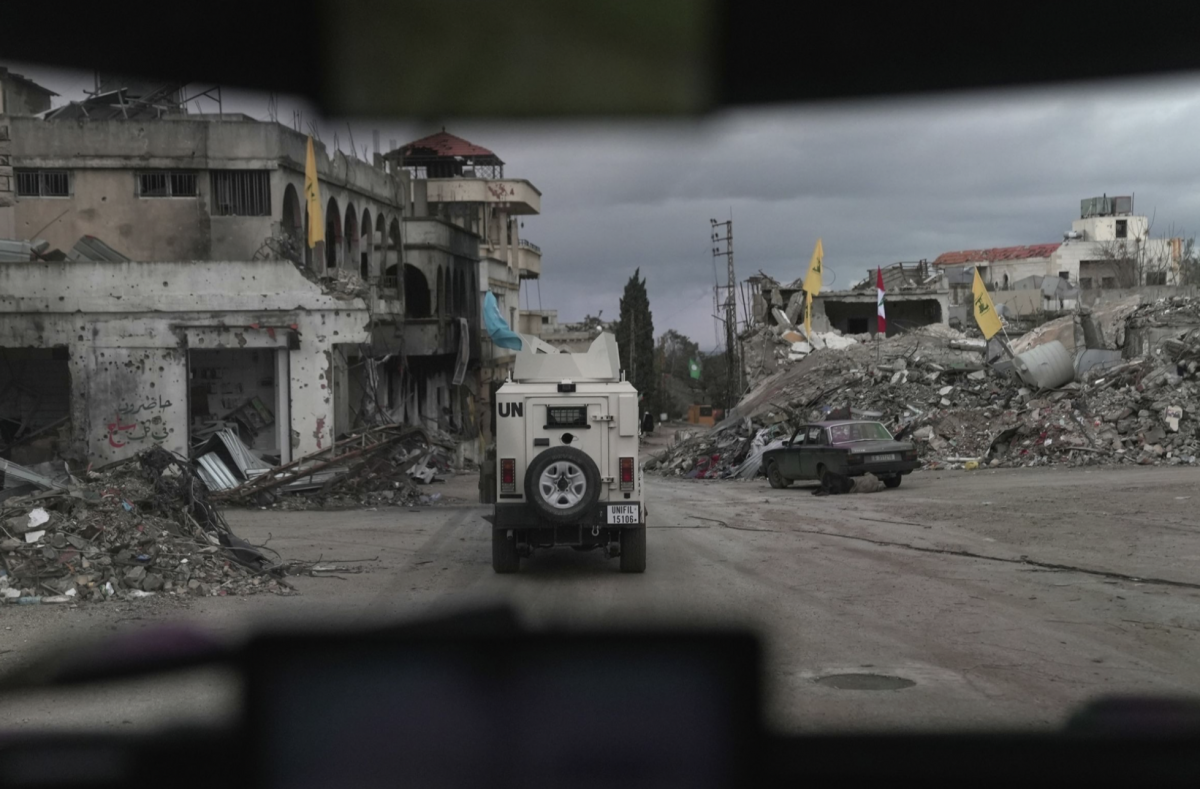
A UNIFIL armored vehicle crossing a devastated locality in the Marjeyoun district, Friday, Feb. 7, 2025. (Credit: Lucile Wassermann/Archives L’Orient Today.)






BEIRUT — Two days after the Israeli attack on UNIFIL soldiers near Marwahine, President Joseph Aoun called UNIFIL chief Diodato Abagnara to ensure peacekeepers’ safety and condemned the Israeli aggression, the Lebanese presidency said Thursday.
On Thursday, Aoun said that "such aggressions confirm once again that Israel continues to defy the will of the international community, which just a few days ago called for an end to hostilities against Lebanon, the withdrawal of Israeli forces from Lebanese territory they occupy in the South, the release of Lebanese prisoners, and the full implementation of Resolution 1701."
On Tuesday, as peacekeepers were clearing a road blocking access to one of its positions near the Blue Line, Israeli army drones "dropped four grenades" near the soldiers, according to a UNIFIL statement.
One of the projectiles "landed about 20 meters away and the other three about 100 meters from U.N. personnel and vehicles" in the convoy, before the drones returned south of the Blue Line, toward Israeli territory, the Force added, calling it a "serious violation of Resolution 1701 [of the Security Council] and international law."
‘International mobilization’
Aoun also said that "what is even more serious" about the attack is that "Israel was previously informed of the UNIFIL operation to clear the roads in the Blue Line area," which "means that the targeting of the international force was deliberate and premeditated," he believes.
While the Israeli army said Wednesday that it had not "deliberately" targeted the soldiers, UNIFIL for its part indicated that Tel Aviv had been informed in advance of the planned work, southeast of Marwahine, a village located a few kilometers from the Jabal Blat position, one of the Lebanese sites still occupied by Israeli soldiers since the ceasefire reached last November.
The president is calling for an "international mobilization to force Israel to end its repeated violations of Security Council resolutions and the international immunities granted to peacekeeping forces around the world," the statement from the presidency added.
The head of state also highlighted that "Israeli attacks on towns and villages in the South continue permanently, causing deaths and injuries every day, and targeting civilians, homes, and civilian infrastructure."
During the expanded Israeli offensive on Lebanon last fall, UNIFIL was targeted several times, mainly by Israeli fire, causing injuries among peacekeepers. Israeli tanks also blocked access to one of its positions and fired tear gas toward the building. Rocket fire of unknown origin from Lebanese territory also targeted one of its posts in Beit Lif (Bint Jbeil district).
UNIFIL's mandate was just extended in South Lebanon for a final time in August by the Security Council. By the end of 2026, the interim force is to begin a withdrawal plan lasting one year, meaning it will theoretically conclude at the end of 2027.
The United States and Israel have made no secret of their opposition to the U.N. presence in South Lebanon, which they see as ineffective given Hezbollah's expansion since the end of the 2006 war in the region.
'The credibility of the international community is at stake'
On Thursday, Prime Minister Nawaf Salam wrote on his X account that Israel’s repeated attacks on Lebanon constitute a blatant violation of the November ceasefire declaration, U.N. Security Council Resolution 1701, and international law principles. He warned that “the credibility of the international community is at stake,” urging immediate action to force Israel to stop its aggression and respect Lebanon’s sovereignty and the safety of its citizens.
On Tuesday, while U.N. peacekeepers were clearing a road blocking access to one of their positions near the Blue Line, Israeli army drones reportedly “dropped four grenades” near the soldiers, according to a UNIFIL statement.
One grenade landed about 20 meters away and the others about 100 meters from U.N. personnel and convoy vehicles before the drones returned to Israeli territory. UNIFIL described this as a serious violation of Resolution 1701 and international law.
The Israeli military said Wednesday it did not “deliberately” target the soldiers, but UNIFIL noted that Israel had been informed in advance about the roadworks near Marwahine, close to the Jabal Blat position — a Lebanese site still occupied by Israeli forces since the ceasefire last November.
During last autumn’s expanded Israeli offensive on Lebanon, UNIFIL was targeted multiple times, mainly by Israeli fire, injuring several peacekeepers. Israeli tanks had also blocked access to a UNIFIL position and fired tear gas at the building. Rocket fire of unknown origin from Lebanese territory also targeted a UNIFIL position in Beit Lif (Bint Jbeil district).
UNIFIL’s mandate was extended for a final time in August by the Security Council. By late 2026, the force is expected to begin a year-long withdrawal, ending in late 2027. The cease-fire agreement between Israel and Hezbollah was adopted in November 2024 to end over a year of war, which weakened Hezbollah and deprived it of its historic leadership.
Since then, UNIFIL and the Lebanese Army have worked together to ensure Hezbollah’s disarmament south of the Litani River. The disarmament issue is now a Lebanese government matter and is scheduled for discussion in the Cabinet on Friday.
The cease-fire agreement between Israel and Hezbollah was adopted in November 2024 to end more than a year of war that left the Shiite party weakened and stripped of its historic leadership. Since then, UNIFIL and the Lebanese Army have worked together to ensure the group's disarmament south of the Litani River, though the issue of handing over its weapons is now the subject of a Lebanese government decision and is expected to be discussed by the Cabinet on Friday.